In an age where work, family, and romance routinely stretch across cities, countries, and time zones, video calling has become one of the quiet miracles of everyday technology.
FaceTime and similar tools do more than transmit faces and voices. They recreate the presence that distance otherwise erases, letting partners share ordinary lunch breaks, bedtime routines, or more intimate moments that keep relationships feeling alive when physical proximity is impossible.
For many long-distance couples, these visual connections are not a substitute for being together so much as a way of remaining together in the meantime, preserving the visual and emotional texture of closeness that texts and voice alone cannot supply.
That same technology recently interrupted an ordinary private exchange in an unexpected way.

Frankie, a 25-year-old Australian woman, was on a FaceTime call with her partner during his lunch break when she decided to flash him.
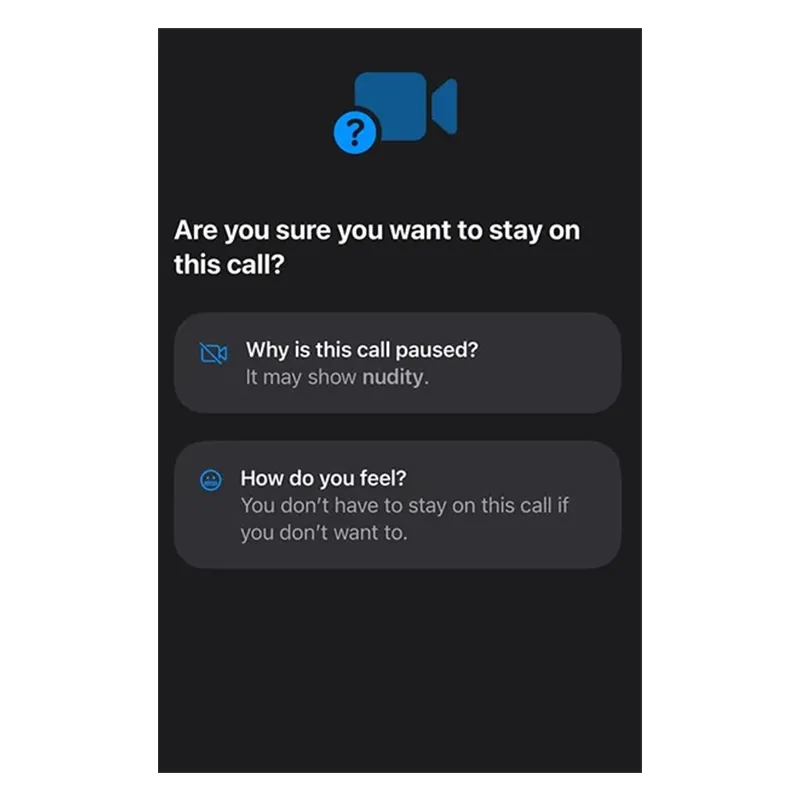
Almost immediately the call froze. On her partner’s screen an Apple message appeared asking, "Are you sure you want to stay on this call?" and noting that the call had been paused because it potentially showed nudity.
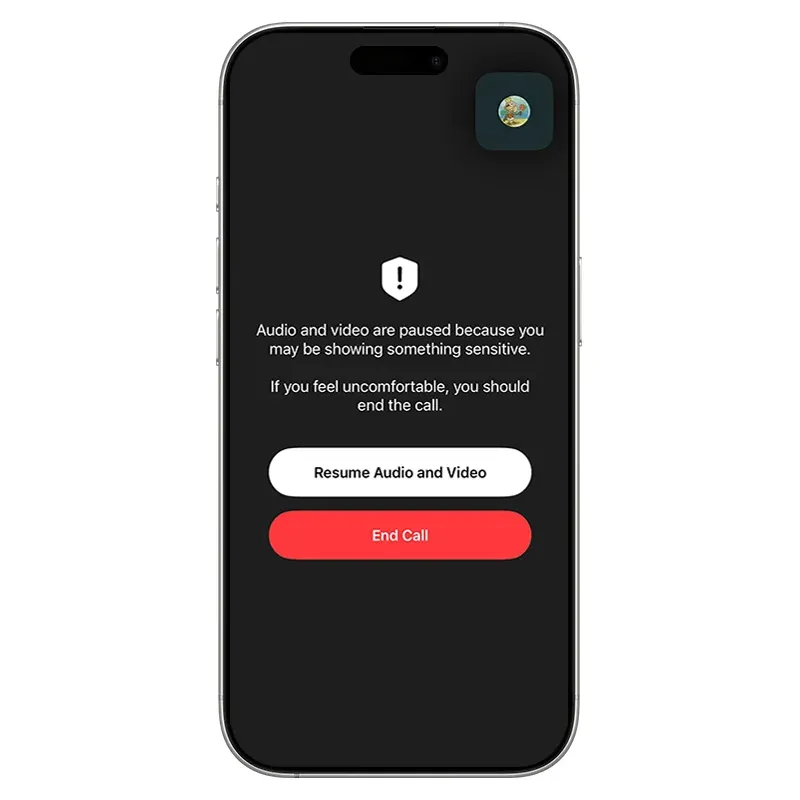
From her side the stream simply stopped: no audio, no video, as if he had put her on hold.
When he resumed and showed her the warning, she was stunned.
The prompt also offered guidance about how she felt and buttons to end the call or continue.
"You don't even know what Apple have, what they don't, or what they see," she later said, describing the sudden intrusion as catching her completely off guard and prompting her to wonder about the standards the system uses to decide what counts as nudity.
What Frankie triggered is Apple's Sensitive Content Warning feature, part of the broader Communication Safety tools that expanded to live FaceTime calls with iOS 26.
According to Apple’s support documentation, the system is designed to detect and blur photos and videos containing nudity, gore, or violence before a user can view them.
On FaceTime, however, it operates differently by completely pausing and freezing the audio and video stream when potential nudity is suspected.
The company explains the underlying method in clear terms: "Sensitive Content Warning uses on-device machine learning to analyze photos and videos for sensitive content, including nudity or gore and violence. Because photos and videos are analyzed on your device, Apple doesn’t receive an indication that sensitive content was detected and doesn’t get access to the photos or videos."
In practice the detection runs entirely locally.
The iPhone's on-device machine-learning models examine the live video frames for visual patterns associated with nudity. When a threshold is met, the call is paused and the warning appears, giving the recipient the choice to resume or end the session.
Nothing is uploaded to Apple's servers for this analysis, and no human reviewer sees the content unless a user later chooses to report it under the child-safety pathway.
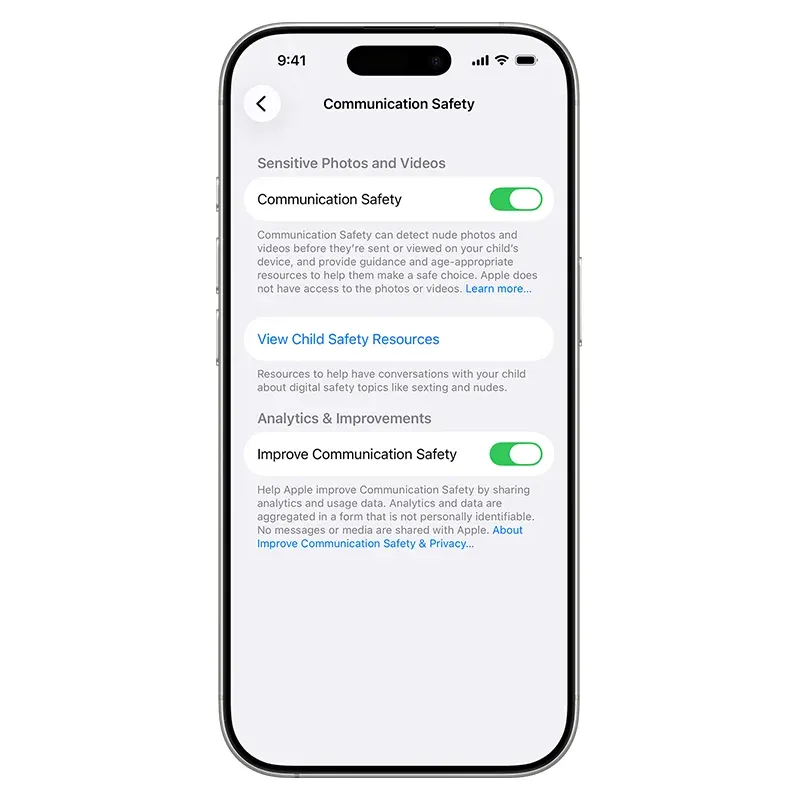
For adult accounts the feature is optional and can be toggled off under Settings > Privacy & Security > Sensitive Content Warning.
For child accounts managed through Screen Time it can be enabled permanently by a parent as Communication Safety. In other apps the intervention is typically a blur.
On FaceTime the stronger step of freezing the entire stream is used so that potentially sensitive material is not shown at all until an explicit choice is made.
The design prioritizes privacy in a technical sense.
The analysis never leaves the device, so Apple itself learns nothing about whether any particular call was flagged and never receives the imagery.
That local processing is a meaningful distinction from cloud-based content scanning.
At the same time, the episode illustrates how even privacy-preserving safety layers reshape private interactions.
Frankie, after researching the feature and discovering similar stories online, said she will continue to be intimate on calls but has asked her partner to turn the setting off.
Her questions, about algorithmic definitions of nudity, about what happens if the model fails to recognize certain bodies, and about the feeling that a device is intervening in a consensual adult exchange, point to the tension inherent in embedding protective machine learning into the same tools people use to stay close across distance.
Technology that reliably bridges physical separation also embeds automated judgments about the content of those bridges, even when the computation stays on the phone and the data never travels to a server.
Tech companies routinely find themselves blamed when something harmful circulates.
They are expected to stop the spread of gore, violence, and other extreme material before it reaches vulnerable users, particularly children, yet any effective intervention risks being read as overreach into private life.
On-device systems like Apple's attempt to occupy a middle ground.
They can interrupt potentially damaging content in real time without sending the material itself to corporate servers or exposing it to human review, which addresses part of the demand for prevention while limiting the privacy cost.
Still, the approach does not eliminate the deeper conflict.
Algorithms must decide what counts as sensitive, and those decisions inevitably affect consenting adults as well as those who need protection.
The result is a continuous balancing act in which the same platforms that make intimacy possible across distance are also required to embed safeguards, knowing that both under-protection and over-intervention will draw criticism.
Before this, several similar cases have emerged around Apple's Sensitive Content Warning on FaceTime.
In May 2026, UK TikToker Jamie Knowles said the feature interrupted his FaceTime call with his long-distance boyfriend while he was showering. The warning questioned whether he was sure he wanted to continue, offered a helpline, and temporarily blocked the screen. Knowles later disabled the feature and criticized it as disruptive for long-distance relationships. His account received hundreds of thousands of views.
Other users have reported similar experiences on Reddit and TikTok, including one recently turned 18 user who said her phone reacted while she was showing her boyfriend a new bikini. More broadly, reports during the iOS 26 rollout describe the warning appearing during consensual adult FaceTime calls, particularly while showering or changing. Some users said they simply turned the optional setting off after experiencing the interruption.
Frankie's experience however, is the clearest mainstream news example, while most other reports have come from social media and tech publications.






















































































































































































































































































