Egypt’s top administrative court ordered the telecommunication companies in the country to block video-sharing website YouTube for a month over a film denigrating Islam’s prophet Muhammad.
The ruling on Saturday ended years-long appeals process over the 2012 amateur film titled Innocence of Muslims, which depicts the prophet Muhammad as a buffoon and a pedophile.
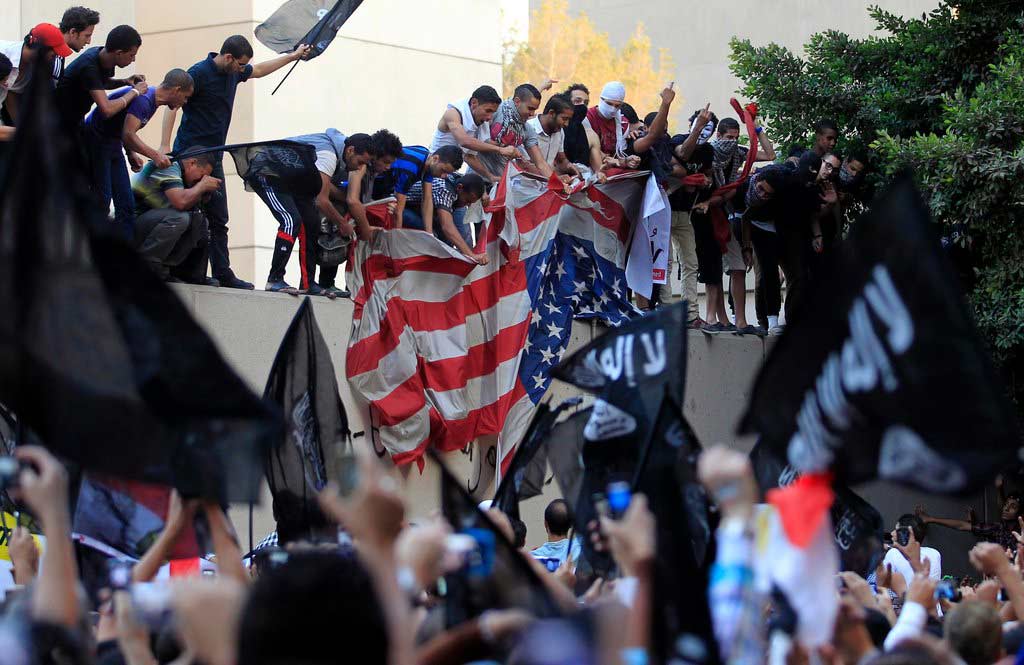
This short film sparked waves of angry anti-American protest throughout the Middle East.
Considering the controversial film, the U.S. said that it was made privately with no official backing. And because of the freedom of speech, the U.S. said that the laws prevented them from stopping the production of the inflammatory material.
A court ordered the video-sharing site to be blocked since it was one of the places where the film was shared.
However, the case was appealed by Egypt’s National Telecommunications Regulatory Authority and the ruling stayed during the appeal process.
The ministry at the time said that it would be impossible for the authorities to enforce the ruling without also disrupting Google’s other products, which may result in huge costs and job losses in Egypt.
Innocence of Muslim is a 14-minute anti-Islam trailer, written and produced by Nakoula Basseley Nakoula, a Coptic Christian from Egypt living in California, and was originally meant to promote an epic two-hour film.
There has been two versions of the video were uploaded to YouTube in July 2012, under the titles The Real Life of Muhammad and Muhammad Movie Trailer.
In September 2012, the video was dubbed to Arabic, and was uploaded to YouTube. This quickly drew the Muslim world's attention to the film, angering them.
The film was set about a life in Egypt 2,000 years ago, and was originally titled Desert Warrior.
The story tells a character called Master George, with several actors brought in to overdub lines. They were directed to say specific words, such as "Muhammad".
It was said that the anti-Islamic contents were added in post-production, without the actors' knowledge.
This was also stated by Anna Gurji, an actress with a role in the film. She said that she was not privy to Nakoula’s plans.
"There was no mention ever by anyone of Muhammad and no mention of religion during the entire time I was on the set,” she said. "I am hundred percent certain nobody in the cast and nobody in the U.S. artistic side of the crew knew what was really planned for this ‘Desert Warrior.’"
"Two hours after I found out everything ... I could not stop crying," she continued. “I feel shattered ... It’s painful to see how our faces were used to create something so atrocious without us knowing anything about it at all."
During the rage in the Muslim world, protests led to hundreds of injuries and over 50 deaths, including the killing of Christopher Stevens, the U.S. ambassador to Libya. He was killed when the U.S. Special Mission in Benghazi, Libya, was attacked by militants on September 11–12, 2012.
The film has sparked debates about freedom of speech and internet censorship. Pakistani government minister Bashir Ahmad Bilour even offered a $100,000 bounty for the killing of Nakoula.
YouTube later stepped in and voluntarily blocked the video in Egypt and Libya, as well as in Indonesia, Saudi Arabia, Malaysia, India, and Singapore due to local laws.
Due to the controversies and other reasons, Nakoula epic film never see the light. Nakoula was arrested by the U.S. federal authorities in Los Angeles and charged with violating terms of his probation.
Prosecutors stated that the violations included making false statements regarding his role in the film and his use of the 'Sam Bacile' alias. Then in November 2012, he pleaded guilty to four of the charges, and was sentenced to one year in prison and four years of supervised release.
In August 2013, Nakoula was released to then serve his remaining sentence in a halfway house, and then to be on probation for the next four years. However, the next month, he was released from the halfway house to the custody of Pastor Wiley Drake of First Southern Baptist Church in Buena Park, California.
Nakoula lives in obscurity, poverty and fear. He stayed at a Los Angeles homeless shelter and worked as a part-time employee at a pizza parlor.