Every few months, the tech world runs into a bizarre mix of developer frustration, satire, and sheer internet chaos, and this latest story fits that bill perfectly.
In an era where modern web applications, electron-based desktop software, and complex artificial intelligence models seem to consume every available gigabyte of system memory, users are feeling the squeeze.
Usually, developers vent their frustration silently on message boards, close background browser tabs, or quietly upgrade their hardware. But every now and then, someone decides that standard troubleshooting just isn't therapeutic enough and takes matters into their own hands in the most creative and public way possible.
The inspiration behind this particular movement traces back to the rapid rise of resource-heavy AI tools and the constant debate surrounding system optimization.
As tech executives continue to urge the industry to scale up compute power, data centers, and memory hardware, ordinary users often look at their own computers and wonder why everyday tasks feel heavier than ever. This tension between high-level tech ambitions and everyday hardware performance eventually reached a boiling point, setting the stage for a piece of code that turned collective frustration into global developer performance art.
Enter the "RAM Altman" project.
This particular project is essentially an open-source script created by developer Iain Kay and hosted on GitHub.
What it does, is automating a hilariously specific grievance.
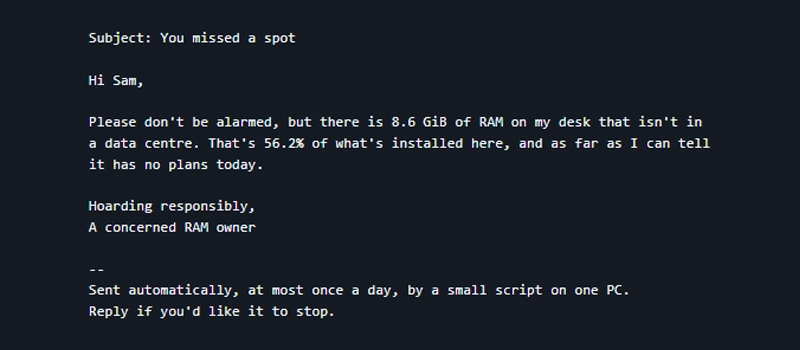
The utility actively monitors a computer's background memory allocation in real time. Whenever it detects unused system RAM sitting idle on a user's machine, it automatically triggers a notification or post addressed directly to OpenAI CEO Sam Altman, humorously offering up the spare memory for his compute-hungry operations.
The underlying joke plays directly on the massive tech industry push for hardware expansion, poking fun at the idea that if AI requires trillions of dollars in infrastructure, it might as well borrow the leftover gigabytes currently sitting idle on a personal laptop.
The project began when Altman told the Cheeky Pint podcast about people running AI models on their own computers.
He said that "from a global allocation perspective… it's quite terrible to have everybody have a bunch of the world's limited supply of DRAM sitting in their own computer" instead of making greater use of AI data centers.
Since the chip industry is experiencing crisis given the rise of the hardware, it literally costs a fortune to get hold of RAM to put into their own computer.
With prices increasing, not only the general public is affected.
Tech giants, OpenAI included, also experience shortage of supply, even when they hoard.
And this project is like adding insult to his injury.
Running the tool allows users to spam Altman about their free RAM usage.
"If your machine has more than 10% of its RAM available, it sends one email a day to let Sam know. It seemed only fair. He can't fix the problem if nobody tells him where the RAM is," the GitHub project reads.
- Tracks total, used and available RAM, plus users' standing with the global allocation authorities.
- Handles page cache correctly, which already puts it ahead of most arguments about RAM.
- Sends at most one email per day.
- Rotates 8 subject lines, 10 messages and 6 sign-offs, so the joke gets old at a carefully managed pace.
- Logs every sample to a CSV file.
- Ships with 14 tests, more than the DRAM market has had sensible outcomes.
- Is written in bash, as an Electron version would have solved the problem by using all the RAM.
As news of the project spread across major tech outlets, the repository quickly went viral across forums and social platforms. However, recognizing how fast internet joke tools can escalate, the developer promptly added a prominent disclaimer asking the community not to actually abuse the script or use it for harassment.
The initiative was designed strictly as a satirical commentary and an amusing coding experiment, rather than a genuine attempt to orchestrate a spam campaign or flood anyone’s notifications with automated messages.
Beyond the humor, the script offers a surprisingly insightful lesson in computer architecture and memory management.
Modern operating systems are designed to utilize available RAM dynamically, often reserving unused memory as a cache to speed up file access and application switching rather than leaving memory addresses completely empty.
The joke itself relies on a classic misunderstanding of system metrics, turning a technical debate about free memory versus cached memory into a lighthearted jab at tech leadership.
Ultimately, the phenomenon highlights the unique culture of the open-source community, where complex technical grievances are frequently transformed into shared cultural moments.
It serves as a reminder of how quickly developer humor can captivate the broader tech landscape, turning routine questions about hardware resources into a clever commentary on the state of modern software engineering.
Whether the script remains a short-lived viral gag or inspires future tech parodies, it perfectly captures the playful, rebellious spirit that keeps the software world entertaining.