French people are proud of French and their French language, and everything that is French.
That is because many French citizens have strong nationalistic indoctrination, which can be traced back to their history.
French is also a relatively difficult language to learn, making those who can speak French proud to speak it.
As a matter of fact, French was a lingua franca, meaning that it was a bridge language, a common language used to make communication possible between groups of people who do not share a native language or dialect, particularly when it is a third language that is distinct from both of the speakers' native languages.
French was once the dominant language within all institutions until the 1990s.
To prove how French value their language over others, its government has started banning the official usage of a number of phrases borrowed from English to describe the world of online gaming.

In its centuries-long battle to preserve the purity of the language, the French government is overhauling the rules on how English video game jargons are used within its borders.
According to France’s national linguistic watchdog, the Académie Française, that came up with the idea, the official usage of a number of phrases borrowed from English to describe the world of gaming should be replaced with their French equivalent.
So instead of saying "esports," government workers should refer to "jeu video de competition." Instead of using the term "pro-gamers," citizens must use "joueur professionnel.” Instead of using the term "cloud gaming," the French alternative is "jeu video en nuage." And instead of "streamers," people should refer ti the "joueur-animateur en direct" — and so on.
The French's Ministry of Culture that has been involved in this decision, said that experts had searched video game websites and magazines to see if French terms already existed.
The ministry said that the video game sector was rife with anglicisms that could act as "a barrier to understanding" for French non-gamers.
So here, the change is to allow the population to communicate more easily.
The rules have been published in the French government's official legal almanac, the Journal officiel de la République Française.
At this time, at least during the moment of the announcement, this means that the changes bind for government employees, and not though the public at large yet.
In other words, while it’s not illegal for French citizens to use the anglicised terms, government workers can no longer use them in an official capacity.

As France’s national linguistic watchdog, the Académie Française has been maintaining the purity of the French language for more than many years.
As a matter of fact, the institution is one of France’s oldest and was founded in 1635 by politician Cardinal Richelieu, who sought to centralize the functions of the French state.
Tasked with that, the Académie’s duties include the promotion of French literature as well as maintenance of the country’s official dictionary, which is issued to government institutions and similar organizations.
And this time, the change is because the language watchdog has warned of a "degradation that must not be seen as inevitable."
In the modern days of tech and internet, the Académie Française's members, known as les immortels or "the immortals," have been working in a particularly challenging situation, in which the dominance of U.S. tech sector has seeded the English-language terms to many people around the globe, and also into the French soil.
Bombarded with many English words and slangs, the Académie Française regularly warned that the French language is in danger of being diluted, especially by English toxins.
In some cases, to forcefully maintain French language's purity, the Académie had to even invent a number of French equivalents for words and phrases born from the Western technology: from "hashtag" (“mot-dièse”) to "sexting" (“textopornographie”) and even "email." (“courriel”).
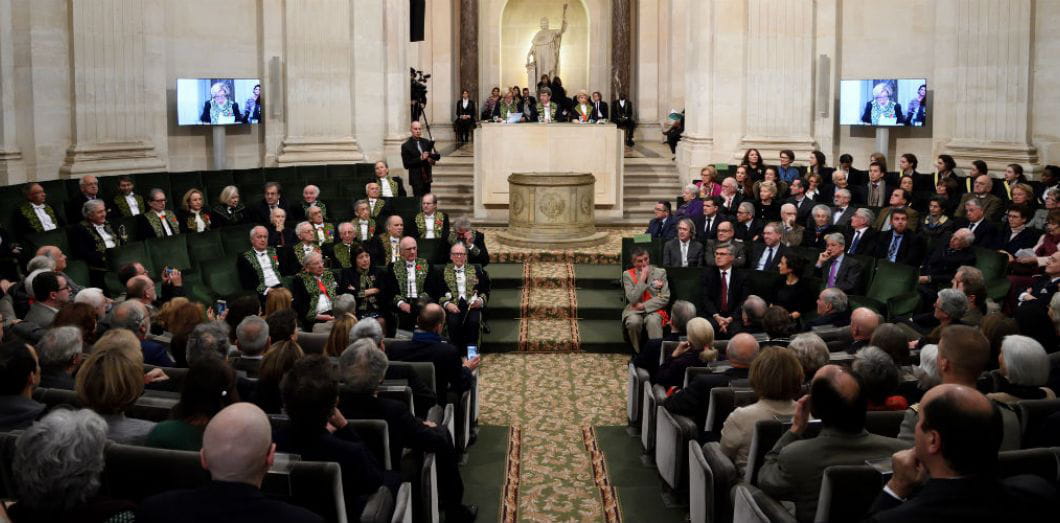
The works of the immortals have become increasingly harder, that the Académie also warned that the growing usage of English and hybrid "Franglais," which could create disaster to the purity of the French language.
It's worth noting though, that the Académie’s work is mostly prescriptive rather than descriptive, and the rules aren't laws that can really punish people.
As a matter of fact, many linguists in France have found that the attempts to remove the influencer of the English language from French are not always successful.
Some terms it failed to naturalize, include changing the word Wi-Fi" to "l’access sans fil à internet."

















































































































































































































































































