The quest to build machines that harness the strange rules of quantum mechanics has always carried an air of the improbable.
For decades researchers have chased systems capable of solving problems that leave even the most powerful classical supercomputers gasping, yet the practical barriers have remained stubbornly high.
Most approaches demand environments colder than outer space, vast supporting infrastructure, and teams of specialists just to keep the hardware from falling apart. Against that backdrop, a quiet shift has begun to take shape in laboratories focused on an unlikely material: diamond.
A German company called SAXON Q has now brought to market what it describes as the first commercial quantum processors built from diamond nitrogen-vacancy centers that exceed the long-standing ten-qubit threshold.
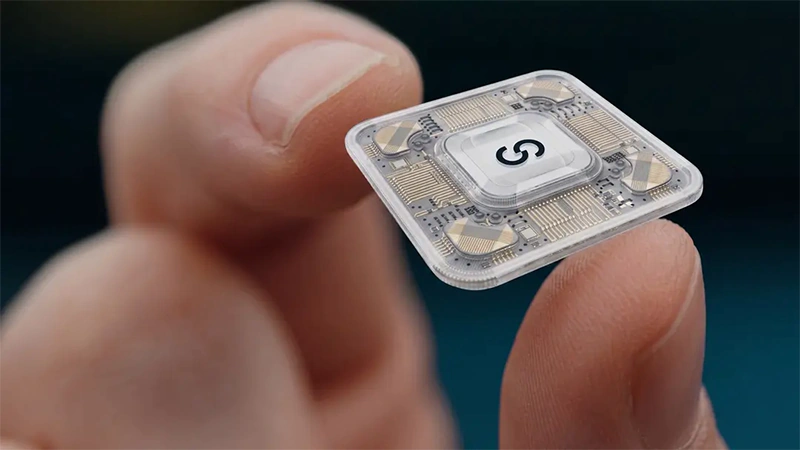
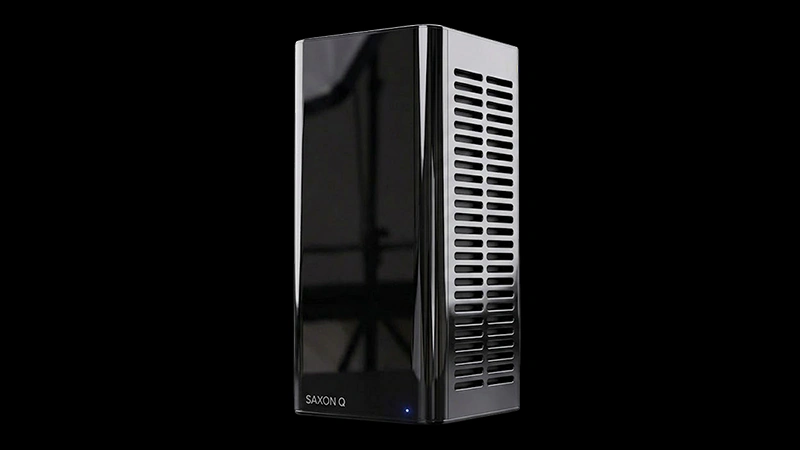
The new systems, designated SXQ128 and SXQ512, deliver 128 and 512 qubits respectively.
They sit inside ordinary server racks, draw ordinary power, and run continuously at room temperature.
No dilution refrigerators, no high-vacuum chambers, no constant recalibration rituals.
Earlier versions of the technology have already spent months in continuous operation at research institutes such as the German Aerospace Center and Fraunhofer IWU, handling industrial optimization tasks in materials processing and robotics.
At the heart of these machines lies a microscopic defect in the diamond lattice.
A nitrogen atom replaces one carbon atom, and an adjacent lattice site is left empty. That combination, known as a nitrogen-vacancy center, creates an artificial atom whose electron and nuclear spins can be controlled with remarkable precision. Green laser light initializes the spin state, microwave pulses perform the logical operations, and the intensity of the resulting fluorescence reveals the outcome.
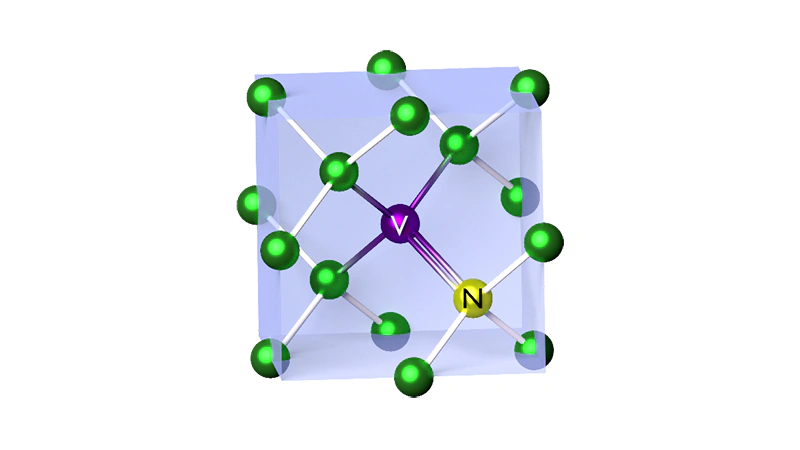
Because diamond itself is extraordinarily rigid, thermal vibrations that would destroy coherence in other materials remain minimal even at everyday temperatures. The result is a qubit that does not need to be frozen into silence.
"For thirty years, NV-center quantum computing was a question of manufacturing — whether we could place qubits with enough precision and yield to build something that works outside a laboratory. We solved that problem," said Marius Grundmann, co-founder and CEO of SAXON Q.
"The SXQ128 and SXQ512 are quantum computers that operate the way a computer should: reliably, continuously and without a team of specialists to keep it running," Grundmann added.
Manufacturing such centers at scale has historically been the bottleneck.
Conventional ion-implantation techniques convert only a few percent of implanted nitrogen atoms into usable qubits.
SAXON Q’s patented sulfur co-implantation process raises that yield above 85%, and the finished qubits achieve gate fidelities of 99.92%, averaging fewer than one error in a thousand operations.
The architecture itself is modular: each core contains a fully entangled cluster of 8 or 16 qubits, and additional cores can be added as workloads grow.
The company has already filed or obtained more than two hundred patents protecting the approach.

These systems are not yet fault-tolerant universal quantum computers capable of breaking modern cryptography or simulating arbitrary molecules at chemical accuracy.
They belong to the noisy intermediate-scale regime, well suited today for variational algorithms, quantum chemistry simulations of modest size, and certain forms of quantum machine learning.
Yet their practical advantages are already tangible.
Energy consumption is reported to be six to ten times lower than equivalent GPU clusters for the same class of workloads, and the hardware can be treated more like conventional compute infrastructure than like a delicate laboratory experiment.
The broader field of diamond quantum technology is no longer confined to a single laboratory curiosity.
Parallel efforts by groups such as Quantum Brilliance have demonstrated hybrid quantum-classical nodes that integrate diamond processors with conventional CPUs and GPUs inside the same rack.
European research consortia are pursuing chip-scale integration that would eventually allow these qubits to sit beside ordinary silicon transistors.
The path from a handful of carefully tended defects to processors containing hundreds of them has been long, but the engineering constraints that once seemed fundamental are beginning to loosen.
What matters most is not the raw qubit count alone, but the fact that the hardware can now leave the specialized clean room and enter ordinary data centers and industrial facilities.
Quantum computing has spent years promising revolutionary capability while remaining locked behind cryogenic walls.
Diamond nitrogen-vacancy systems offer a different proposition: capability that is still limited, yet already usable, continuous, and free of the most extreme environmental demands.
That combination may prove more transformative in the near term than any single leap in abstract performance.
It's worth noting that earlier generations of SAXON Q's quantum hardware have already been deployed at leading research institutions, including the German Aerospace Center (DLR) and Fraunhofer IWU, where they are being used to explore practical industrial applications.
"We began using a Saxon Q mobile quantum computing system in June 2025 for industrial optimization in material processing and robotics," said Albrecht Hänel, Head of Digital Production Twin, Fraunhofer IWU.
"The system has operated at room temperature continuously since installation — and has exceeded the gate fidelity specifications we outlined in the tender."






















































































































































































































































































