Astronomers have gazed to the empty space for more than many years, and researchers have long wondered about the rules that govern it.
The universe is too big. But in order for everything to do what it must do, there needs to be some force behind it that makes the laws to happen.
And this time, a team of theoretical physicists working with Microsoft published a pre-print research paper describing how the universe could be a self-learning system.
In other words, the researchers suggest that the universe is one giant computer.
Dubbed “The Autodidactic Universe” (PDF), published to arXiv, the 80-page paper argues that the laws governing the universe are an evolutionary learning system.
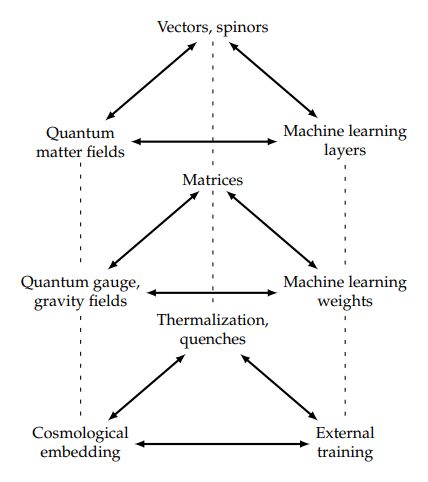
In a novel theory of everything, the researchers laid out the foundation, where the universe, rather than existing in a solid state, it actually perpetuates through a series of laws that change over time.
The researchers explain that the universe as a learning system by invoking machine learning systems.
Just like how researchers created and taught AIs how to work, AI will become clever and unfold new functions over time.
Based on that knowledge, the laws of the universe could be essentially algorithms that do work in the form of learning operations.
[...]
"One implication is that if the evolution of laws is real, it is likely to be unidirectional, for otherwise it would be common for laws to revert to previous states, perhaps even more likely than for them to find a new state. This is because a new state is not random but rather must meet certain constraints, while the immediate past state has already met constraints."
"A reversible but evolving system would randomly explore its immediate past frequently. When we see an evolving system that displays periods of stability, it probably evolves unidirectionally."
To illustrate their theory, the researchers invoke the image of a forensics expert attempting to recreate how a given program came to a result.
In one example, the expert could simply check the magnetic marks left on the hard disk. That way, the results of the program are reversible, meaning that a history of their execution exists.
But if that same expert tried to determine the results of a program by examining the CPU, things would be much difficult, although the CPU is arguably the entity most responsible for its execution.
This is because CPUs don't hold any internal records of the operations they run.
In order to retrieve even a glimpse of the historical picture of a program, the expert needs to observe how each and every particle interacts with the CPU's logic gates during operations.
And in this case, if ever the universe operates as one giant computer via a set of laws, while simple, the self-learning mechanism of the universe should be able to evolve over time. And if this is true, it could be impossible for humans to ever unify physics.
"We are examining whether the Universe is a learning computer," the paper says.
Just before this, Vitaly Vanchurin, a professor of physics at the University of Minnesota Duluth, wrote on his paper that the world is a neural network.




















































































































































































































































































