For most people, the digital services that organize their daily lives feel abstract and untouchable. Maps that guide a morning commute, apps that summon a ride or a meal, cloud storage that holds work files or personal backups, and payment systems that quietly move money all operate in the background until something goes wrong.
In Russia and several neighboring countries, things are different.
What supposed to be a quiet day at the area, experienced a series of drone strikes that have left large parts of the country's dominant technology platform struggling to stay online.
Between 8 and 11 October 2026, Ukrainian drones hit three of Yandex's major data centers.
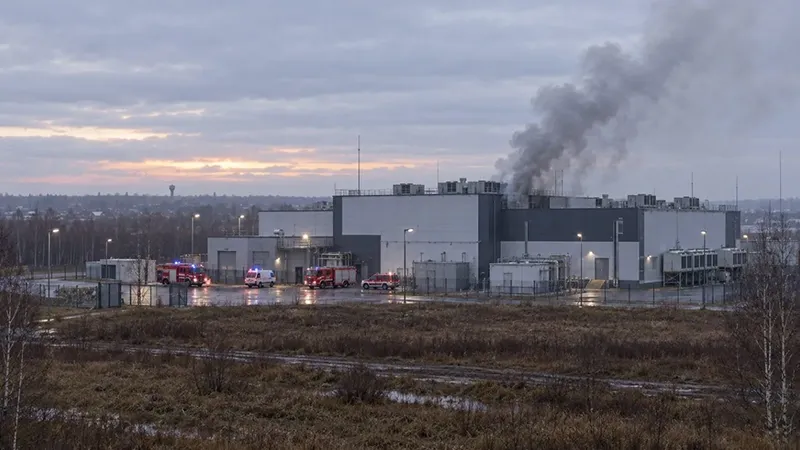
The first struck the Sasovo facility in the Ryazan region overnight into 8 October, starting a fire and forcing a complete shutdown.
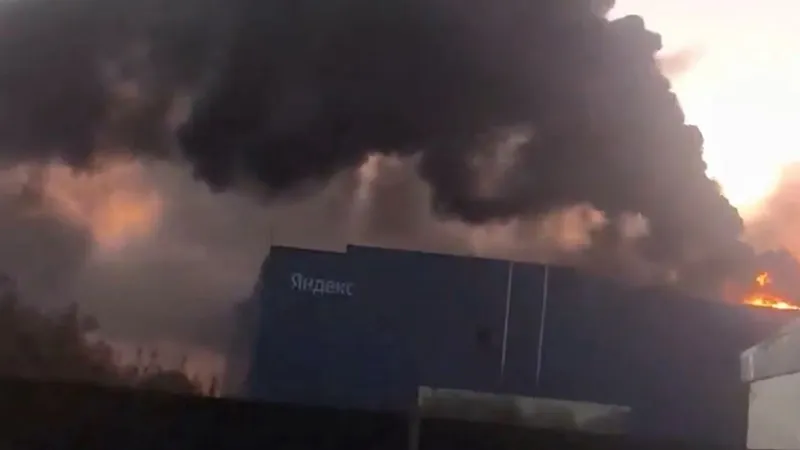
That site housed two of the company's three supercomputers used to train its YandexGPT AI models. The next day, drones damaged the large Kaluga data center southwest of Moscow, knocking several modules out of service. On the night of 10-11 October, a third attack shut down the facility in Vladimir entirely.
Some employees were reportedly injured, but fortunately, no death was confirmed.
But the structural damage was catastrophic.
First off, temporary power cuts affected local residents from the wider drone activity. And second, Yandex, often called Russia's Google, the company that powers far more than search, has its many of its services crippled.
From its cloud platform, taxi and delivery apps, payment services, maps, email, music, and AI assistant that are used by tens of millions of people, struggled to even turn on.
After the strikes, Yandex Cloud entered a limited or emergency mode, with dozens of services, either unavailable or significantly degraded.
As of October 2026, Yandex operates five major data centers in Russia. They are in Sasovo, Kaluga, Vladimir, Ivanteevka, and Mytishchi. With three down, Yandex literally survived by the remaining two.
With employees working around the clock to restore the services, consumer features only recovered only partially.
Search, maps, the Alice assistant, and taxi ordering returned with limitations, while downloads from Yandex Disk were restricted to protect more critical systems.
Payment access was interrupted for some users, and problems spread beyond Russia into Kazakhstan, Belarus, Armenia, Uzbekistan, and Kyrgyzstan.
Users described practical frustrations that quickly became personal.
Drivers reported difficulty receiving orders or using navigation, with some advised to switch to other map apps. People trying to order food or taxis found the services unreliable or unavailable. Customers with money in Yandex Pay complained that funds were temporarily inaccessible, leaving them unable to complete ordinary purchases. Cloud users faced slow or failed downloads and uncertainty about how long their data and applications would remain reachable. Automated traffic from Yandex's networks, mostly search crawlers, collapsed sharply according to monitoring data, an indirect sign of how thoroughly the infrastructure had been disrupted.
The longer-term implications are still unfolding.
Replacing damaged equipment is expected to take months, and Yandex has advised customers to consider alternative providers while it works around the clock.
The company updated its terms to treat drone attacks as force majeure, limiting its liability.
The strikes also put at risk the computing capacity behind Yandex’s AI efforts; the fate of the three supercomputers remains unconfirmed.
For a country whose digital economy is unusually concentrated around a single domestic platform, the outages have shown how physical damage to a handful of buildings can ripple through payments, logistics, communications, and everyday convenience far beyond the sites themselves.

The strikes on the Yandex data centers in Sasovo, Kaluga, and Vladimir were carried out by Ukrainian drones in early October 2026, as a retaliation of what Russia did before.
Back in September, Russia launched a series of drone and missile strikes against Ukrainian data centers and telecommunications infrastructure, including facilities in the Kyiv region. These attacks temporarily disrupted internet and mobile services for tens of thousands of households.
Russia's Defense Ministry described the strikes as a "forced digital detox" and claimed the data centers supported Ukrainian military intelligence processing and transmission.
Ukrainian President Volodymyr Zelenskyy publicly framed the subsequent attacks on Yandex as a symmetrical response. He stated that Russia "have been and still are striking our data centers" and that Ukraine was responding "in kind" or "in mirror-like fashion."
Ukrainian officials and the drone maker Fire Point linked the strikes to this tit-for-tat dynamic after Moscow expanded its campaign against Ukraine’s digital infrastructure.






















































































































































































































































































