Most phone software arrives the way furniture arrives from a catalog. In case of Android, the default store where users can buy things, is through the default store Stire.
Android defaults on Google Play Store. After opening the store, users can look for what they want, and tap install. The other path, is by sideloading apps from third-party app stores.
Most people will rearely think or care about who compiled the package.
But for those who care, F-Droid exists to carter those peculiar users.
F-Droid is primarily a catalog and distribution platform for free and open-source Android apps (FOSS). While F-Droid's catalog rebuilds apps from source, and this has always existed on Android, its development was frozen in 2016.
Now, a decade later, F-Droid project posted that version 2.0 of its official client is beginning a staged rollout, after more than a year of work and fourteen test builds.
In the announcement, the team calls it "the largest app update in 10 years."
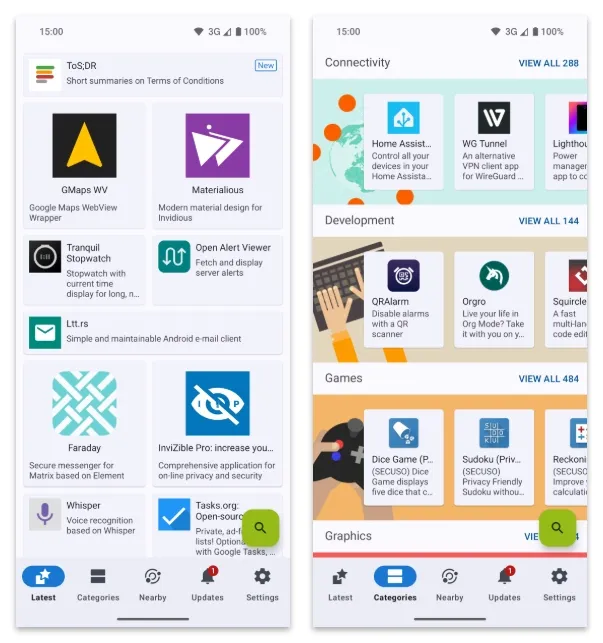
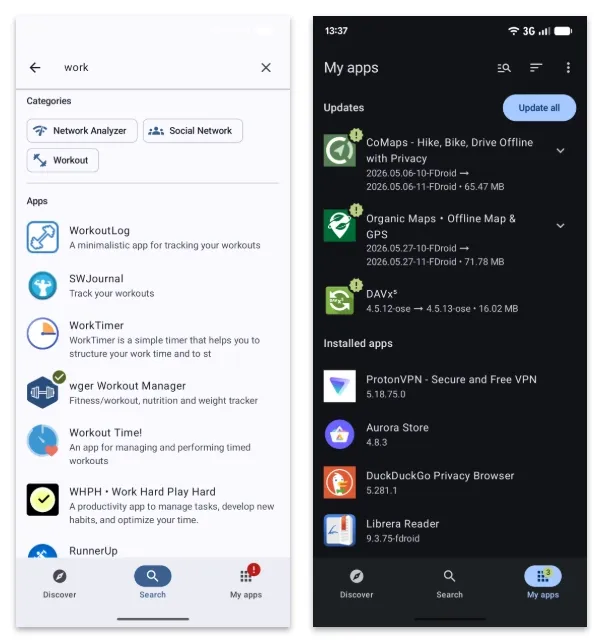
The client was rewritten in Kotlin with a Jetpack Compose interface, optional Material You colors, and a three-tab layout: Discover, Search, and My Apps. Categories sit inside Discover instead of fighting for a slot in the bottom bar. Settings and Nearby Swap stay in the top bar.
Finding software is the part that had aged the worst.
The main repository now holds thousands of free and open source apps, and a handful of broad buckets no longer mapped onto that list. Version 2.0 splits those buckets into narrower ones, including dedicated groups for VPNs, firewalls, password managers, launchers, and navigation tools, plus 17 game genres instead of one Games pile.
Search looks through descriptions, category text, and translations, with better handling for Chinese, Japanese, and Korean.
Filters can be stacked, so a list can be limited to, for example, action games that run on the current device and do not depend on non-free network services.
Discover also surfaces newly added titles, recent updates, and the most downloaded apps in the repo. The project says none of that depends on tracking taps to keep people in the store.
Install and update behavior is the other half of the rewrite. Android has long made third-party stores feel second class: download an APK, wait, then confirm a system warning.
Pressure from the EU Digital Markets Act and related cases opened a pre-approval API that store apps can use.
On supported devices, F-Droid 2.0 asks for install permission when you choose the app, not after the file finishes downloading. The client uses a unified session installer for packages whether F-Droid shipped with the OS or was added later.
Multiple downloads and updates can run at once.
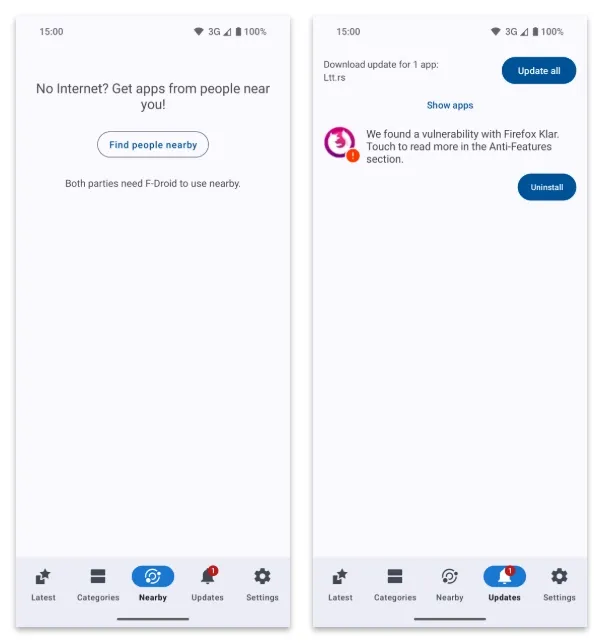
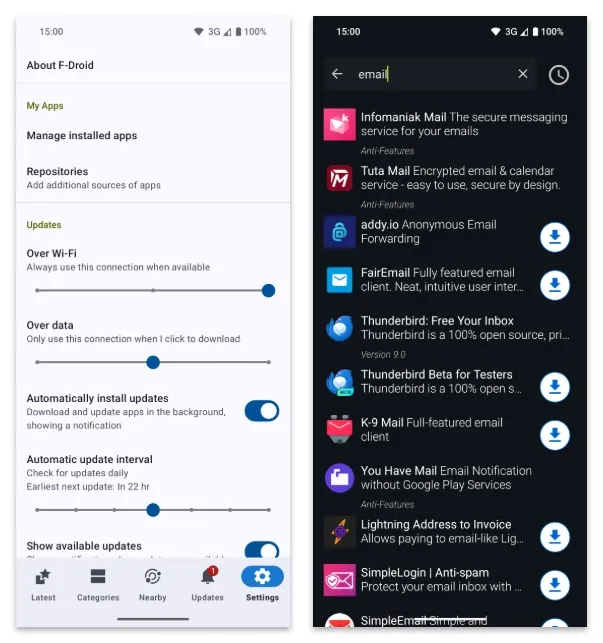
Background update checks and installs are on by default, with old preferences still honored, including limits on mobile data. Pull-to-refresh on the app list is gone because the list is meant to refresh itself. A manual check lives in the three-dot menu on My Apps. The client also warns when something is wrong with a package, such as a signing key change.
F-Droid itself started in 2010 as a repository and a client for software that can be built from public source under a free license.
Maintainers review recipes, compile on their own servers, and publish signed indexes so a phone can verify what it downloads.
That model is why people use it for messengers, maps, ad blockers, and tools that never appear on Play, or that appear there with extras the F-Droid build strips out. Custom Android distributions such as CalyxOS, iodéOS, and some Lineage-for-microG images ship F-Droid or extra repos by default.
Other clients can read the same indexes. The official app is only one front end, and for years it showed its age next to forks that already used Compose and Material You.
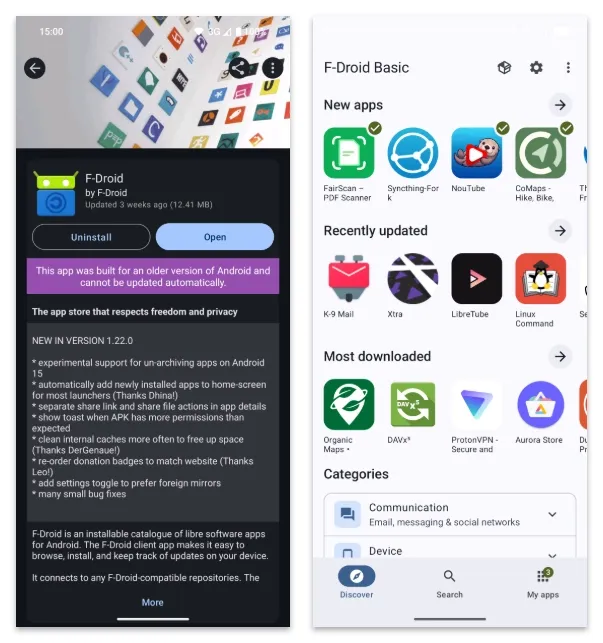
Some of that age was not only visual. Features that matter to a smaller set of users were rearranged or dropped so the new code could ship.
"Use Tor" is no longer a special auto-detect toggle. Existing choices migrate into generic proxy settings, and the project points people toward Tor VPN or Orbot rather than maintaining its own detection.
Panic tools that clear sensitive data remain.
The old disguise that made F-Droid look and act like a calculator is reduced to an icon and name change, which the team says is more honest about what a forensic look at the Apps list would still see.
Wiping other apps in response to a panic trigger such as Ripple is not in 2.0.
Maintainers say the feature has a small audience and a high maintenance cost, and they ask people who depend on it to stay on the previous client until they decide whether to rebuild it.
F-Droid Privileged Extension is also unused in 2.0. Background updates now go through the session installer on current Android, which removes the need for that privileged helper, at least for this release. Android 6 is no longer supported.
F-Droid Basic 2.0.0, the slim client, listed Android 7.0 as the floor when the packages appeared around 23 September.
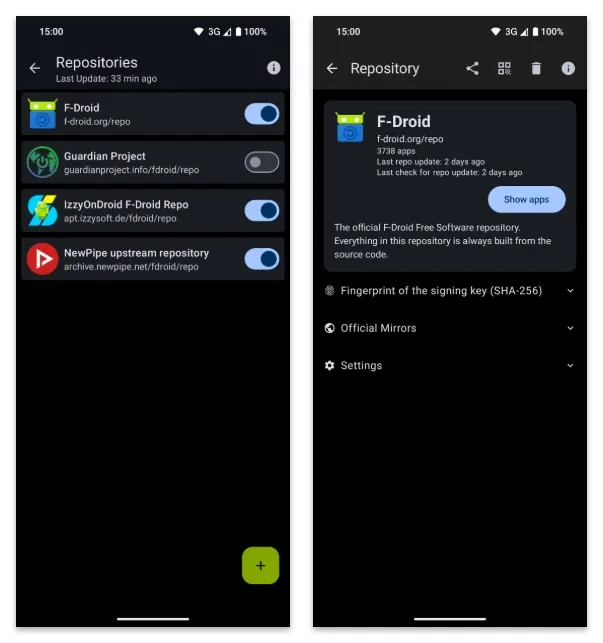
The timing is not only about design.
The same week, the F-Droid site still carries a banner pointing to keepandroidopen.org and Google’s coming developer verification rules, which the project treats as a threat to sideloading outside Play.
Version 2.0 does not solve that policy fight. It does try to make the remaining path less clumsy: a store that looks like current Android, installs with fewer steps on devices that expose the new APIs, and updates in the background without a swipe.
Rollout is gradual over the coming weeks.
The default download on the website has not been swapped yet. Anyone who wants 2.0 immediately can take it from the versions list on the package page.
Some ideas from the year of alphas did not land, and the team says community reports from the wider install base will decide what returns first.
For a catalog that spent a decade looking like a volunteer project that happened to work, that is the actual change: the client finally matches the size of the archive behind it, while a few sharp-edged tools wait in the old build for people who still need them.






















































































































































































































































































