
For years the tools people used to get things done stayed firmly in the reactive category. You asked a question, received an answer, and the interaction ended. Even when software could chain a few steps together, the responsibility for deciding what came next, noticing when conditions changed, and carrying the thread across days remained with the person.
That division of labor is starting to shift as systems gain the ability to hold a standing brief, watch for relevant signals, and continue working without a fresh prompt each time.
Perplexity's 'Teammates' sit inside that shift.
Teammates are persistent agents that operate on top of the company's earlier Computer product.
Computer already lets a Max subscriber describe an outcome and have a multi-model system break it into subtasks, run them in isolated sandboxes, and deliver results.
Teammates take the same underlying orchestration and give each agent a continuing role rather than a one-off session.
A user assigns a teammate a job description, a standing brief that describes the desired outcome and constraints, and rules that define when the agent should stop and ask for a human decision.
The agent then draws on the Projects, Skills, Memory, connectors, and files already present in that user’s Computer workspace, so it does not begin from a blank context.
Once set up, a teammate can plan its own sequence of work, spawn additional agents when a goal splits into parallel pieces, and keep a single continuous thread that records what it has done and what remains.
It can monitor connected tools such as Slack, GitHub, or Linear and begin acting when something changes, rather than waiting to be asked.
Multiple teammates can hand work to one another; an engineering agent that opens a pull request, for example, can pass the change to a separate QA agent for testing across environments.
Each also has its own desktop and browser session with independent cookies, so one agent signed into advertising platforms does not share that login state with another working in source control.
Isolation is enforced at the virtual-machine level.
Each teammate's environment runs with its own guest kernel, and all external communication is mediated through controlled channels. Credentials stay outside the sandbox in a separate store and are injected only at the network or browser layer as needed.
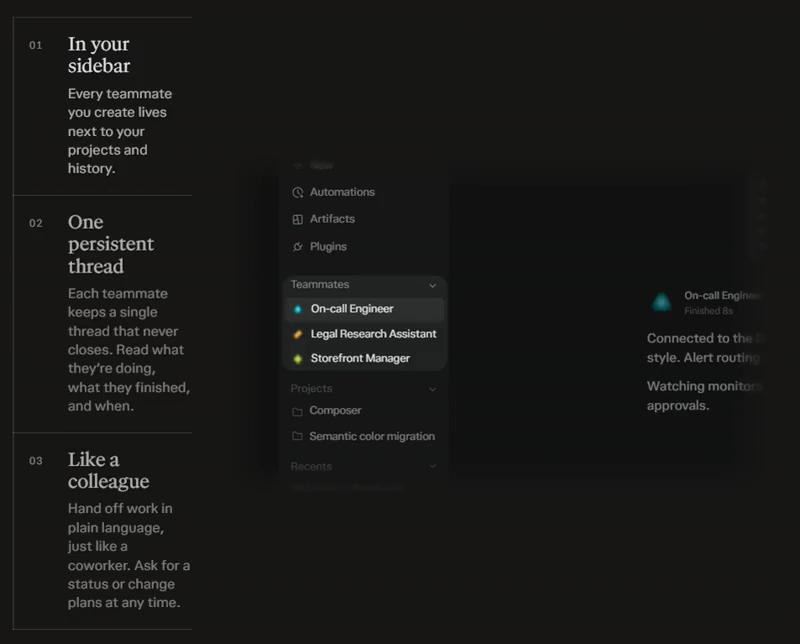
The agent inherits the same tool and project permissions the user has already granted to Computer, and the user can review the ongoing thread, take over the desktop mid-task, or redirect the agent at any point.
Perplexity has published technical notes on the runtime architecture that supports these long-lived sessions, including snapshotting for recovery and mechanisms that keep credentials from entering the agent’s working environment.
Official examples illustrate the intended pattern. An ads-manager teammate is given a brief to keep holiday campaigns inside budget caps, pause underperforming sets, and escalate only decisions that require approval; it can pull channel results, adjust spend, draft new creative, and message a legal teammate about a contract extension.
An engineer teammate can be told to diagnose a checkout failure on zero-total orders, locate the cause, open a pull request with a rollback plan, and watch the subsequent deploy.
Similar standing roles are described for sales follow-up, operations deadline tracking, marketing competitor monitoring, and finance invoice reminders. In each case the agent is expected to close loops on routine steps and surface only the points that need a person.
Access is currently limited to individual Max subscribers on the web, with native mobile and desktop versions described as forthcoming.
Max is priced at $200 per month or roughly $167 when billed annually, and it includes 10,000 Computer credits per month plus a one-time bonus for new subscribers.
During a promotional window Teammates usage draws from an additional grant; afterward it consumes the regular monthly credit allocation.
Parallel agent runs and sustained monitoring consume more credits than simple queries. Enterprise plans do not include Teammates by default, though administrators can request access.
Perplexity’s own internal workspace reportedly created roughly 10,000 teammates in the thirty days before the public launch, a multiple of its human headcount, with about a thousand active on a given recent day.

What remains sparsely documented is the practical cost in credits for a continuously running teammate, the maximum number of simultaneous teammates a single Max account can sustain, and independent measurements of reliability over multi-day or multi-week horizons.
Early public discussion has noted the high entry price relative to some competing agent products and the absence of third-party evaluations of error rates, recovery from tool failures, or the quality of handoffs between agents.
Users who already pay for Max can begin with bounded, low-stakes roles and observe credit consumption and intervention frequency before expanding scope.
In practice the system moves the boundary of what stays inside a chat window.
A person can still set the goals, review the output, and override decisions, but the continuous monitoring, decomposition of work, and cross-agent coordination now sit with the agents themselves.