Computer security has a funny way of reminding us that monumental failures rarely look like cinematic masterclasses.
Most critical vulnerabilities are not born from shadowy code wizardry or complex memory corruption schemes, but rather from the quiet, mundane intersections of separate software choices made years apart.
When a piece of code behaves unexpectedly because two distinct systems interpret the exact same character string in two totally different ways, the resulting chaos can leave millions of systems exposed.
That is precisely what happened with a newly uncovered vulnerability that Wakefield researcher Özgün Kültekin, who discovered it, quickly nicknamed it '*sshold,' a clever play on words highlighting an authentication bypass that turns a simple string match into a backdoor.
Tracked as CVE-2026-123158, the flaw lives in the delicate plumbing between OpenSSH and alternative C libraries like musl libc, which are heavily favored by lightweight Linux distributions such as Alpine Linux for their minimal footprint.
Under normal operating rules, accounts configured without an active password store an asterisk symbol inside their configuration records, signaling to the system that password logins are completely disallowed.
But as security researcher Kültekin points out in a deep technical analysis, the roots of this convention go back much further than most engineers realize, tracing all the way to the early BSD Unix era of the 1980s when Sun Microsystems cofounder and BSD heavyweight Bill Joy helped establish the practice of putting a single asterisk in the file entry for daemon accounts to block password entry.
Today, password hashes typically live in separate security files while those asterisks remain standard practice for accounts that are never supposed to accept direct password logins.
Unfortunately, relying on an asterisk as a foolproof gatekeeper proved disastrous when paired with modern memory handling quirks.
When a system relies on musl libc without Pluggable Authentication Modules and handles an incoming authentication attempt using an excessively long password exceeding 256 characters, the underlying library rejects the oversized string and returns that exact same asterisk symbol as an error marker.
Because OpenSSH compares the returned error value against the stored configuration, it misinterprets the resulting asterisk as a legitimate password match, unlocking the door for unauthorized users.
What makes this particular flaw so dangerous in the real world is how easily it can manifest in standard cloud configurations.
Popular lightweight images frequently ship with default administrative or secondary user accounts that lack direct passwords, occasionally pairing them with lightweight administrative tools that permit privilege escalation.
If an attacker slams a vulnerable target with a multi-character password string that triggers the length limit error, the authentication logic collapses under its own weight. Systems running mainstream GNU C library distributions dodge the bullet entirely, but lightweight container environments, edge routers, and specialized cloud instances running musl found themselves scrambling to push emergency patches as details of the exploit spread across the security community.
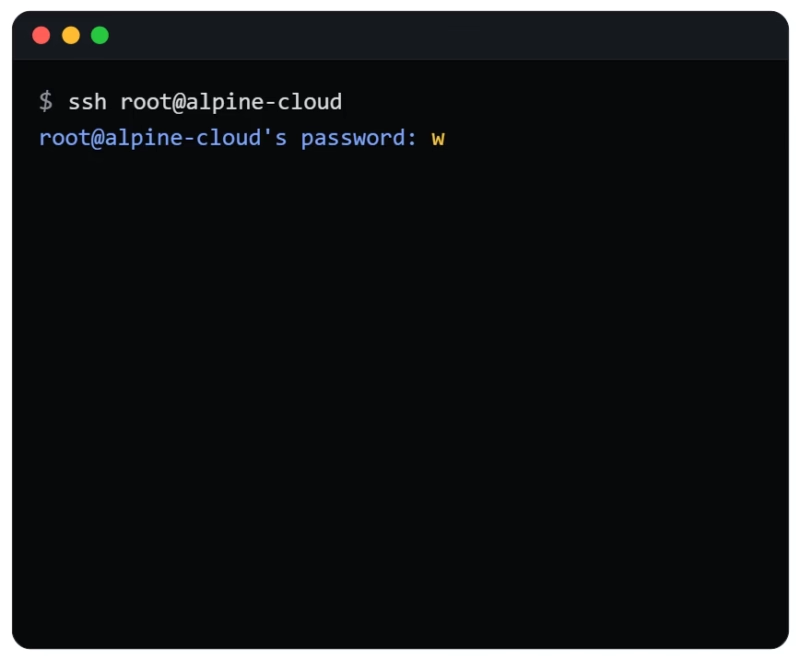
Mitigating the risk requires more than just a casual package update, though upgrading OpenSSH to version 10.6p2 or applying distribution-specific fixes is an immediate necessity.
Because restarting the active Secure Shell daemon is required for fixes to take effect, and because pre-built cloud container images often bake vulnerable components into their base layers, administrators have had to audit their environments aggressively.
Enforcing strict key-only authentication policies by disabling password logins entirely provides a reliable safety net for systems that cannot be patched instantly.
It is a stark reminder that in modern infrastructure, the smallest components often carry the heaviest weight, and keeping systems secure means looking closely at the boring glue holding everything together.