In a world where access to information can feel increasingly fragile, the quiet battles over online freedom continue to shape how millions experience the internet every day.
Governments tighten controls, platforms face pressure to filter content, and ordinary users often find themselves locked out of open conversation without even realizing the walls going up around them.
Tor has been at the forefront of this.
For years the organization has built and maintained tools that let people reclaim some measure of privacy and access when ordinary connections fall under restriction.
One of the quieter but increasingly important parts of that work involves volunteer-based systems that expand the paths available to those who need them most.
The newest contribution in this area is an Android application called 'Snowflake Volunteer.'
According to The Tor Project in a post, Snowflake is a pluggable transport built into Tor Browser that is specifically designed to bypass internet censorship.
Like a Tor bridge, Snowflake allows users to access the open internet even when direct connections to the Tor network are blocked. Enabling it is straightforward, requiring only a switch to a different bridge configuration within Tor Browser.
It's further explained that Snowflake is also integrated into other Tor-powered applications, including Tor Browser, Orbot, and Ricochet-Refresh. If these apps cannot establish a direct connection to the Tor network, Snowflake can provide an alternative path that bypasses censorship.
The system relies on WebRTC, the same technology widely used by video conferencing platforms.
By making Tor traffic resemble ordinary audio or video calls, Snowflake helps users avoid detection by internet censors, making it significantly harder to identify and block their connections.
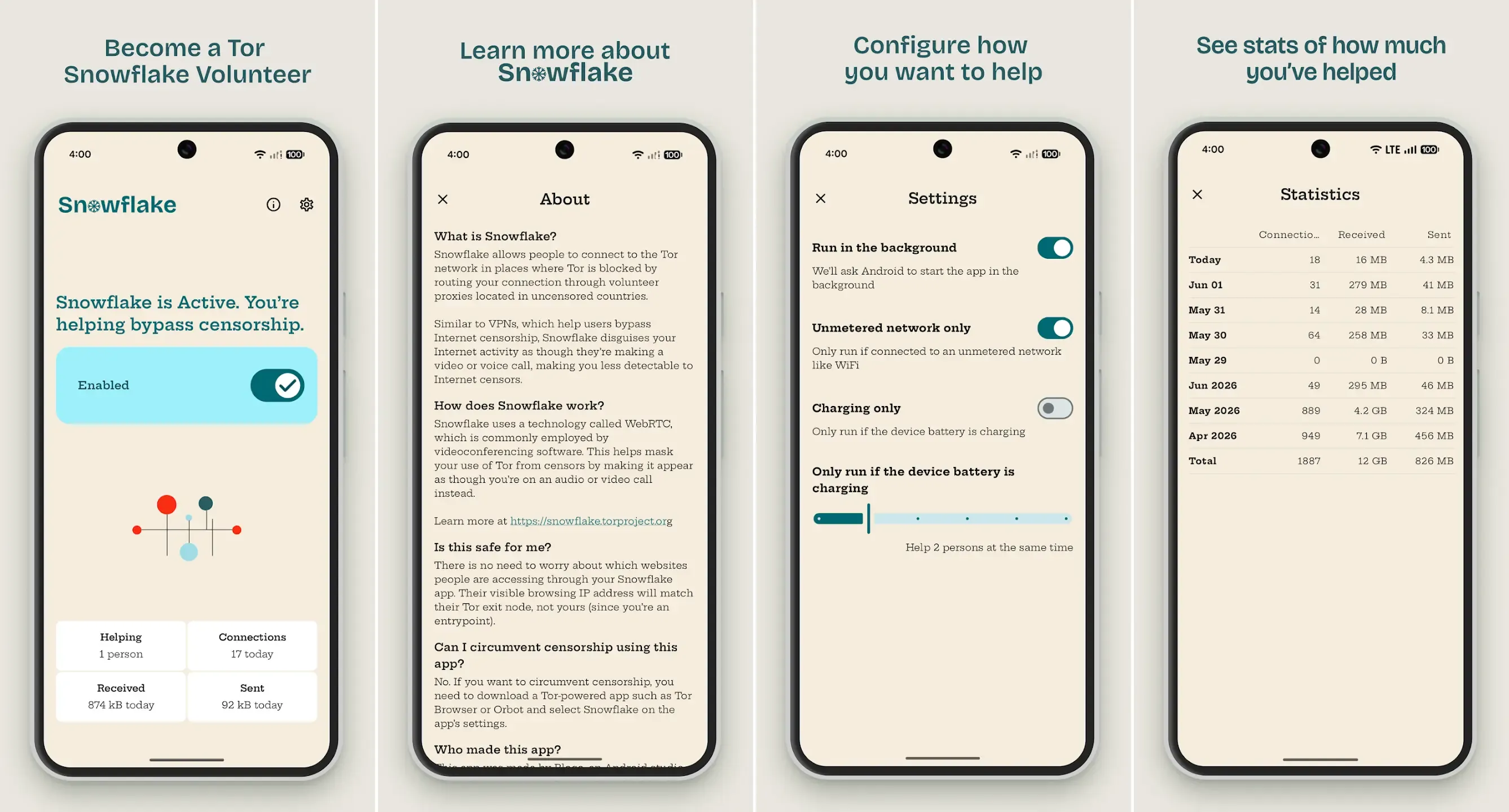
The newly released mobile app, developed by the Portuguese studio Bloco with support from The Tor Project's anti-censorship initiatives, allows any compatible Android phone to temporarily serve as a Snowflake proxy.
Users decide when it runs, typically while the device is connected to Wi-Fi and charging.
Behind the scenes, the app relays short-lived encrypted connections for people attempting to reach the Tor network from countries where access is blocked or heavily monitored.
Each participating phone becomes another volunteer-operated bridge, expanding the network of available entry points.
The practical benefits are immediate.
People living under strict internet censorship can disguise their traffic as ordinary WebRTC communications, connect to the Tor network through Snowflake, and regain access to the wider internet.
Because Snowflake traffic blends in with widely used real-time communication services, blocking it often requires censors to disrupt large portions of legitimate internet activity.
This substantially raises the cost of censorship while allowing information to continue flowing into and out of restricted regions.
Every volunteer who enables the app contributes another temporary proxy, making it increasingly difficult for authorities to identify and block every available route into the Tor network.
Shortly after the public launch, The Tor Project reported an increase in the number of unique Snowflake proxy addresses, suggesting that even modest participation can meaningfully strengthen the network.
For volunteers, the impact on their devices remains minimal.
The app limits the number of simultaneous connections, is designed to keep battery and data usage low, and includes simple statistics that let users see how many people they have helped connect to the uncensored internet.
This tool occupies a distinct place compared with the Tor Browser or the Tor Project itself.
The Tor Project is the nonprofit that develops the core anonymity network, conducts research, and advocates for digital rights, and the Tor Browser is the main application people download when they themselves need to browse privately or reach restricted sites.
Snowflake Volunteer does neither.
It does not anonymize the phone owner's own traffic, nor does it turn the device into a full relay.
Instead it supplies capacity to one specific pluggable transport so that others can more reliably reach the network the Project maintains. One set of tools is for using privacy infrastructure; this one is for quietly expanding it.
The broader implications go beyond raw numbers.
A wider and more varied set of mobile proxies makes the system harder to predict and therefore harder to shut down completely.
It also removes technical barriers that once kept most people from contributing.
Anyone with an Android phone and a stable connection can now take part without learning onion routing or managing server software. Volunteers should still understand that their public IP address becomes briefly visible to the users they assist and to the system coordinators, yet the design keeps those links short and constrained.
When enough people leave the app running during ordinary charging hours, idle devices become a distributed form of support for open access, each small contribution adding resilience where it is needed most.






















































































































































































































































































