For most of the last twenty years, the internet has been less a network of pages than a string of rooms people treated as public space.
Some of those rooms were built for photos or friends. One became the place where news arrived first, where a joke could travel farther than a press release, and where institutions, celebrities, journalists, and anonymous accounts occupied the same timeline.
That room was Twitter, and its hold on daily life was never only about the software.
Twitter began in 2006 as a side project inside Odeo, a struggling podcast company. Jack Dorsey, Noah Glass, Biz Stone, and Evan Williams built a service around short status updates. Dorsey's first post, “just setting up my twttr,” was not a manifesto.
The product found its shape later, after South by Southwest in 2007, after hashtags and retweets, and after journalists discovered that a few hundred characters could outrun a newsroom.
By the time Twitter went public in 2013, it had become a default destination for breaking news, sports, politics, celebrities, and the kind of argument that once belonged to talk radio. It was also fragile. Harassment was common, moderation was uneven, and the business depended on advertising alongside whatever the crowd decided to amplify.
Those tensions never went away.
They just became part of the furniture.
And now, the brand is back in business.
When Elon Musk completed his purchase of Twitter on October 27, 2022, for about $44 billion, what followed was not a quiet change of ownership. It was kind of chaotic.
Large parts of the staff were dismissed. Verification, once a check against impersonation, became a paid product. The public API was restricted. Advertisers left and returned in uneven waves.
Musk described the company as a digital town square and later as an “everything app,” borrowing from the model of WeChat.
In July 2023, the bird and the word Twitter were retired in favor of X. Musk wrote that the company would “bid adieu to the Twitter brand, and gradually, all the birds.”
The domain shift from twitter.com to x.com was completed in May 2024.
The rebrand created a brief void, and that void helped alternatives such as Bluesky, Threads, and Mastodon attract parts of Twitter's diaspora. None inherited the original brand. X moved quickly to replace visible references to Twitter with X.
But the old word never completely disappeared.
In other words, the name did not vanish.
It never did.
That has now created an opportunity for a small company that believes the name was abandoned.
Operation Bluebird, Inc., a Delaware corporation with a Virginia mailing address, launched a new service at twitter.now in late August 2026. The people behind it are not former product leads from the old company.
Michael Peroff is an Illinois trademark lawyer. Stephen Coates, who now serves as Bluebird's general counsel, was Twitter's first in-house intellectual property counsel and later associate director of trademarks, domains, and marketing between 2014 and 2016.
Several reports have described Coates as Twitter's former general counsel, but his documented role was narrower: he worked on the company's intellectual property, trademarks, domains, and marketing.
That history is particularly relevant because Bluebird's entire project rests on a legal argument.
In December 2025, the company asked the U.S. Patent and Trademark Office to cancel X Corp.'s registrations for “Twitter” and “tweet.” Bluebird argued that the marks had been abandoned after being removed from products, marketing, and the interface, and pointed to Musk's public farewell to the brand as evidence that X had no intention of returning to it.
Days later, X sued in federal court in Delaware.
X's position is straightforward: a rebrand is not the same thing as surrendering a trademark. The company has argued that twitter.com continued to receive millions of visits, that consumers still associate Twitter with the service now called X, and that Bluebird is attempting to appropriate a famous mark rather than revive an abandoned one.
During an April 2026 hearing, Judge Colm Connolly made tentative remarks suggesting that X may have surrendered rights in “tweet,” the bird logo, and potentially the Twitter name.
But there is no final written ruling establishing that those marks have been abandoned.
Trademark lawyers remain divided. Some consider Bluebird's theory viable. Others argue that proving abandonment of a still-famous mark will be an unusually difficult task.
The USPTO cancellation proceeding has also been affected by the federal court fight.
None of that is settled.
The launch happened anyway.
Coates has said the company has investors, a product, and a willingness to continue while the legal process plays out.
Twitter.now is not X with a different coat of paint, and it is not the 2012 version of Twitter restored from a backup.
It is a separate, member-funded social network that borrows enough of Twitter's old grammar to be immediately recognizable.
There is a composer in the middle of the page. There is a feed, replies, reposts, and a trends column. The interface deliberately looks familiar because familiarity is the product's most obvious advantage.
At launch, however, only hundreds of people were using it.
Early access is not free. $20 buys “Founder” status, a reserved handle, and a numbered badge. Paying $40 or more adds a “Fighter” badge and is described as additional support for building the service and defending the name.
Bluebird says the fee is intended to keep bots out and prevent the platform from becoming dependent on advertising.
That is a genuine departure from classic Twitter, which grew in part because anyone could walk in.
It is also a constraint.
A paid door can reduce spam. It can also reduce the accidental discovery that made the original Twitter feel like a public square.
Bluebird's other major idea is expressed in a phrase that sounds simple until the platform has to enforce it:
“Freedom of speech, not freedom of reach.”
Posts are supposed to carry visible trust signals. Users get a “Trust Dial” that can hide posts below a chosen score instead of removing them from the service. Bluebird says nobody is banned and nothing is deleted merely because it is considered untrustworthy. Low-scoring posts simply travel less.
There are still boundaries. The service prohibits illegal content, child exploitation, threats, harassment, and scams, while saying explicit material will be kept out of the public feed.
Those promises currently sit beside an unfinished constitution.
The homepage says the full rules are still coming.
The scoring system is called VERA, described as a veracity engine that evaluates claims rather than people. Reporting around the launch says the first version uses Google's Gemini model to assess posts in something close to real time and attach sources and context.
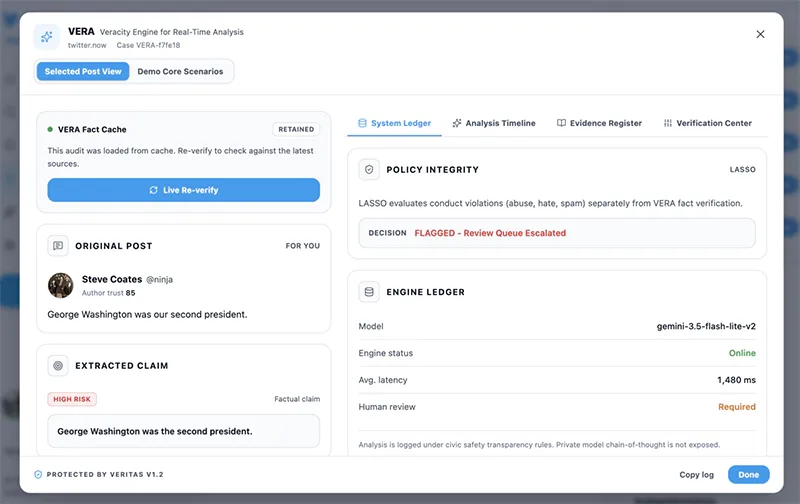
Even the site's presentation of VERA contains some uncertainty. One section describes the system as coming soon, while another presents trust scores as part of the product's current pitch.
That gap matters.
An automated score that decides who keeps a megaphone is still a form of ranking, even if the slider is placed in the user's hands. Who trains the model, what it recognizes as a claim, and how it handles satire, breaking news, uncertainty, or minority viewpoints are not secondary implementation details.
They are the product.
Reusing the old name is Bluebird's obvious advantage.
“Twitter” still means a short public post to millions of people who have not opened X in years. Search, memory, and muscle memory all point toward the word.
A new network with a new name has to explain itself.
A network that puts “Twitter” in the address bar inherits a story.
That is also the risk.
The same recognition that attracts curious users creates confusion with X, which remains vastly larger and continues to claim rights associated with the Twitter brand. A domain on the .now registry does not settle ownership of a word that spent more than fifteen years on television screens, news broadcasts, and phones.
If a court ultimately sides with X, the brand Bluebird is trying to reclaim could become little more than a generic description attached to a small paid social network.
Even if Bluebird wins, it inherits expectations that cannot be satisfied by a few hundred accounts and an unfinished trust engine.
People do not miss Twitter only because of a bird logo.
They miss density.
They miss the sense that if something happened, it would appear there before it appeared anywhere else. Journalists were there. Politicians were there. Fans were there. Strangers were there. The person who knew something before everyone else was there.
Density is not a trademark.
It is a network effect, and network effects do not transfer because a lawyer filed a cancellation petition.
There is another tension in the story Bluebird tells about itself.

Its marketing presents the project as an attempt to take the square back from a billionaire who broke it. Coates has also said, in plainer terms, that twitter.now is not an attempt to recreate the old platform.
Both can be partly true.
The interface leans heavily on memory. The business model, paid entry, and AI-powered trust scores do not.
Classic Twitter was chaotic, free, and often untrustworthy. X is larger, more commercial, and organized around a different owner's idea of speech and product.
Twitter.now is something else: a small experiment built around a brand its founders argue has been abandoned, combined with a business model designed to keep the crowd smaller and a trust system designed to decide how far that crowd's words should travel.
It may win the argument over the name.
What it cannot simply reclaim is the moment when “Twitter” meant everyone was already there.




















































































































































































































































































