In an era where generative AI and hyper-realistic digital manipulation make it virtually impossible to distinguish real photography from synthetic media, verifying image authenticity has become one of technology's steepest challenges.
Existing solutions like C2PA add metadata at the end of a software pipeline, but these can be vulnerable to operating system tampering or compromise somewhere along the edit chain.
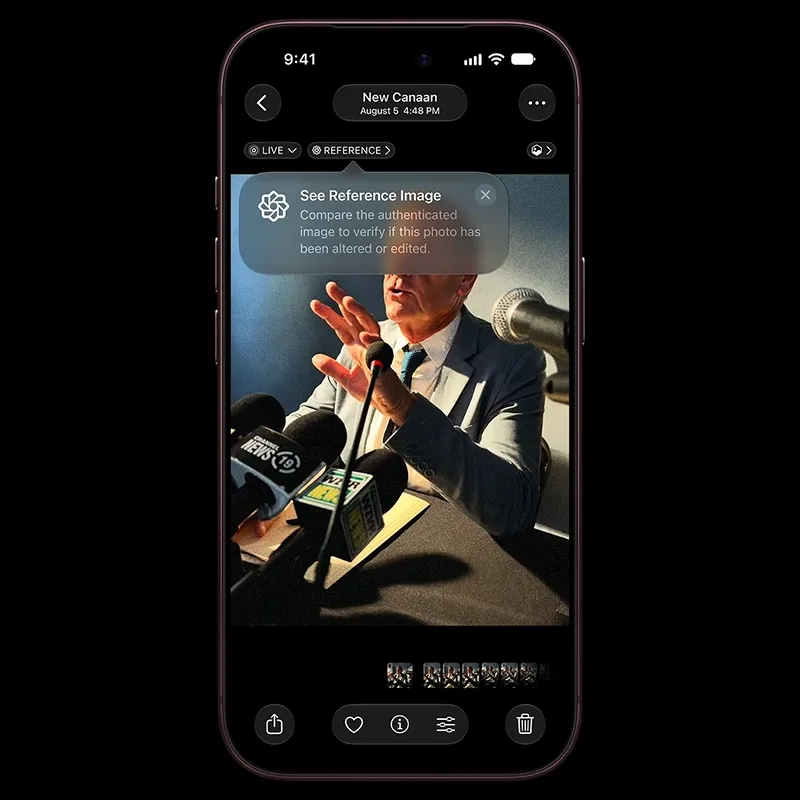
To solve this, Apple introduced 'Apple Reference Image.'
This novel, hardware-enforced image provenance framework debuted with the iPhone 18 Pro camera system.
The feature is designed to cryptographically verify that a photograph was captured by a physical camera sensor at a specific moment in time, all while preserving the photographer's privacy and hiding the image data even from Apple itself.
The foundation of this system begins long before a photo is taken, inside Apple's manufacturing facilities.
In a blog post, Apple said that:
This new, opt-in camera mode lets a photographer create a securely timestamped reference image that accurately reflects what was captured by the iPhone's camera sensor. Dedicated secure hardware on the device protects the integrity of this reference image, and Private Cloud Compute protects the privacy of the image data during processing. The system is built to be resilient to compromise, no matter how unlikely: any fraudulent images can be revoked without exposing the photographer's identity.
According to Apple, each iPhone 18 Pro camera sensor generates its own unique cryptographic signing key pair, keeping the private key locked inside its silicon.
That sensor identity is paired with a separate signing identity generated by the iPhone's Secure Enclave Processor (SEP).
Apple binds these keys together into a signed factory manifest, establishing a permanent hardware-backed record that attests the sensor and the phone's secure hardware belong together on the exact same device.
The feature works like this:
When a photographer switches to Reference mode in the Camera app, the phone initiates a secure boot process directly on the camera sensor. When the shutter is pressed, the raw analog light data is digitized, and the sensor cryptographically signs the pixel data and sensor-level metadata right on the silicon before handing it off to the phone's operating system.
As a result of this, the hardware-level seal prevents malicious software or compromised data buses from injecting synthetic pixels.
Off-sensor metadata like digital zoom bounds or exposure settings are simultaneously signed by the Secure Enclave Processor, creating an immutable, unalterable digital negative.
To establish precisely when a photo was taken without relying on easily manipulated system clocks, the feature uses a dual-timestamp mechanism.
The iPhone maintains a background connection to Apple's servers that periodically fetches cryptographic timestamp tokens (typically every 15 minutes), establishing a verified lower time bound.
Immediately after a photo is captured, the device requests another token from Apple's servers to serve as an upper bound.
Bound inside the digital negative, these two tokens create a cryptographically proven time window during which the image must have been taken.
Developing this secure digital negative into a viewable photo relies on Private Cloud Compute (PCC).
Once the digital negative is uploaded to PCC, Apple's privacy-preserving cloud architecture verifies the cryptographic signatures from the sensor, the Secure Enclave, and the manufacturing manifest to ensure no hardware component has been swapped or tampered with.
A machine-learning model then analyzes the raw signal to ensure it exhibits the true physical properties of an actual sensor capture. Once validated, PCC performs standard camera processing, such as demosaicing, tone mapping, and compression, and outputs a final JPEG image.
Because PCC runs open, publicly verifiable code in an isolated enclave, Apple engineers cannot access or view the image data being processed.
Once the reference image is developed, Apple signs it using a forward-looking hybrid signature scheme that combines standard RSA-3072 encryption with post-quantum ML-DSA-87 cryptography, ensuring the photo's authenticity remains verifiable against future quantum computing attacks.
To protect journalists and users operating in sensitive environments, the system generates no public device identifier or persistent user credentials, meaning outside observers cannot link two different reference images back to the same camera or identity.
Should a hardware sensor ever be compromised, a centralized revocation service tracks sensor confidence scores and revokes fraudulent sensors or images without ever revealing the underlying image contents, delivering an end-to-end framework that redefines truth in modern photography.




















































































































































































































































































