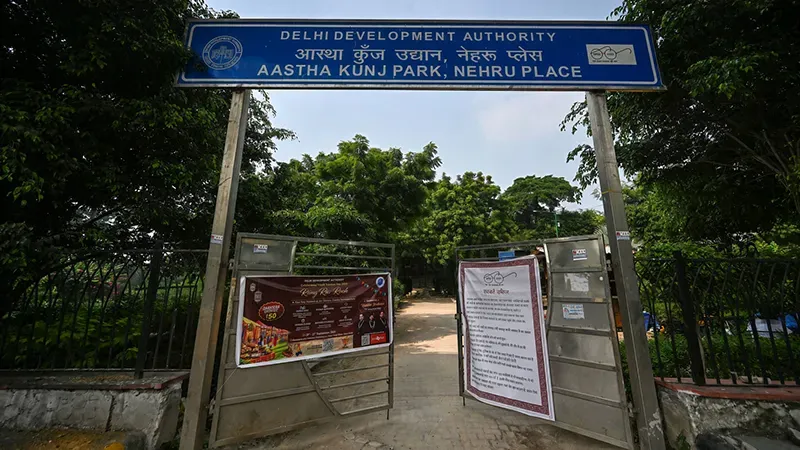
On the evening of 21 September 2026 a 17-year-old girl and a male friend, also 17, were in Aastha Kunj Park in south-east Delhi.
She had left home around 5 p.m., her mother a cook who was at work, and had told an elder sister she was going to Kalkaji temple with the friend. They reached the temple around 5.45 p.m., stayed until about 7 p.m., bought chips and water outside Kalkaji metro station, and entered the park through Gate No. 7.
In her statement to police, she said she also wanted to go to the ISKCON temple, and that they sat on a bench to eat first.
Three men approached and said they were police.
They used legal and police language to convince the teenagers they were in trouble, took both phones, slapped the boy, and separated the pair. One man called another with the words recorded in the FIR as "Asif bhai, gun nikal."
A black firearm was shown to threaten then, and knives were also pulled.
She was taken to a dark, isolated part of the park.
She told police she asked to speak to her mother and was refused.
In the statement reported by major local publications, she said Asif raped her on a bench while holding a knife to her neck and telling "Hemu" to keep watch. After Asif is done, Hemant and then Mukesh also raped her.
After they're finished, the men returned the phones, threatened to kill them if they spoke, and left.
The friend called the police control room at about 8.45 p.m.
Amar Colony police registered the case under sections 70(2), 61(2), 115(2) and 351(3) of the Bharatiya Nyaya Sanhita, covering gang rape of a minor, criminal conspiracy, hurt and intimidation, and under sections 6 and 17 of the POCSO Act. She was examined at AIIMS.
Police identified the men as Asif, about 30, an onion wholesaler at Okhla Mandi who lived near the park; Hemant Singh, 31, described in some reports as a lawyer; and his brother Mukesh Singh, 24, a final-year mathematics student.
Some early reports used the name Mahesh for the younger brother; later police naming settled on Mukesh.
Officers said the three knew each other and knew the park.
Asif was arrested around 6 a.m. on 22 September after a shootout near the district magistrate's office road, about 50 metres from the back gate of Lady Shri Ram College for Women. Police said he fired three rounds, one of which hit head constable Rajesh's bulletproof jacket, and that Rajesh fired back and hit Asif in the right leg.
An unlicensed firearm, a knife and condoms were recovered from him.
Hemant and Mukesh were picked up about an hour later at their home in Sri Niwaspuri.
Police said the brothers had gone to an eatery and then washed clothes. Search histories had been deleted from two phones, and pornographic material was found on Asif's phone.
At least 12 witness statements were recorded.
Their father said the sons had been framed.
None of the three has been tried. Unnamed officers later told reporters that Asif had been seen in the park with a knife harassing couples, and that those complaints were never formally written up.
One report said Hemant had been removed from a gym a month earlier after women complained.
The park where it happened, is a 142-acre Delhi Development Authority ground between Kalkaji temple, Nehru Place and the college. It has seven gates and official opening hours between 4 a.m. and 9 p.m.
In such a huge park, some of the gates are unmanned, and that some said that no cameras can be found near the entries of the exists. Then, there are places that have poor lighting.
A guard said that the park was indeed too large to watch. A police officer said the gates stay open regardless of the hour since there are no way of stopping people from jumping barriers if they are shut.
Due since the park isn't too far from LSR, men had been found stalking women, and some were found masturbating in the dark.
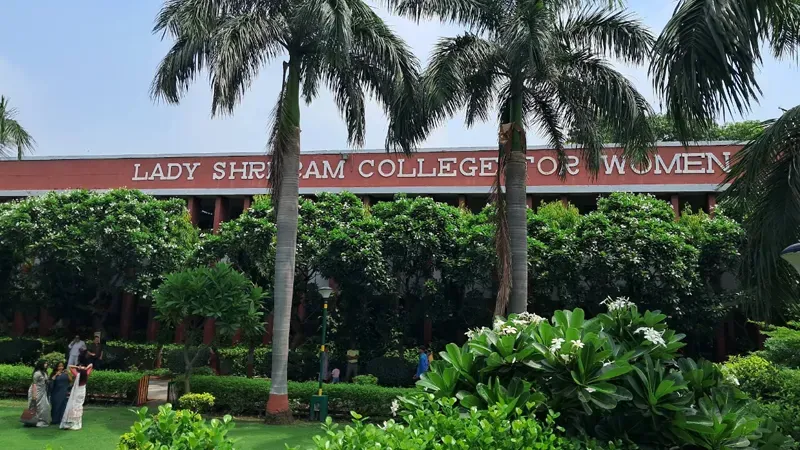
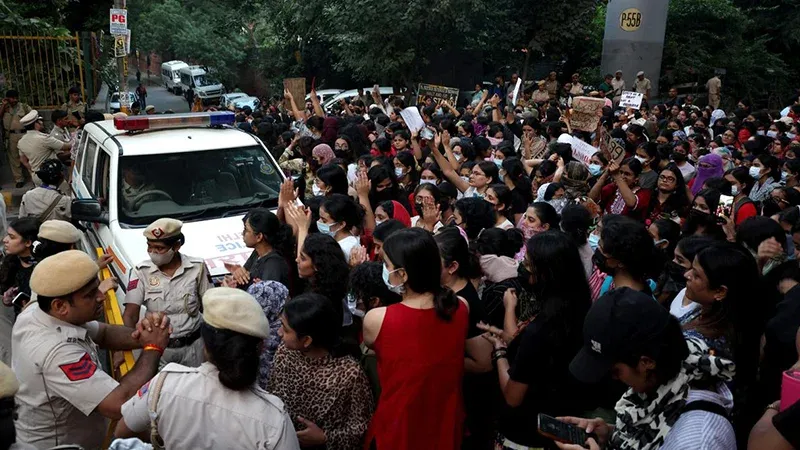
When the news of the assault and the shooting spread through Delhi University WhatsApp groups and Instagram stories on 22 September, Lady Shri Ram suspended in-person classes around noon that day and taught online on 22 and 23 September.
Principal Kanika K. Ahuja said student safety was the priority.
A teachers' strike on 23 September also kept staff away. Offline classes resumed on 24 September, and the college later set up a student security council to talk to police.
Students treated the closure, the DDA's new evening gate limits, and calls from parents to paying-guest owners as one pattern.
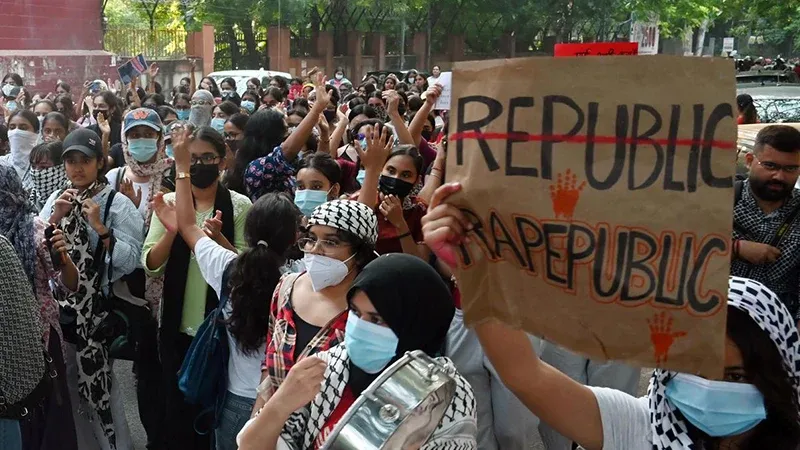
Marches followed: a solidarity walk from the college on 23 September, a Kamala Nehru and Gargi march to Arun Jaitley Park on 25 September under the banner "Hum Auratein Azaad Hai", and a nearly two-hour march on 28 September from Miranda House to the Faculty of Arts. Placards read "Curfew for Rapists, Not Women," "Thank you for online classes, we'd prefer safe roads," "Rapist ko andar karo, ladkiyon ko nahi" and "Beti ki location nahi, bete ka intent check karo", and "Girls just wanna have fundamental rights."
One slogan, "Ek kachori, do samosa, in mardon ka kya bharosa" was heard at Lady Shri Ram College for Women (LSR) protest, clipped and reposted enough that the student who raised it was interviewed about the harassment that followed the clip.
Hundreds of women walking off campus shouting "We want justice."
The internet did not invent this case.
What it did was carry the FIR language, the encounter video stills, the slogans and fragments of the students' protests from one phone to another. Within hours, material that had begun as police records, witness accounts and reports from Delhi media was being reposted through university WhatsApp groups and Instagram stories. Some of it was information. Some of it was protest. Some of it was simply a clip detached from its original context.
That circulation mattered because the story did not remain confined to Aastha Kunj Park. It moved onto the LSR campus, into student marches and parents' conversations, and eventually into the courtroom. On 28 September, Justices J.B. Pardiwala and K. Vinod Chandran opened In Re: Recent Rape Incidents in Delhi NCR on their own motion, with the Aastha Kunj case among the incidents before the court.
The institutional response followed the same rapidly widening trajectory.
On 23 September, the Lieutenant Governor ordered a safety audit of Delhi's parks. The next day, the DDA promised cameras, floodlights, more guards and night bike patrols within seven days, while limiting evening entry to selected gates. Delhi Police sent women officers and vans to the college.
On 30 September, Chief Minister Rekha Gupta said restrictions should not fall only on girls.
But for the students who walked out of LSR, the issue was never simply what happened on one bench inside one park.
It was what had been allowed to surround it: dark stretches, weak surveillance, complaints that had not produced enough action, and a public space that could be difficult to monitor even when it was technically open and staffed. The protests turned those details into slogans; social media turned the slogans into clips; the clips carried the story far beyond the park.
And that is the defining feature of the case, as story around them moved at the speed of the internet.






















































































































































































































































































