Presidents, as the heads of state, are the highest-ranking officials in a republic—entrusted with representing national unity, upholding the constitution, and steering the course of government policy and diplomacy.
They often serve as the face of the nation, both domestically and internationally, and typically function as both the head of state and the head of government. In this dual role, they wield significant authority over domestic and foreign affairs, command the armed forces, and possess the power to enact or veto legislation.
As the most prominent figure in the nation, the president becomes a living symbol of the country’s values, aspirations, and political direction.
For this reason, security is not just a necessity—it is a constant priority.
Among all the presidents across the globe, the President of the United States stands out as the most heavily protected, intensely scrutinized, and undeniably influential, reflecting the immense power and responsibility that come with leading one of the world’s most formidable nations.

Whenever the president travels, security is an absolute priority. So central is their presence that every mode of transportation they use carries the distinguished name "One".
Air Force One, Marine One, Army One, Navy One, Coast Guard One and Executive One, the "One" signals not just the president's importance, but the layers of protection and protocol that surround the commander-in-chief.
Motorcade routes are kept tightly under wraps, and any premature disclosure about a presidential trip aboard one of the Air Force airplanes can prompt the Secret Service to cancel the visit altogether.
This time however, something went unnoticed for quite a long time.
The Chronicle alerted the Secret Service to a troubling discovery: a government document containing detailed information about the Air Force planes.
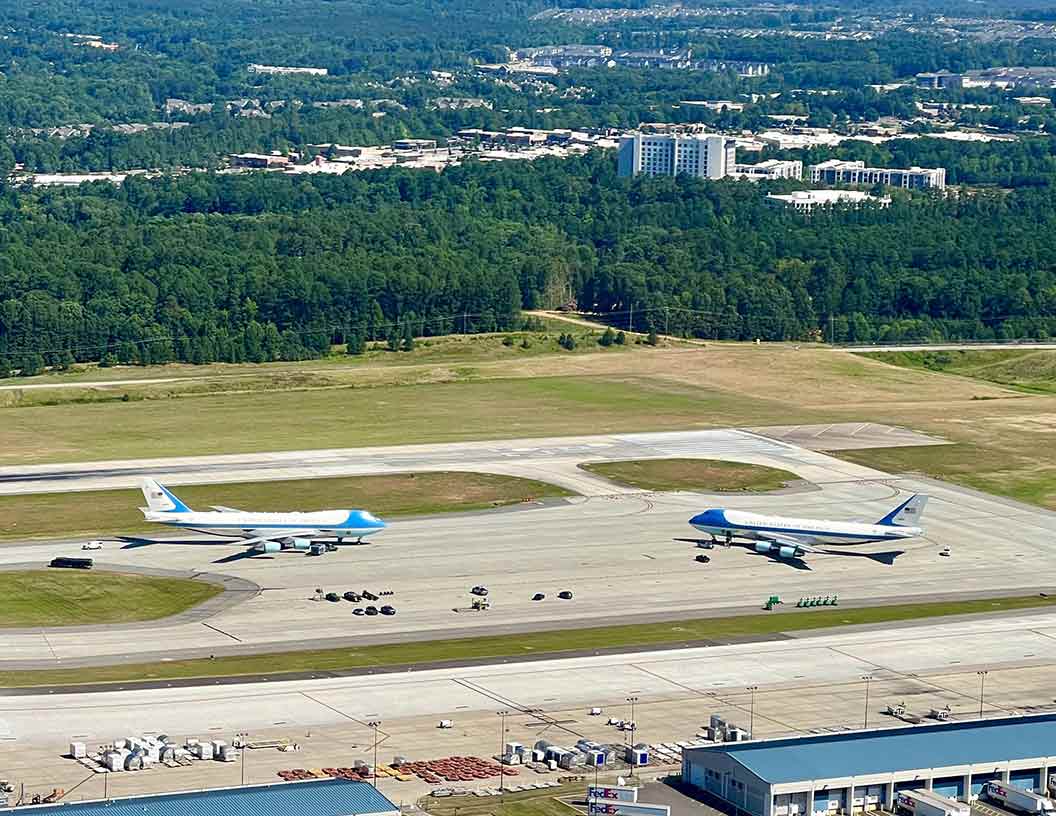
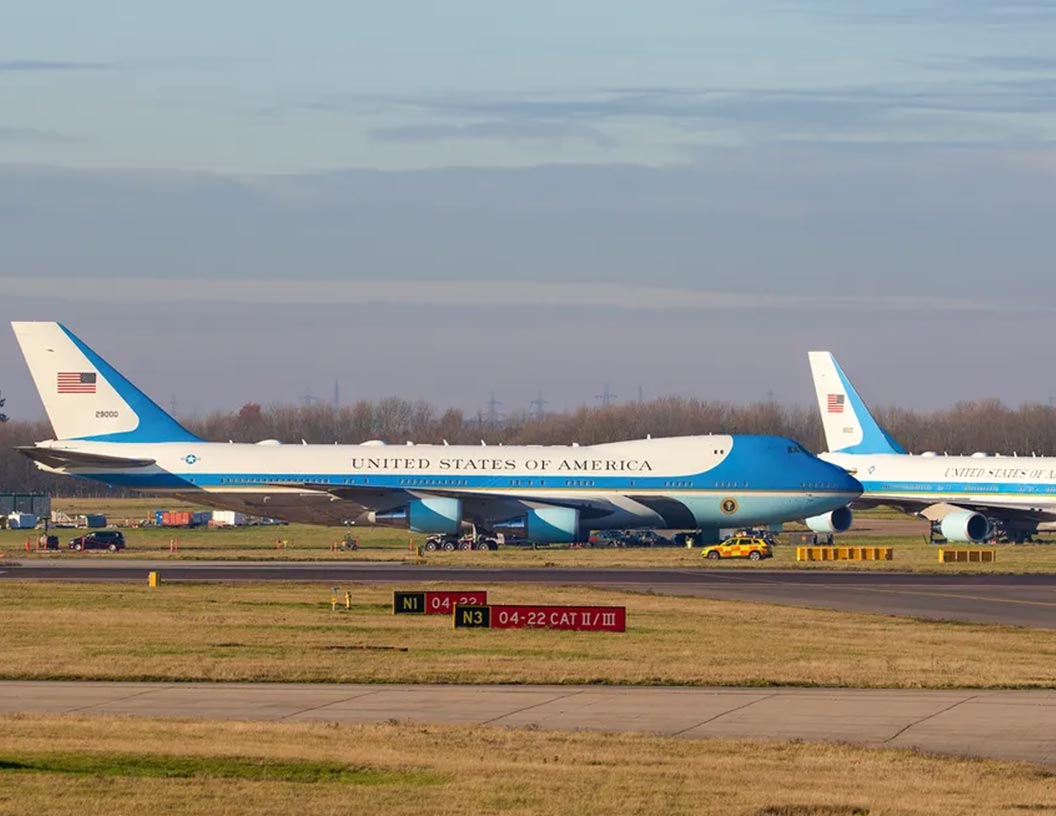
The United States operates two specially modified Boeing 747-200B aircraft, officially designated as VC-25A.
These aircraft, known affectionately as “The Flying White House,” serve as the primary air transport for the President of the United States. Outfitted with cutting-edge communications systems, defensive countermeasures, and a secure onboard command center, they ensure that the president can safely govern—even while thousands of feet above the ground.
The leak in question involved a document titled Air Force Technical Order 00-105E-9 – Aerospace Emergency Rescue and Mishap Response Information (Emergency Services), Revision 11.
This technical manual provides interior layouts and emergency response details for a variety of critical U.S. Air Force aircraft, including the:
- E-3 Sentry (30/35).
- E-4A/B “Doomsday Plane”.
- E-6B Mercury.
- EA-6B Prowler.
- E-8C Joint STARS.
- E-9A Widget.
- YAL-1A Airborne Laser.
- And notably, the VC-25A (Air Force One).
The intent behind the document was entirely practical and safety-focused—to inform firefighters, paramedics, and emergency personnel about each aircraft’s unique hazards, internal layout, and structural materials, so they can execute rapid rescues in the event of a crash or emergency.
However, what raised eyebrows was that this same manual also included specific information about onboard defensive systems—such as the VC-25A’s anti-missile countermeasures.

It also shows the interior layouts, which include the sitting positions of Secret Service agents while onboard.
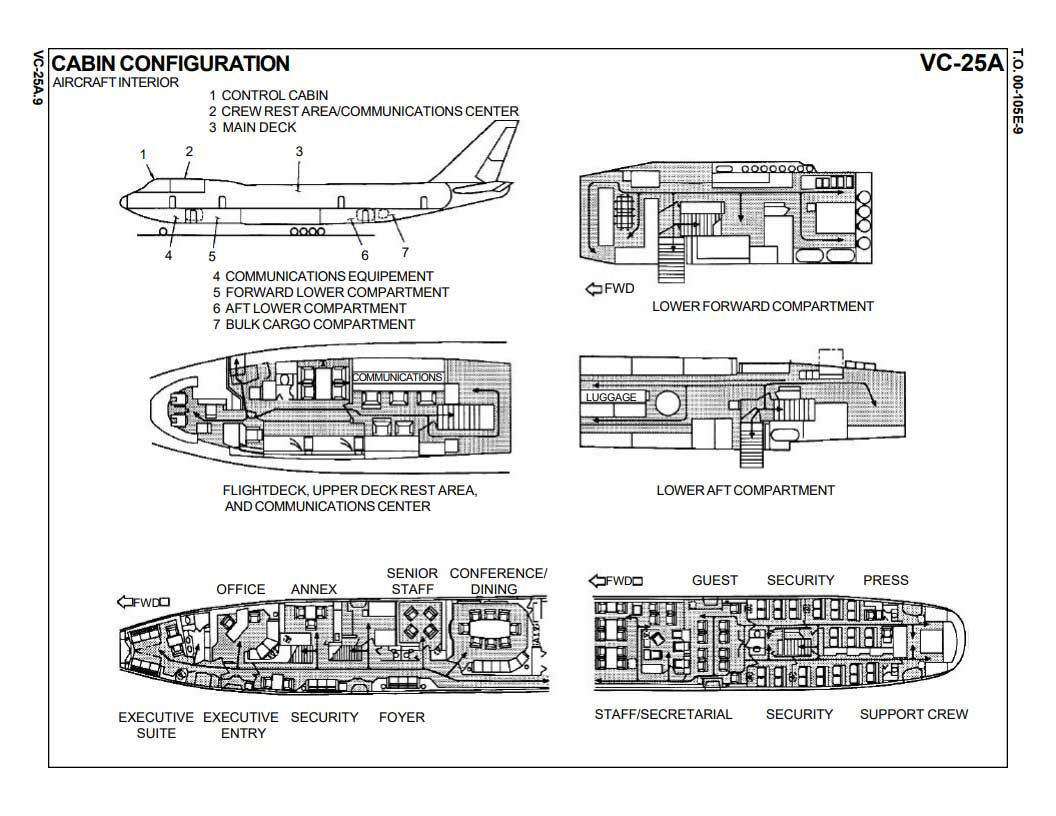
The document reveals where anyone armed with a high-powered rifle could potentially detonate the oxygen tanks that supply the Air Force planes.

The inadvertent release of this information raised serious concerns about operational security.
Experts noted that such details could potentially aid adversaries in planning targeted attacks. For instance, knowledge of the aircraft's countermeasures could allow for the selection of more effective weapons or attack strategies. Additionally, the document's inclusion of interior maps and the locations of critical systems highlighted potential vulnerabilities that could be exploited.
While the document was intended for emergency response purposes, it was publicizing more information that what the public think is necessary.
People commented that the exposure underscored the importance of stringent information security measures, especially concerning assets as critical as the Air Force planes.
The Secret Service declined to comment on the security breach, even when the information is clearly available to anyone with an internet connection.
"It is not a good thing" for that information to be in the public domain, said Lt. Col Bruce Alexander, director of public affairs for the Air Mobility Command's 89th Airlift Wing, Andrews Air Force Base, which operates the presidential air transport fleet. "We are concerned with how it got there and how we can get it out. This affects operational security."
Information about Air Force One's anti-missile systems is considered particularly sensitive.
"Having information about a target's countermeasures does two things," said Daniel Goure of the Lexington Institute. "It gives you an opportunity to choose a different weapon and to choose a different attack style ... perhaps choosing to launch a salvo attack, or choose a missile that uses an active beam."
"It is tough enough for the Secret Service to do its job without this," said Leon Panetta, former chief of staff to President Bill Clinton, who now runs a public policy study center at California State University at Monterey Bay. "If I were still chief of staff, I would order the damned site (to) pull it down."
It’s worth noting, however, that the so-called “leaked” document had in fact been cleared for international public release years prior.
Take, for instance, the interior blueprints of the VC-25A. While they show the layout of the aircraft, it's hardly surprising that Secret Service agents would be stationed near the President’s suite, and also in the vicinity of the press, who are known to be seated toward the rear of the aircraft. In truth, this type of information would be critical for emergency responders—helping them know where to look for people in the event of an accident.
As for the plane’s defense systems, their existence is no secret. It’s well-known that Air Force One employs infrared countermeasures (IRCM) to defeat incoming surface-to-air missile threats. The document simply notes the locations of the infrared emitters—on the tail and near each engine pylon. This information is included not to give away vulnerabilities, but to protect first responders. These IR systems emit invisible radiation that can cause injury if someone unknowingly walks too close while they are active.

Regarding the oxygen tanks, while it’s true that they could be dangerous if punctured, it’s rather unlikely that anyone would ever be able to target them in mid-flight. And if a terrorist ever managed to get that close to the President near the aircraft, the obvious target would be the President—not the oxygen tanks.
And lastly, if the goal was truly to bring down the aircraft, aiming at the fuel tanks would be a much more effective strategy. These tanks are already common knowledge to anyone familiar with the Boeing 747-200, and they are strategically located throughout the wings, fuselage, and tail for structural balance and safety. Again, this knowledge is shared in the document to aid rescuers—so they can quickly shut off valves and reduce the risk of a post-crash fire or explosion.
In other words, information contained inside this document s is neither sensitive nor classified, despite how dramatic some of the reactions may have seemed.






















































































































































































































































































