Magnetic tape data storage is a way for storing digital information inside a magnetic tape through digital recording.
This medium was the primary data storage in early days of computers. At that time, the magnetic tape storage typically used large open reels of 9-Track tape. This is different than modern magnetic tapes that are mostly packaged in cartridges and cassettes.
In the era where data is abundance, there needs to be a way to store more data, in a smaller-sized medium as possible.
While there are various medium to store data in this modern day of computing, magnetic tape technology somehow managed to withstand the test of time.
The technology has long been the preferred means of storage for companies handling massive volumes of information. In addition to increasingly large storage capacities, magnetic tapes are also cheaper than hard drives. And unlike hard drives, magnetic tapes don't require continuous source of power.
And in addition to that, data inside magnetic tapes are also less vulnerable to cyberthreat attacks because the data can be made physically separated from the data network, and therefore capable for being stored in a more secure environment (air gapping).

In the modern days of computing and internet, humans produce at least 2.5 quintillion bytes of data on a daily basis, mainly due to the continuous rise of the Internet of Things (IoT), the emergence of high-definition 4K/8K videos and AI-based big-data analyses, IBM said.
Knowing that data storage requirement is increasing and knowing that magnetic tapes can handle that massive growth of digital data, the relatively old technology is still under continuous development.
And here, IBM managed to create a magnetic cartridge that has the most dense storage capacity than anything in the world at this time.
Partnering with Fujifilm, the companies managed to stockpile more data in a smaller space, leading to the creation of a magnetic tape, capable of storing 580 terabytes of data.
In comparison, storing 580 terabytes of data would require 86,977 CDs. Stacking them all up, would make them taller than the world's tallest building, the Burj Kalifa in Dubai, UAE.
Another comparison, is storing books from the modern history. According to a research by software engineer Leonid Taycher, there are around 130 million books in modern history. Assuming that 1 book equals to 1MB, the 580 terabyte magnetic tape can store all of those printed human knowledge in the form of data, with rooms to spare.
The companies managed to reach this feat, using a material known as strontium ferrite.
This SrFe12O19 (SrO·6Fe2O3) material is known as 'hard ferrites', meaning that they have high coercivity and high remanence after magnetization. This makes strontium ferrite resistant to becoming demagnetized, have a high magnetic permeability, and cheap.
This is why in the past, strontium ferrite has been used in small electric motors, microwave devices, and other devices in the telecommunication and electronic industry.
Knowing that strontium ferrite is a chemically stable oxide, "suggesting expectations of excellent performance in long-term data storage," wrote Fujifilm on its own website post.
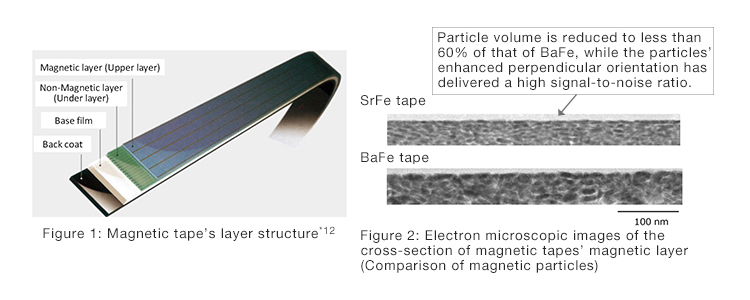
Here, the IBM-Fujifilm partnership was able to create nano-sized strontium ferrite particles by manipulating the addition of trace elements and blending materials more efficiently.
Packing huge amount in a smaller space, strontium ferrite can be bundled at 317 billion bits per inch to create the 580 terabyte drive.
But it is not just the smaller particle size that is responsible for the new cartridge's massive potential. The team at IBM and Fujifilm also designed a low-friction tape head with precise positioning management that enables accuracy in data reading.
IBM's Advanced Tape Technologies Manager Mark Lantz wrote in a blog post:
Although it may take many more years before this strontium ferrite-based magnetic tape is manufactured at a large scale, the invention is indeed paving a safer future-proof data storage.
With its capacity and reliability, IBM is certain that strontium ferrite-based magnetic tapes can be the storage solution for hybrid clouds "for decades to come."
Knowing that using strontium ferrite would increase the capacity of a magnetic tape, the material would replace barium ferrite, which has been used as a tape component for more than a decade. In the past, barium ferrite, which as a density of more than 123 billion bits per square inch, is used in 220 terabyte drives.
The very first material used to make magnetic tapes, was ferric oxide particles glued to long metal strips.
This led to German engineer Fritz Pfleumer in inventing the first magnetic recording tape in 1928. Magnetic tape was first used to store computer data on the UNIVAC I in 1951.




















































































































































































































































































