As smartphones became nearly ubiquitous around the world, a new kind of business flourished. In particular, digital payment apps turned everyday transactions into something that happened in seconds.
The result of this is that money moves from one party to another, flourishing outside the formal banking system.
In China, a trend emerged.
Students who needed money for tuition top-ups, living expenses, or small businesses hoped that they could get the funds they needed when traditional banks turned them down. Many of these people lacked an employment history, property, or the kind of credit records that state institutions recognized.
Into that gap stepped a rapidly expanding world of peer-to-peer (P2P) platforms and informal lenders, promising money within minutes through apps and chat groups.
What started as a convenience for some quickly became a trap for others, particularly young women, when the only collateral certain lenders would accept was not a guarantor or a future salary, but photographs and videos of the borrowers themselves, naked and holding their national identity cards.
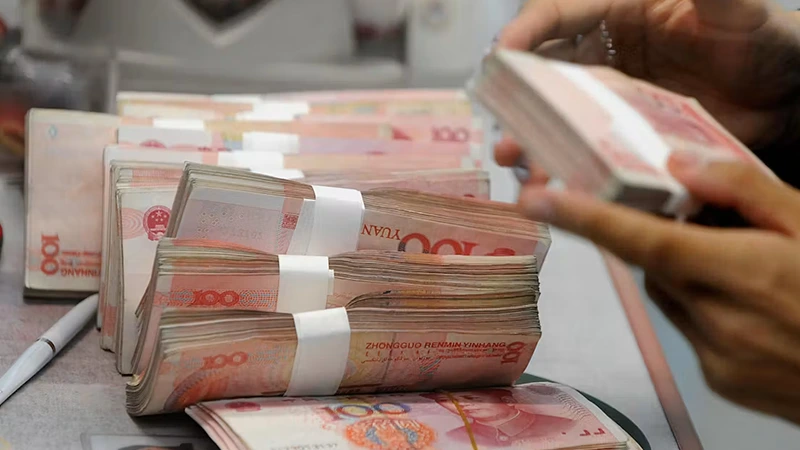
The practice did not appear overnight.
China's shadow credit market had already grown enormous by the mid-2010s, with the International Monetary Fund (IMF) later estimating its overall size in the multi-trillion-dollar range and peer-to-peer platforms alone handling tens or hundreds of billions of dollars in volume across thousands of operators.
Formal credit coverage remained thin for hundreds of millions of people, including students, rural migrants, and those without stable jobs.
Whereas banks preferred safer borrowers, some of the blooming online platforms positioned themselves as simple matchmakers.
They required borrowers to register with their real identities, needing no lengthy policy or contract to read.
As a result, money moved quickly.
But in that environment, some lenders worked individually. They remained relatively anonymous, often operating through QQ groups and WeChat rather than the platforms' official interfaces.
Realizing their advantage, they began asking for explicit images of the borrowers and utilizing them as the most effective form of leverage available.
While the idea of asking for nude photographs as informal IOUs was not new in underground lending circles, the method of the so-called "nude loans" (luò dài) had existed for years among private loan sharks who dealt with people already deep in debt.
What changed here was that digital channels allowed both convenience and exposure.
Borrowers were typically required to send clear photographs or short videos in which they appeared naked or partially undressed while holding their Chinese resident identity card.
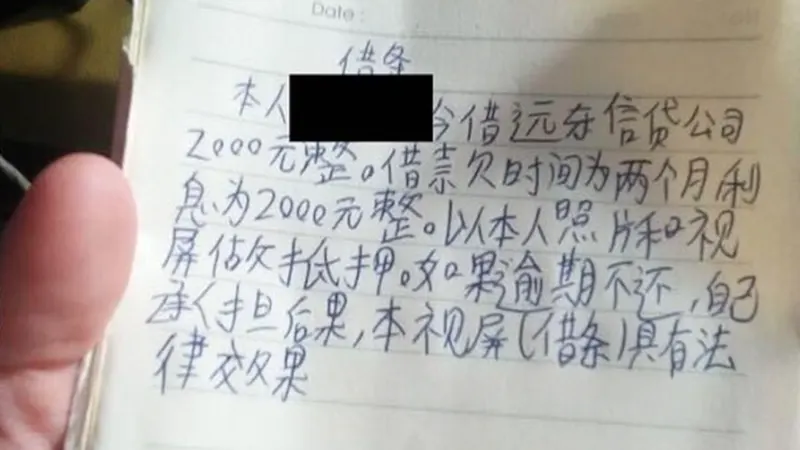
Some notes written on paper and held in the frame spelled out the loan amount, the interest rate, and a statement that the images served as collateral and would be considered binding.
Additional documents were often demanded: student identification, family contact lists, home addresses, university enrollment records, and sometimes even phone service passwords or Alipay details.
In return, the available loan amounts rose significantly, often two to five times what a lender would otherwise offer, with reported ceilings around 15,000 yuan or higher for those at better universities.
Interest rates were routinely described as 15% to 30% per week, far above the roughly 24% annual ceiling that applied to formal personal loans.
Repayment windows were short, frequently a matter of days or a few weeks.
Because the rates compounded so aggressively, a few hundred yuan borrowed for an emergency could rapidly become tens of thousands.
As a result, many fell as victims.
Some of the victims were even locked into cycles of new loans when more urgent issues like abortions, everyday expenses, or medical bills arose, spiraling them into even higher interest obligations.
In this scenario, debt spirals were common.
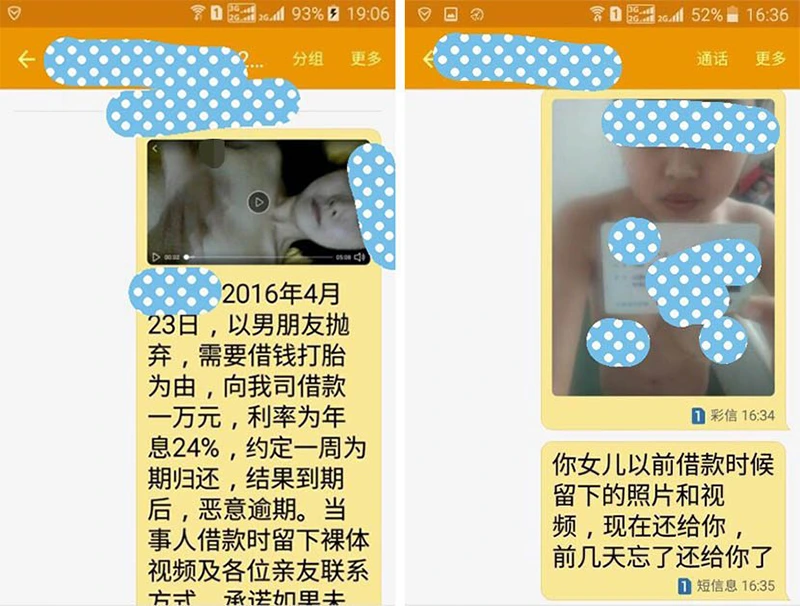
When borrowers could not keep up, the consequences escalated in predictable ways.
Lenders threatened to publish the images on social media or in group chats, to send them directly to parents, classmates, or university counselors, or to sell the material as pornography.
In some documented cases, the demands went further.
Women who fell behind were pressed for additional explicit videos, including ones in which they had to masturbate on camera. Some were even asked for sexual services as a method of repayment.
One lender arrested in Gansu in early 2017, reportedly had used the photographs to coerce at least three women into sexual repayment; police found extensive collections of such material on his phone after a victim came forward.
The full scale of the practice became harder to ignore after a roughly 10 gigabytes archive circulated online in November and December 2016.
The files contained photographs, videos, chat logs, and identity documents linked to at least 161 and as many as 167 young women, the large majority being college students between 17 and 23 years old drawn from provinces across China.
Alongside the images were detailed personal dossiers that included national ID numbers, student records, family addresses, phone numbers, and in some instances passwords.
Certain notes in the material explicitly stated that the photographs and videos would serve as collateral and that non-payment would make the images legally binding in the lenders’ view.
Some women had also agreed, under pressure, to provide further sexual content or services if they defaulted.
The dump was widely linked in public discussion to activity connected with Jiedaibao, although the company stated that the transactions themselves had been arranged offline through social messaging apps and that the platform had only processed the money transfers.
It denied storing the images, froze certain accounts after the leak, and later announced it would halt collection efforts against the affected women and restrict lending to anyone under 23.

Public reaction on Chinese social media was intense, and police action followed in at least some instances.
This kind of scandal was one of several others that contributed to the eventual, far more comprehensive crackdown on China's entire peer-to-peer lending industry.
By 2020, regulators stated that the operating P2P sector had effectively been reduced to zero after years of fraud, defaults, and unregulated growth.
What began as an informal enforcement tactic in a credit-scarce environment, where public humiliation and personal leverage substituted for reliable courts and credit bureaus, had by 2016 become a visible system that extracted both money and explicit images from students who had few other options.
The combination of extremely high weekly interest, short repayment periods, and the permanent nature of digital photographs meant that missing a payment rarely ended the obligation.
Instead, it often deepened it, transferring control of intimate images and personal information into the hands of lenders who faced little immediate risk of formal sanction.
The 2016 reporting and the subsequent leak made the mechanics public, but the underlying conditions (thin formal credit for young people and the rapid growth of lightly supervised digital lending) had made the practice possible long before the first headlines appeared.






















































































































































































































































































