Foxconn is a Taiwanese multinational electronics contract manufacturer, with its headquarters located in Tucheng, New Taipei City, Taiwan.
Established in 1974, the company is amongst the Fortune Global 500, and considered one the world's largest technology manufacturer and service provider. While headquartered in Taiwan, the company is the largest private employer in China. There, Foxconn is largest assembly plant for a number of devices.
They include BlackBerry, Nokia and Kindle devices, as well as Google Pixel devices, and Xiaomi devices.
It's also the place where Sony assembles its PlayStation gaming consoles, Nintendo consoles, Microsoft Xbox, and more.
It's also Apple's largest assembly plant for assembling iPad, iPhone, iPod devices.
As China continues to pursue its zero-COVID-19 policy, a COVID-19 outbreak in Foxconn's biggest assembly plant in Zhengzhou, China, is causing thousands of people to flee the city in an exodus-like manner.
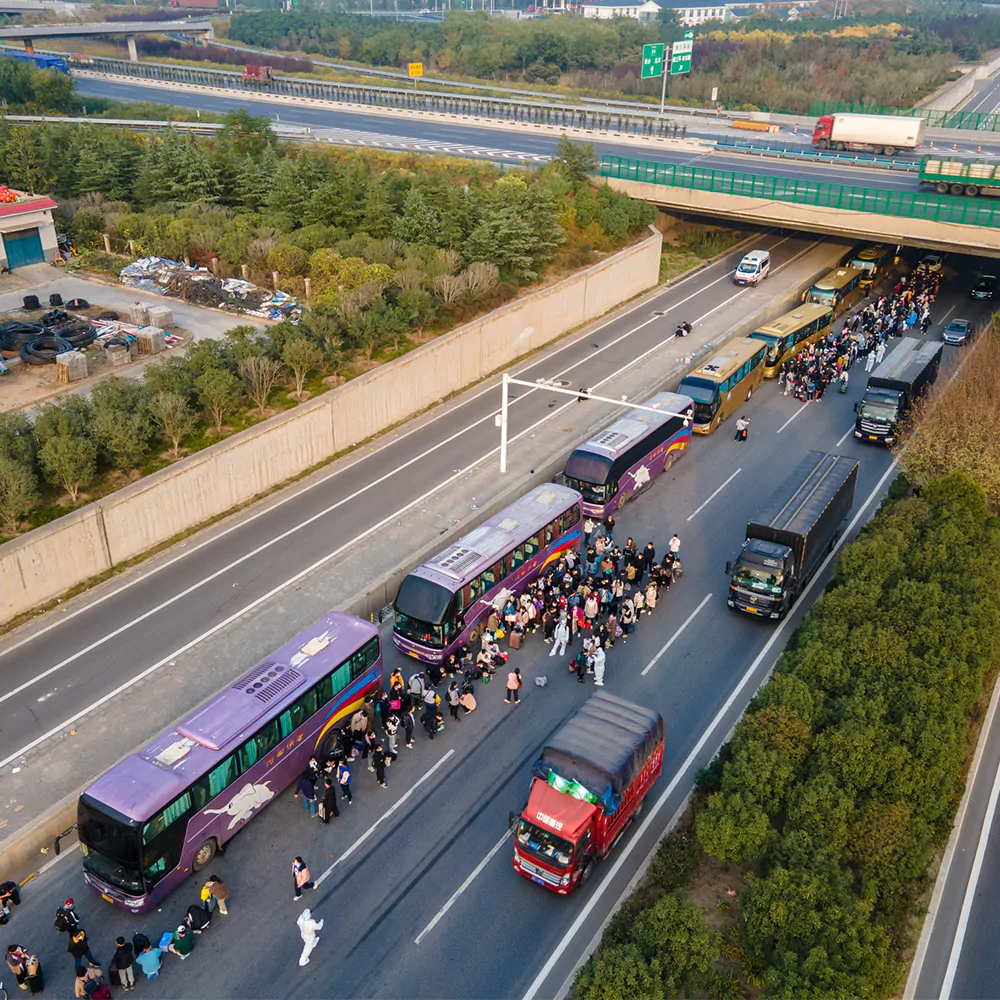
Soon after the news, many of Foxconn's employees packed their belongings to return home to where they came from.
To prevent unrest and chaotic migration, the authorities at Zhengzhou authorities, as well as Foxconn, promised that the people migrating home would get transportation.
"Please stay where you are. The staff and vehicles will contact and serve you as soon as possible," read one of the many messages.
The authorities have set several pickup points where people can gather.
The thing is, not everyone followed the suggestions
Quickly, the commotion was caught by internet users, who uploaded many photos and videos of Foxconn employees trying to find a way home.
Videos on social media show thousands of people walking on the highway or getting rides on open trucks. Other people from surrounding areas have come out to help the Foxconn workers by giving them free food and water.
"They were Foxconn employees who escaped from the factory and were walking home," wrote a user of WeChat in a post about the social media images.
"Some people walked amid wheat fields with their luggage, blankets, and quilts. I couldn't help but feel sad," another use said.
In anticipation of the migrant workers returning home, many surrounding cities have communicated their COVID-19 prevention and control measures.
Like most places in China, a seven-day quarantine is mandatory when one returns from a medium-risk area like Zhengzhou.
It all began on October 19, when Foxconn started banning employees from eating in canteens, ordering them to eat in their dormitories instead.
This happened after several new locally transmitted cases were reported that day in the city of nearly 13 million people.
In the following days, more and more people tested positive, and this worried the government.
Particularly, online rumors said that the epicenter of the new outbreak happened around the Foxconn factory.
On October 26, Foxconn issued a statement rebuking the rumors.
However, officials refuse to provide more details, nor give additional information on the number of positive cases inside the factory.
In the end, Foxconn put out a statement saying there are no factory cases. But the statement came a bit too late, because the panic already seemed to spread.
Most Foxconn workers are migrants who share small dormitories with their co-workers.
Videos that spread on social media show that the fear of being locked up for an unknown duration, food and water shortages, and lack of health care, forced them flee the city using any means necessary.
China is among the places where strict rules regarding COVID-19 still applies throughout its many cities.
Since the start of the pandemic in late 2019 and early 2020, numerous places have been put under strict lockdown measures that can easily stay in place for months. Earlier this 2022, residents of Shanghai were confined to their homes for months.
Earlier, Shanghai which had only a few dozen cases was labelled "medium-risk areas."
An area is labeled medium risk if a person infected with COVID-19, symptomatic or asymptomatic, lives in the area or passes through it.
All people living in that area are required to stay within their own residential area, and, in most cases, are subjected to daily COVID tests. If no new infections are found in the relevant area for seven consecutive days, the label shall lowered to "low-risk."
Zhengzhou is often referred to the "iPhone City" by its locals, considering that =half of the world's iPhones are produced there.
The city in southern China, which is also near Hong Kong, is also the home to tech giants such as Huawei and Tencent.






















































































































































































































































































