People scrolling their feed have the tendencies of seeing clips they did not search for.
In this case, a video of someone alone in a building must mean that the building should be empty. The lights are on, nothing suspicious. The thing is, an object that has no business, moves closer and closer.
Soon, the comments fill with people saying they will not look away from the screen, which is exactly the wrong instinct.
That is how a six-minute Dutch short from 2024 has been traveling again.
After festival dates that began at Grimmfest in Manchester and continued through Imagine in Amsterdam, Molins in Spain, Dunwich in England, Austin, and Island of Horror, the film landed on the Final Girl YouTube channel in early August.
In about seven weeks the official upload has passed hundreds of thousands of views, with clips of it have been hopping across social media platforms.
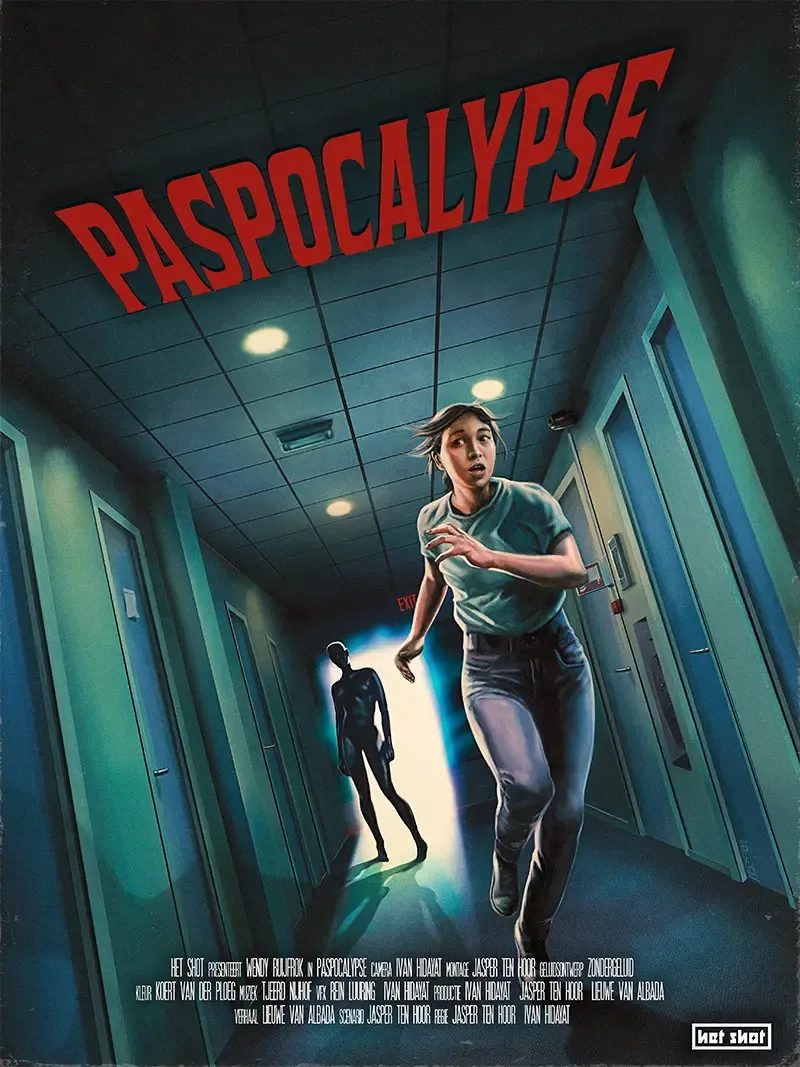
The short is called Paspocalypse.
Jasper ten Hoor and Ivan Hidayat directed it for Het Shot on an estimated budget of €1,500. Wendy Ruijfrok plays Tina, a cleaner on a late shift in an empty office.
There is almost no lore. There is almost no set dressing beyond what an empty workplace already contains.
It begins with Tina arriving at an office complex. She walks through the lot and glances at a mannequin standing oddly near the loading dock. She shrugs it off and starts work.
The night still feels ordinary. She moves through the rooms with an easy rhythm and treats the job as something she can still enjoy, except the dirty toilet.
When she goes outside to throw out the garbage, the mannequin is no longer at the dock. It is much closer now, standing in the middle of the lot. She does not notice.
She keeps working until a silhouette startles her in the hallway.
She takes it for a person. She turns on the light and finds a mannequin. She shrugs, puts it in a storage room, and goes back to work. Later the figure is in the hallway again. The storage door is open. In the brief moment her eyes leave it, the mannequin has moved several meters closer, into her space.
She steps back, trying not to look away, and her back hits the doorframe. The instant her eyes leave it, the figure moves again, this time only inches from her face.
She runs downstairs to get out and finds the main doors locked. She looks back. The mannequin is there again, keys in its hands. She takes the keys without looking away, opens the doors, and shuts them behind her. In that brief turn the figure is already right there on the other side of the glass door.
The entrance is a vestibule. Past the second set of doors the lot is full. Outside the building, thousands of mannequins stand waiting, frozen, as if they are only holding still until she looks away.
The video went viral because the mastery in how little the film explains.
Minimal props and a sparse backstory do the work that bigger productions try to buy with lore dumps and creature design. Unexplained movement is the whole engine.
Viewers never get a clean look at why the figure advances, only the fact that it does, and that it seems to wait for the moment they blink.
Ambient unease does the rest: earbuds, a song that does not belong in that hallway (the song she listens to, You're Feeling Popular, repeatedly uses the word "pop," which is Dutch for "doll"), the sound of a building after hours. The production was even recorded without live sound. The designer built much of the mix in post, using a mannequin itself as an instrument.
That choice makes the space feel wrong in a way that dialogue never could.
Lingering questions do more damage than answers would.
What kind of office is this? Why this woman? Why a nude dummy instead of something with a face she can read? What happens after the last shot, when the geometry of the building and the number of figures no longer add up?
The short is only six minutes, so it refuses to close those doors.
The same logic drives Don't Look Away, in which in the 2023 film, a person can only advance when nobody is watching it. Look at it and it freezes. Eyes of it even for the brieftest moment, or glance at a phone and it closes the distance.
But most notably, it was Doctor Who's Blink that made that idea famous with statues called the Weeping Angels.
Paspocalypse doesn't invent the idea, but only works with the same nerve with less explanation.
There is no cursed crate, no spoken rule, no expert who arrives to name the threat. The figure simply moves when Tina is not looking, and the office becomes a place where looking away is fatal.
Virality here is not a mystery either. A cheap, clear image travels.
A woman running from something that should be furniture is easy to clip, easy to caption, easy to send at 1 a.m.
The Indonesian co-director gives the piece an extra hook for regional accounts.
Festival hardware gives it permission to be taken seriously. The rest is the oldest trick in low budget horror: leave the motive blank, keep the movement slightly off, and let the audience finish the sentence in their own building after the lights go out.
In other words, Paspocalypse is a way of saying the idea is old and the execution is tight enough that it still works.






















































































































































































































































































