Attempts to break land speed records are nothing new, and these happened since the dawn of the motor car.
In the modern days, supercar and hypercar manufacturers are always about numbers. They boast horsepower, torque, lap times, acceleration and top speed, as their achievements.
As for top speed, it involves quite a lot of criteria, and is considered the peak of automotive engineering.
For example, achieving the highest speed possible for a production car involves not only a high number of horsepower and torque, as it requires a greater power-to-weight ratio, gear ratio, a car's design that minimizes drag coefficient, capable suspension and chassis and more.
And of course, a capable driver.
Since the year 2000, the first fastest production cars that surpassed and dethroned the undisputed McLaren F1, was the Bugatti Veyron EB 16.4, capable of achieving 408.47 km/h (253.81 mph) top speed in 2005. This was followed in 2010 by Bugatti Veyron 16.4 Super Sport with 431.072 km/h (267.856 mph). Then in 2017, the Super Sport was surpassed by Koenigsegg Agera RS with 447.19 km/h (277.87 mph) speed record.
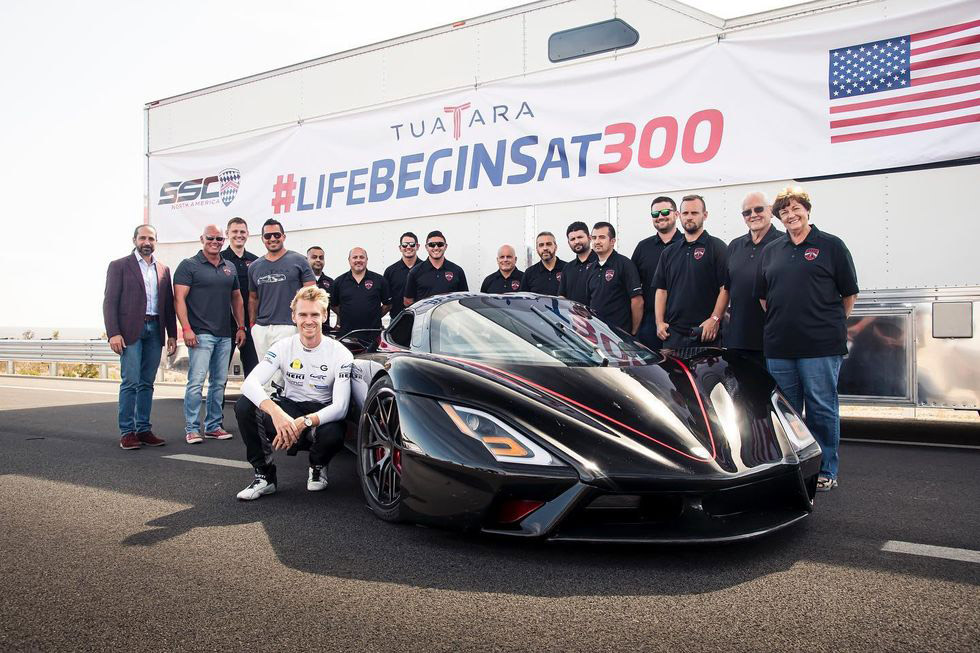
And this time SSC Tuatara, manufactured by SSC North America, attempted to break the speed record.
But the attempt was disputed, and not recognized as the fastest because of many reasons.
And it was a number of internet users that helped uncover some of the inconsistencies.
They have been raising questions about the legitimacy of SSC Tuatara's claim as the “world’s fastest production car”, after video footage of the car reaching a two-way average speed of 508.73 km/h (316.11 mph) on a closed strip of state highway just outside of Las Vegas, Nevada, failed to correlate with the company's claims.
First of all, the only GPS system responsible for verifying the telemetry has not been validated by the producer. And this GPS data appeared to show the car moving before the car even moved.
Second, the car has not been homologated for road use, meaning that during the run, the car was not street legal.
Third, the footage had a helicopter, an Airbus H125, which doesn't have the ability to safely surpass 200mph, where in the video, it did in order to keep up with the Tuatara.
After that, internet users with the knowledge about the field, analyzed SSC's video footage, applied some mathematics relating to the car's drive ratios. The mathematicians said that the true top speed of the SSC Tuatara was around 250mph, rather than the 331.15mph touted by the clip.
A number of prominent Youtubers in the automotive field have also broken down the video and helped publish some of the inconsistencies for the public to hear.
To explain the situation, SSC’s founder and CEO, Jerod Shelby, released a statement explaining that there had been a mix-up between the video and GPS data when the clip was edited together.
He said that after he and his team re-watched the raw video files of the attempt, they too “were seeing the same doubts.” He continued, saying that: “we were seeing different speeds for the very same run – and the more we looked and the more we tried to analyze, the more we were concerned there were doubts in the relationship between the video and the GPS.”
For this reason, the company will retry the attempt in “the very near future.”
Then there was the issue about the GPS tracking device SSC used.
At the time, SSC said it used 15 satellites and the Austrian company Dewetron to record the attempt. But after the run was published, Dewetron stated that it had no official involvement in the record.
Shelby again offered a solution in his statement, saying that the next attempt will be performed under the watchful eye of “multiple GPS companies”, with representatives from each brand on-site to make sure the attempt is recorded as accurately as possible.
It should be noted that the 'unofficial' title for the fastest production car at this time, is held by Bugatti Chiron Super Sport 300+.
The car didn't make the official list because it was a pre-production Chiron prototype, and was only performed in a uni-directional top speed run.
The Super Sport 300+ had a top speed of 490.48 km/h (304.77 mph).
SSC Tuatara isn't SSC's first attempt to break the land-speed record for production cars. In early 2000 for example, the car manufacturer attempted to break the record with the Ultimate Aero.
SSC first announced the Tuatara back in 2011, before unveiling a production-ready version of the car at the 2018 Pebble Beach Concours d’Elegance. Since its conception, it was designed with one thing in mind: to break the 300mph barrier and crown itself as king of all hypercars.
The Tuatara has a massive 5.9-litre twin-turbo V8 and a free revving flat-plane crank capable of reaching 8,800RPM. The engine pushes out 1,750bhp and 1,735Nm of torque on commercially available fuel.
All of Tuatara's brute power is sent to the rear conventional Michelin Pilot Sport Cup 2 tires through a seven-speed dual-clutch automatic gearbox.
With a body and chassis that are created from carbon fiber, despite its decent interior, the car has a dry weight of only 1,247kg. The hypercar also has a drag coefficient of just 0.279, which is less than both the Chiron and the Agera.
Data from the October 10 run wasn't submitted to the Guinness World Records, with SSC CEO saying that: "I don't believe Guinness would even review the submission due to all the controversy."
"The perfect view I had of this record is now gone," he said.
"And no matter what we do in the coming days to try to salvage this particular record, it's always going to have a stain on it [...] There's just no way to now make this perfect. It hit me: we need to re-run the record. We have to do this again. And do it in a way that it's undeniable and irrefutable. So the next time we do this – and we'll prepare to do it in the very near future – we need to make sure we have multiple GPS companies' equipment in the car. I want to make sure we have their staff on site looking over our shoulders and analyzing every run, every detail of this."
"We’ll run it again, with every backstop in place, so the speeds clocked on the next run are irrefutable." Shelby said.
While nobody is really accusing the company for lying or deception in this case, the incident is more likely be a simple calibration mistake that's been blown way out of proportion due to the extraordinary numbers involved.
But still, SSC is aiming for a world record.
Despite in real life, owners of the car won't likely push the car to even half its top speed, to buyers of these multimillion-dollar toys, prestige is everything.
To the rich, cars like these contribute to their reputation. Shelby knows this, and this is the reason why he is not giving up from those internet disputes.
In January 2021, SSC retried the attempt, and finally managed to break the land speed record.
But rather than going back to the Nevada State Route 160 where the first attempt took place, SSC went to the Johnny Bohmer Proving Grounds at Space Florida's Shuttle Landing Facility.
To qualify for a record-breaking attempt, the Tuatara did two runs in opposite directions. It managed to reach 279.7 mph (450.1 km/h) northbound and 286.1 mph (460.4 km/h) southbound, resulting in an average speed of 282.9 mph (455.2 km/h).
To avoid any validation issues that the company previously encountered, the Tuatara that was owned by one of SSC's customers, was equipped with multiple satellite tracking systems, including two Racelogic VBox systems, a Life Racing tracking system, two Garmin systems, and a trap speed system from the International Mile Racing Association.