Cashless and contactless payments are soaring during the 'COVID-19' coronavirus pandemic and lockdowns.
This can be seen with PayPal's stocking fresh all-time highs in just one day after the company boasted new records for daily transaction volume and monthly user signups.
Stock of the San Jose financial tech company jumped more than 13% on Thursday’s market open, briefly hitting $146.90 per share.
Overall engagement from PayPal users in Austria and Germany reportedly multiplied by two and three times since the start of the coronavirus.
According to CEO Dan Schulman speaking with the finance portal MarketWatch, those numbers have persisted even after lockdown measures have been lifted, saying that April “was probably the strongest month for PayPal” since it became a standalone public company in mid-2015.
“Our view is, we think we are hitting a tipping point across the world where people are seeing just how simple and easy it is to use digital payments to pay for services.”

PayPal processed $191 billion in payment volume during Q1 2020, or up from $161.5 billion from the previous quarter. PayPal‘s peer-to-peer volume accounted for $56 billion, while PayPal's mobile payment service Venmo was up to $31 billion.
While the company's stock price and transaction volume increased, its profit doesn't experience the same thing.
Despite attracting 7.4 million new accounts in the previous quarter, PayPal has proven that it's not immune to the effects of the coronavirus pandemic.
The company earned a net income of just $84 million. According to MarketWatch, this is down from $667 million the company posted in 2019’s equivalent quarter.
Besides PayPal, the financial company Square that was founded by Twitter founder Jack Dorsey, is also benefiting from the coronavirus.
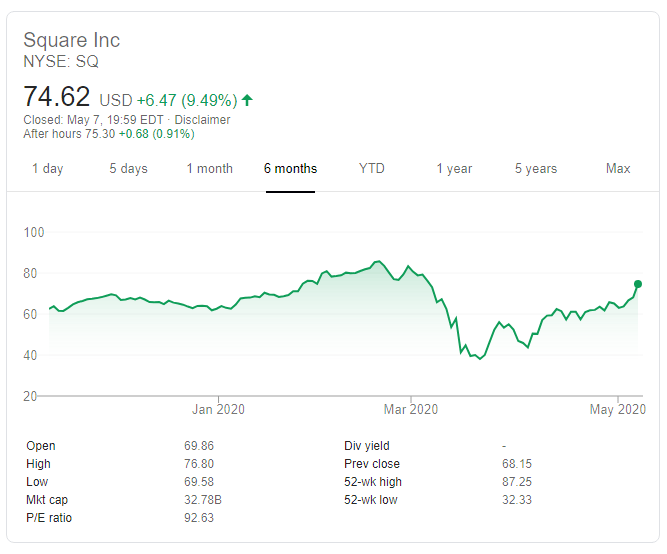
Square, the payments service is also making gains, with its stock price briefly up by more than 12%, right before falling back down to below $76 by midday on Thursday. As for its highest monthly volume of direct deposits, it grew by three times over March.
This happened because a record number of people use Square to raise social fundraising, charitable donations, and online tipping, as well an increasing number of U.S. users who opted to have their coronavirus stimulus checks loaded directly into their Square's mobile payment Cash App accounts.
The total amount of funds stored in Square accounts now exceeds $1.3 billion, up from $945 million last quarter.
“[…] We believe we’re in a transformational moment right now where new commerce standards, new banking habits, new ways of conducting financial services and commerce are taking shape,” said Square Chief Financial Executive Amrita Ahuja.
Square’s profit was $539 million, which is around 36% more than what it earned at the same quarter in 2019, but was still far below the $620.3 million expected by Wall Street analysts.
Square‘s gross payment volume hit $25.7 billion for the quarter, or down by almost $3 billion from Q4 2019.
As for Visa and Mastercard, the two financial services corporations experienced quite the opposite.
Both started just right in 2020. During the first three months of the year, revenue of both companies rose year-over-year. However, as the coronavirus-induced economic lockdown spread to the United States and other markets, both companies said that transaction activities dropped dramatically.
PayPal, Square, Visa and Mastercard have all experienced a sudden drop during the first time the coronavirus declared a pandemic.
But apparently, Paypal and Square were quick in regaining their position as customers get accustomed to living in quarantine and isolation, Visa and Mastercard on the other hand, failed to do so.
Those warnings prompted JPMorgan Chase to cut its estimates on Visa and Mastercard, arguing the coronavirus outbreak has severely impacted travel across borders, particularly in Asia and is slowing down e-commerce sales which will hit their bottom lines.
The Wall Street analyst thinks that both Visa and Mastercard are facing the biggest hit from coronavirus largely because their margins are narrowing.






















































































































































































































































































