GitHub stands as the world's leading platform for software development and collaboration.
As of early 2026, it hosts over 180 million developers worldwide, with more than 36 million new users joining in the past year alone. This is equivalent to roughly one new developer every second. The platform manages more than 630 million repositories, including a surge of over 121 million new projects added recently, reflecting explosive growth in open-source and private code hosting.
This scale cements GitHub's position as the default hub for developers globally.
Millions rely on it daily to discover projects, fork code, contribute via pull requests, track issues, and manage version control through Git. Its integration with tools like Visual Studio Code, GitHub Actions for CI/CD, and extensive marketplace for extensions has made it indispensable across individual hobbyists, startups, and large enterprises, including 90% of Fortune 100 companies that use related services.
The platform's popularity stems from its accessibility and community-driven nature. Anyone can sign up for free, create public repositories to share work openly, or keep private ones for internal projects. This fosters massive collaboration: billions of contributions occur annually through commits, merges, and discussions, turning GitHub into a social network for code where trends in languages, frameworks, and best practices emerge organically.
AI fits seamlessly into this ecosystem, and this is exactly what GitHub is doing: introducing developers to vibe code with different AI agents, right within GitHub.
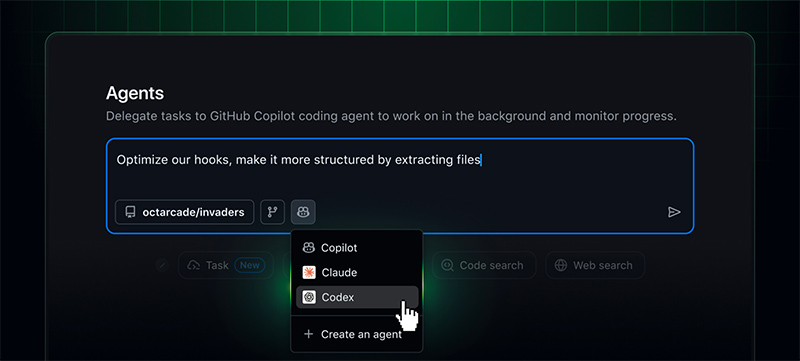
You can now use @claudeai and @OpenAI’s Codex in GitHub and @code with your GitHub Copilot Pro+ or Copilot Enterprise subscription.
Define your intent, pick an agent, and they’ll get to work clearing backlogs and bottlenecks, all within your existing workflow.… pic.twitter.com/6o13VDaPVw— GitHub (@github) February 4, 2026
Developers already spend significant time on repetitive tasks like writing boilerplate code, debugging, reviewing changes, or documenting features.
These kind of activities are exactly those that AI excels at. And the technology's availability can accelerate the development of projects without replacing human judgment. GitHub recognized this early with Copilot, which has seen rapid adoption, reaching tens of millions of users and contributing substantial portions of code in many workflows.
And now, it's including additional AI agents: Anthropic's Claude and OpenAI's Codex.
Building these directly on this foundation, through Agent HQ, users with appropriate subscriptions can now select and run these agents natively within GitHub's interfaces: on the web, mobile app, or VS Code, for tasks such as generating implementations, addressing issues, proposing pull requests, or iterating on feedback.
Outputs appear in familiar formats like draft PRs and comments, preserving the collaborative review process that defines GitHub.
By embedding multiple AI providers side-by-side with its own Copilot, GitHub enables developers to compare approaches, divide complex work, or choose the best tool for specific needs, all without leaving the repository context. This multi-agent flexibility aligns with how developers already mix tools and services, while enterprise controls ensure security and visibility remain intact.
As AI continues evolving, its deeper integration into GitHub enhances productivity in a platform built for sharing and building together, keeping the focus on human creativity and collaboration at the core of software development.
Still, embedding AI agents directly into GitHub’s workflow introduces new frictions.
Faster code generation does not automatically mean better code. Teams may face growing technical debt if AI-produced solutions are merged more quickly than they are deeply reviewed, especially when the reasoning behind implementations is less transparent.
Responsibility can also blur: GitHub’s model has long centered on human collaboration and accountability through pull requests and reviews. When AI agents propose changes, developers remain responsible for the outcome, even if the decision-making process behind the code is partly opaque.
There are practical concerns as well. Multiple AI tools can lead to inconsistencies in style and architecture, requiring stronger oversight to maintain coherence. Enterprises must also weigh data governance carefully when sensitive repositories interact with external models.
GitHub’s direction reflects a larger transition in software development: AI is becoming part of the infrastructure, not just an assistant on the side. The gains in speed and convenience are clear, but how teams manage oversight, responsibility, and long-term code quality will shape whether this shift simplifies development or adds new layers of complexity.

















































































































































































































































































