
The field of text to image generation has seen rapid advances in recent years with models growing larger and more capable yet often demanding substantial computational resources for training and deployment.
In this context Microsoft introduced 'Mage-Flow' as an open source alternative that prioritizes efficiency without sacrificing output quality. The approach relies on careful co design of its components rather than scaling parameter counts.
At the core of Mage-Flow is a shared stack built around two main elements.
The first is Mage-VAE, a lightweight latent tokenizer that provides high fidelity reconstruction while requiring far fewer operations per pixel than comparable systems such as the VAE used in FLUX.2.
The second is NR-MMDiT, a native resolution multimodal diffusion transformer with 4 billion parameters trained using rectified flow matching.
This combination enables the model to operate directly at the target resolution without fixed bucketing or padding. A single checkpoint supports outputs from 512 by 512 up to 2048 by 2048 pixels across arbitrary aspect ratios including extreme ones such as 4 to 1.
And it is fast. Like, extremely fast.
In all, Mage-Flow with its 4 billion parameter for text-to-image generation and instruction-based image editing, achieves a competitive performance with significantly larger systems, like FLUX.2 at 32 billion parameters, and various other 6 billion to 20 billion parameter models.
Performance evaluations indicate that Mage-Flow matches or exceeds many larger open source models on standard benchmarks.
In text-to-image tasks it records strong scores on GenEval, DPG-Bench, TIIF-Bench, and long text rendering tests for both English and Chinese.
For image editing it shows solid results on ImgEdit-Bench, GEdit-Bench, and TextEdit-Bench.
Inference remains practical on consumer grade hardware with the turbo variant producing a 1024 squared image in roughly 0.59 seconds on an A100 GPU and the editing turbo variant completing operations in about 1.02 seconds while keeping peak memory usage relatively low.
And this is astonishing, nevertheless.
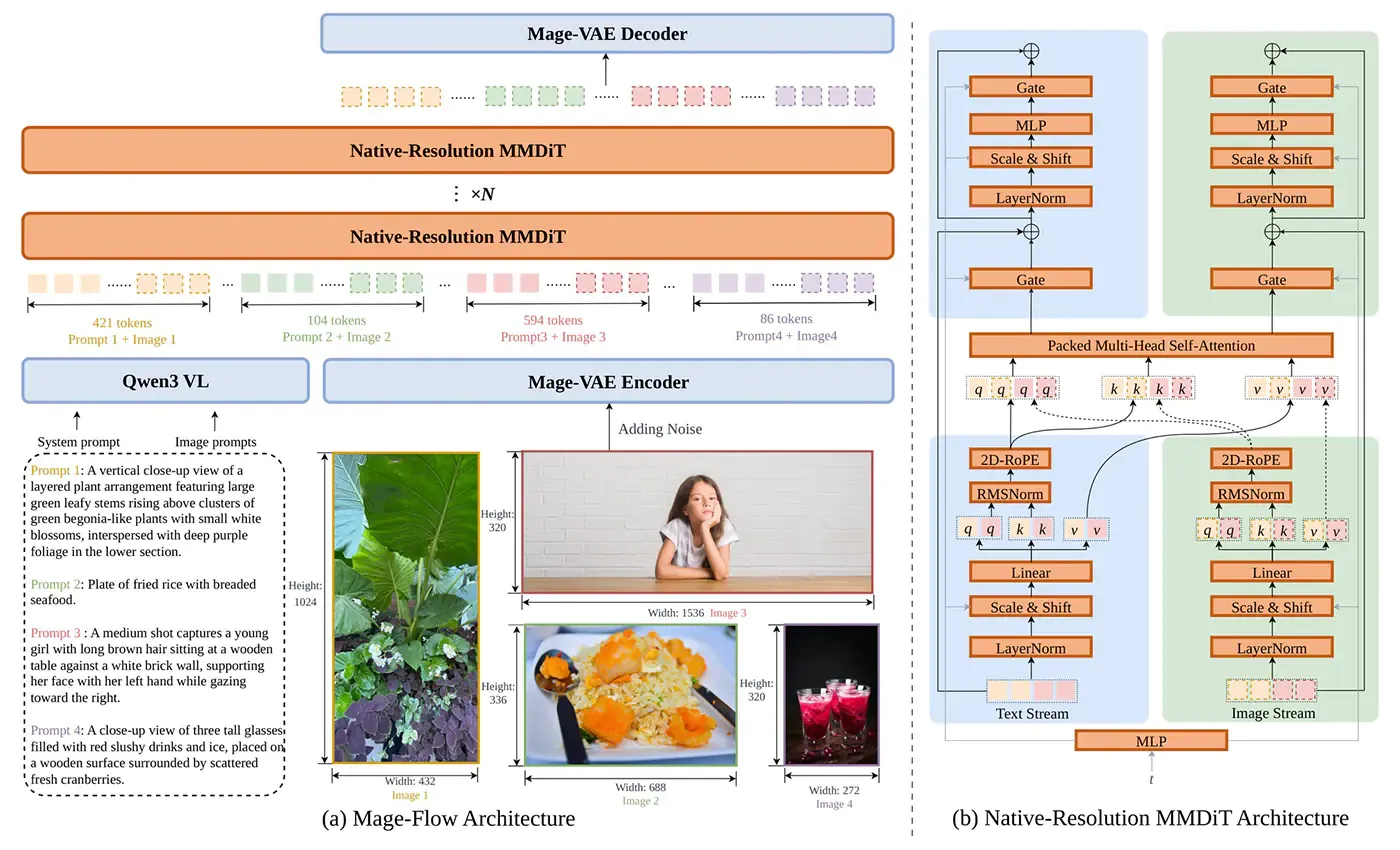
It managed to achieve this using a system that offers variants tailored to different use cases.
These include base models, RL aligned versions for improved prompt adherence and aesthetics, and distilled turbo versions that require only four sampling steps.
Separate pipelines exist for pure text to image generation and for instruction based image editing. The editing model handles a range of tasks including semantic content changes, appearance transformations, structure aware modifications, and image restoration while preserving the generative capabilities of the base system.
Additional optimizations contribute to its speed.
Native resolution packing combined with variable length attention and per sample rotary embeddings reduces overhead.
Fused kernels and other system level improvements accelerate both training and inference. The architecture also fuses conditional and unconditional branches during classifier free guidance into a single forward pass.
All model variants are available on Hugging Face under the microsoft organization.
Users can access Mage-Flow, Mage-Flow-Turbo, Mage-Flow-Edit, and their corresponding base versions along with supporting code and diffusers compatible pipelines.
The release is accompanied by a technical report on arXiv that details the design decisions and experimental results.
This open sourcing provides researchers and developers with a capable and resource efficient foundation for further experimentation and application development in image generation and editing.




















































































































































































































































































