Most people never count the pictures that make a moving image.
A film print, a phone clip, a broadcast master, and a generated shot can all look like continuous motion while they are actually different stacks of stills arriving at different speeds.
The mismatch only becomes obvious when two clips sit on the same timeline, when audio drifts a few frames over a minute, or when a 24 frame cut is asked to live inside a 59.94 delivery spec that television still treats as law.
Filling those missing pictures is not a new job.
Post houses have used motion-compensated conversion for decades. Neural interpolators have been public since at least Super SloMo in 2018, then RIFE, Google FILM, Topaz Video AI, and a long list of open models.
Runway itself shipped a Frame Interpolation tool in 2022, mostly for turning stills into motion.
Now, the company introduces a finishing pass it calls 'Enhance Frame Rate.'
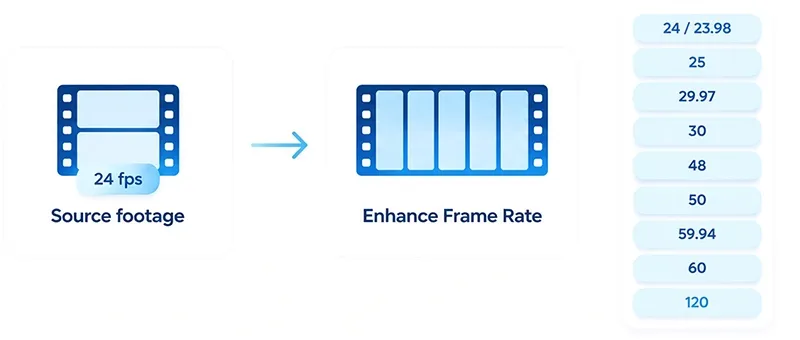
The model takes footage a user already has, from a camera, an edit, or another generator, and synthesises the in-between frames needed to land on a chosen rate. It is not a text-to-video system.
There is no prompt and no new scene. The work is retiming, not invention.
Supported targets include the familiar integers 24, 25, 30, 48, 50, 60 and 120, plus the fractional standards that finishing departments actually hand off: 23.98, 29.97 and 59.94.
Those last three matter more than the headline 120.
A true 24 versus 23.976 difference is tiny on a short clip and becomes a sync and quality-control problem across an hour of picture. Consumer tools often ignore that column. This one does not.
On the developer side the model is called enhance_frame_rate and lives on the same POST /v1/video_upscale endpoint already used for resolution upscaling.
A job accepts up to 300 seconds of input and is billed at one credit per two seconds of that input, so cost tracks duration rather than how many extra frames the target rate invents. In the product itself the company points people to the web app, and inside
Workflows a dedicated Enhance Frame Rate node is distinguished from the simpler Update FPS utility, which only applies basic interpolation when you raise the rate.
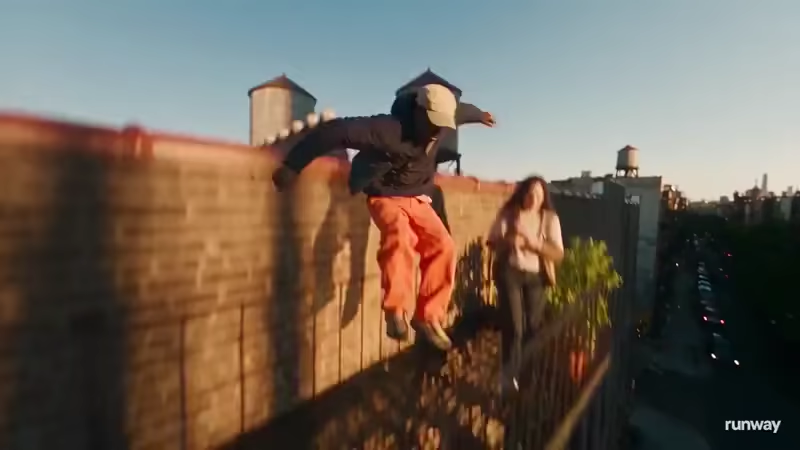
The launch clip showed side-by-side conversions: 24 to 60 on a rooftop jump, 30 to 60 on a snowboarder, 60 to 120 on a tight medical shot.
The claim in the accompanying text is that the pass can sit on any video and any model.
That is useful because many of Runway's own generators still default to 24 frames, while social, sports, and broadcast pipelines often expect something else.
Interpolation here is the finishing step after generation, not a substitute for shooting or generating at the rate you need.
There are limits worth keeping in view.
Independent published tests of artifact behaviour on fast motion, occlusions, heavy compression, or hard cuts were not available at launch. Longer pieces have to be split, and cuts are safer handled at scene boundaries because the model is not described as a scene detector.
Audio carry-through versus resample is not clearly specified in the public docs.
Older Runway interpolation, dating to 2022, was aimed more at morphing stills into motion. This release sits closer to a conform tool than to that earlier creative toy.
Frame rate conversion has always been a choice between dropping or duplicating frames, blending neighbours, or inventing new ones. The last option is what this model does.
The practical change is that the conversion now lives next to the generators that keep producing 24 frame clips, and that the target list includes the awkward NTSC numbers that finishing still has to match.




















































































































































































































































































