The film industry is profitable. Decorated by stars with many titles released every single day, the business is alluring to many, including to online pirates.
These pirates operate inside and through underground networks, where they get their content from people filming movies inside theaters, scamming wholesale distributors and more.
The demand is high, and these pirates are there to supply the demands.
The European Union knows that most pirate websites and apps won’t survive without advertising revenue. This is why it targets the advertising industry because it is seen as an important partner to combat piracy.
The union managed to launch a campaign to introduce a voluntary anti-piracy agreement for advertisements for major EU brands.
In 2016, this resulted in a set of guiding principles. Two years later in 2018, some leaders in the advertising business, including Google, promised to help reduce ad placements on pirate sites.
“This initiative will help deprive these websites and mobile applications of the revenue flows that make their activities profitable,” the EU Commission notes, summing up the ultimate goal.

As a result of this, the European Commission reported that the number of ads placed on pirate sites is trending down.
While there is no data on how the revenue of pirate operators has evolved in the first year after the deal was signed, the EU Commission reported that the effect on ad placements is visible in Europe.
Specifically, the number of ads served per visit dropped by 12%.
“There has been a 12% decrease in the average number of ads collected per visit to IPR infringing websites following the introduction of the MoU, down from 2.02 in the pre-MoU comparison dataset to 1.77 in the post-MoU comparison dataset,” the EU Commission reports.
In addition, the number of ads that appear on pirate sites through EU intermediaries, such as advertising outfits, have also decreased from 28% to 22% in the year following the signing of the deal.
This is a positive outcome.
However, the data shows that the number of branded advertising campaigns, which are ads attributed directly to specific brands - have actually grown.
“Although fewer ads were found per visit, the percentage of branded advertising post-MoU has increased from 38% to 52%,” the report notes. “The largest increases came from the UK, the Netherlands, Germany and Italy.”
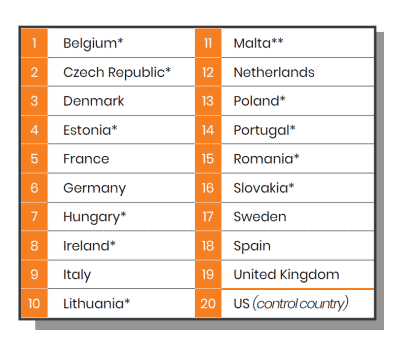
The reported data from the Commission comes from a study that was conducted by White Bullet Solutions, a company that works to protect advertisers and brands from digital piracy.
The company in its study. monitored ad placements on 7,627 websites from 19 EU countries, using the U.S. as a control group.
The pirate sites that were under the monitor, offer a wide variety of content, but 72% of them were dedicated to film piracy. Most of these sites were so-called linking portals, followed by direct-download and torrent sites respectively.
While the those site's revenue is down, the number is merely a calculation based on predictions. The study doesn’t detail precisely how much the EU dented those pirate sites’ revenue.
Pirated website are more than many, and most can be found through simple search engine queries. While many countries, including Indonesia for example, are tracking them down, new ones are created as soon as old ones were shut down.
This is why the Commission is planning to shed more light on this in a future report.
“The second study will provide an estimation of the ad revenues collected by IPR-infringing website owners, in addition to quantifying the evolution of online advertising on IPR-infringing websites over time.”
The EU Commission is confident about this initiative. It hopes that in the future, more and more companies will join the deal. This applies to advertise companies but also social media firms, payment providers, and others. The more companies can join, the more effective the initiative will be.






















































































































































































































































































