The technology landscape operates under a peculiar set of rules where timing rarely dictates market leadership, and early adoption often yields ground to refined late entries.
Across consumer electronics, brands repeatedly release cutting-edge form factors that capture initial headlines, only for mainstream adoption to stall until a broader consensus is reached regarding durability, software optimization, and long-term utility.
This dynamic has defined the foldable smartphone category since its inception, with early iterations enduring years of scrutiny over mechanical longevity and compromises in screen engineering.
When Apple enters an established hardware space, the narrative shifts from proof-of-concept experimentation to mainstream luxury, creating an immediate halo effect around a category that previously struggled to cross the threshold into universal desirability.
The long-anticipated introduction of the iPhone Duo marks this exact inflection point for flexible screen technology.
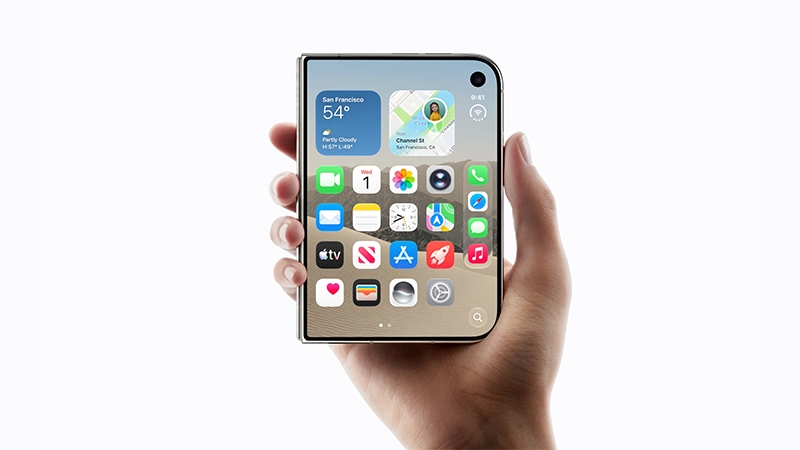
Apple did not pioneer the foldable format. Actually, Apple is extremely late in this case. The first commercial foldable Android smartphone was the Royole FlexPai, announced in October 2018 and released in December 2018.
Shortly after, mainstream Android manufacturers launched their own flexible display flagships. In 2019, notable ones include Samsung with the original Galaxy Fold, Huawei Mate X, and Motorola Razr.
Apple being Apple, chose not to dive its head straight to the water, choosing instead to observe nearly a decade of hardware iterations from its principal competitors before unveiling its own interpretation.
This intentional delay allows the company to capitalize on matured component supply chains, higher quality flexible OLED panels, and proven structural materials.
Despite entering a market saturated with established folding devices, the iPhone Duo commands an elevated level of prestige and exclusivity, positioning itself as the definitive hardware benchmark for high-end smartphones while commanding a starting price point that further separates it from standard flagship devices.
Underneath the refined exterior, the iPhone Duo incorporates a dense configuration of custom hardware components designed to balance a thin profile with structural rigidity.
- Primary Display: 7.6-inch Super Retina XDR Flexible OLED, 2712 x 1220 resolution at 460 ppi, 1-120Hz ProMotion variable refresh rate, peak brightness of 2600 nits, ultra-thin flexible glass substrate with self-healing polymer protective layer.
- Cover Display: 5.4-inch Super Retina XDR OLED, 2080 x 960 resolution at 458 ppi, 1-120Hz ProMotion, Ceramic Shield 2 protection.
- Processor: Apple A20 Pro chip built on a 2nm architecture, featuring a 6-core CPU (2 performance cores, 4 efficiency cores), 6-core GPU with hardware-accelerated ray tracing, and a 16-core Neural Engine.
- Memory and Storage Configurations: 12GB unified memory; internal storage options available in 256GB, 512GB, 1TB, and 2TB tiers.
- Chassis and Hinge Architecture: Grade 5 titanium frame with matte glass rear panels; proprietary multi-gear liquid metal hinge utilizing 114 micro-components with gear-driven stabilization and zero-gap flat closure.
- Camera Array: Dual 48MP Fusion main cameras (24mm f/1.6 primary with sensor-shift optical image stabilization, 13mm f/2.2 ultra-wide with macro capability); 12MP under-display interior camera for video calls; 12MP TrueDepth front cover camera.
- Battery and Power: Dual-cell split lithium-ion battery array totaling 4650 mAh capacity; supports 35W wired fast charging, 15W MagSafe wireless charging, and Qi2 standard.
- Connectivity and Ports: USB-C port operating at USB 3.2 Gen 2 speeds (up to 10Gbps) with DisplayPort output support; Wi-Fi 7, Bluetooth 5.4, second-generation Ultra Wideband chip, Sub-6 and mmWave 5G.
- Ingress Protection: IPX8 water resistance rating (submersion up to 1.5 meters for 30 minutes).
- Dimensions and Weight: 5.1 mm thickness when unfolded, 10.7 mm thickness when closed; total weight of 238 grams.
The technical evaluation of the iPhone Duo highlights both the advantages of Apple's patience and the compromises required to achieve such a thin chassis.
Reviewers generally agree that the mechanical feel of the device is unmatched, particularly noting that the center crease is significantly less prominent than on competing devices due to the custom hinge design and its matte display.
The crease is still there.
After all, no glass can technically fold, and this glass screen on the Duo is pretty much not glass.
While Apple marketing labels it flexible glass, the display panel relies heavily on specialized polymer and plastic layers to handle repetitive bending. True silicate glass cannot fold completely without breaking, meaning the screen uses ultra-thin "glass engineered" but compounded it alongside flexible plastic substrates.
Because of those physical material limits, a visible and tactile crease remains along the hinge axis, proving that even Apple cannot completely overcome the physics of flexible displays.
But still, Apple doesn't let that flaw stop Apple from marketing the device as a masterclass in materials engineering.
Rather than attempting to eliminate the crease (because it could not), Cupertino frames the structural compromise through the lens of longevity and tactile precision. The narrative centers on structural integrity over total invisibility, pitching the engineered composite as a necessary trade-off for scratch resistance and long-term mechanical durability.
By tightly controlling the display calibration and anti-reflective coatings around the hinge region, Apple minimizes visual distortion under direct light, turning what could be viewed as a glaring physical limit into an acceptable signature of flexible hardware.
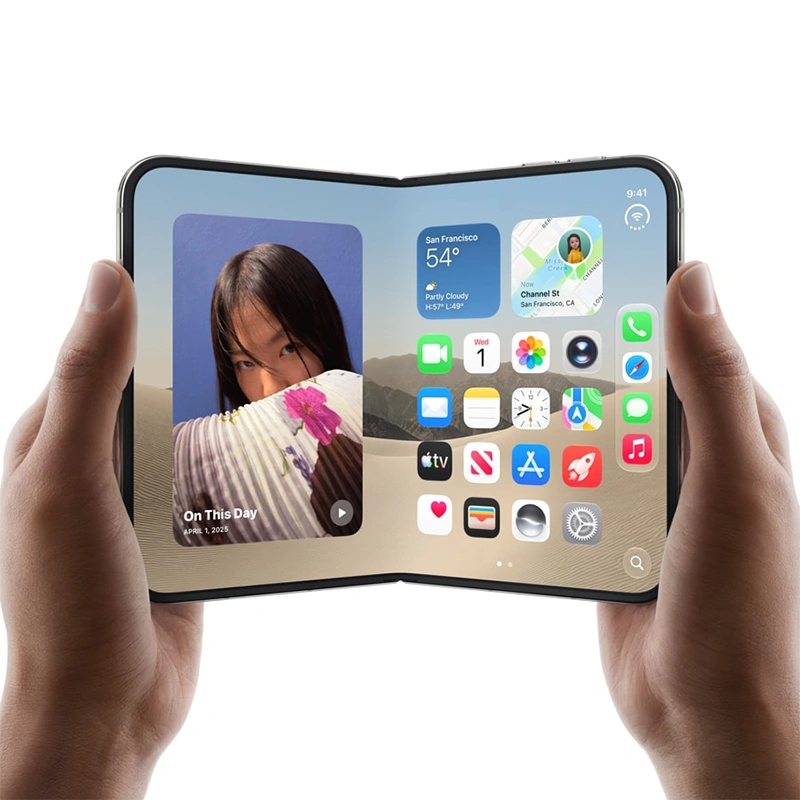
The integration of iOS adapts dynamically to the expanding display, allowing seamless handoffs between the cover screen and the primary display.
However, testing also draws attention to notable omissions, such as the absence of a dedicated telephoto lens (a trade-off driven by internal space constraints) and a battery capacity that, while sufficient for a standard day of moderate use, falls short of the endurance offered by thicker, non-folding flagships.
When framed against the broader Android ecosystem, the iPhone Duo arrives at a time when competing platforms are already on their sixth, seventh, or eighth hardware revisions.
Manufacturers like Samsung, Google, and Honor have spent years iterating on software multi-tasking, stylus input, and split-screen workflows, establishing a mature baseline for productivity on foldable displays.
By contrast, Apple enters the segment with a primary focus on build quality and unified platform execution rather than feature overload.
This delay means Android rivals maintain a clear advantage in multi-window flexibility and power-user customization, leaving Apple to rely on its established brand equity and refined hardware execution to capture consumer interest.
The reaction from market rivals and industry analysts underscores the unique position Apple holds in the consumer market.
Competing brands have leveraged their head start to emphasize their superior software maturity and broader range of foldable form factors, including flip-style compact devices.
Yet, the commercial introduction of the iPhone Duo fundamentally alters the trajectory of the foldable category.
Rather than rendering the iPhone Duo obsolete due to its late arrival, Apple's entry validates the entire foldable concept for mainstream consumers, effectively shifting flexible display devices from a niche alternative into the absolute peak of status and luxury engineering.
Following the revelation of the iPhone Duo, rivals quickly used the momentum and the news it generates to troll Apple on social media and remind everyone they had been selling foldables for years.
For example, Samsung Belgium posted a clap-back that Apple had "eventually caught up," tagging its Galaxy Z Flip 8 and Z Fold 8.
Motorola did the same with its Razr line, noting that some people were "just discovering" flip-phone form factors while it had been refining them the whole time.
Both posts leaned on the same joke: Apple is late to a category the Android makers already own.






















































































































































































































































































