Petrol heads feel most at home when they’re behind the wheel.
Some love hearing engines roaring, turbos whistling, blow-off valves hissing, exhausts crackling, and adrenaline surging through their veins. Others prefer to ride low and scraping the asphalt as they go, fit the biggest set of wheels possible, and flaunting cosmetic mods that turn heads. Then there are those who put big subwoofers in their trunks, turning every drive into a rolling concert for anyone within earshot, while others focus on being audiophiles with their obsession on high-fidelity sound reproduction.
Not to mention those people who are pushing their builds far beyond factory limits, chasing uniqueness no matter the cost.
In Indonesia, the online automotive scene once revolved around a single name: modifikasi.com. Affectionately known as 'ModCom,' it was a pioneering digital platform dedicated to car modification. Founded as an online discussion forum, back when forums were the backbone of internet communities, it became the beating heart of Indonesia’s modification culture.
At its peak, ModCom wasn’t just a website; it was a living, breathing hub.
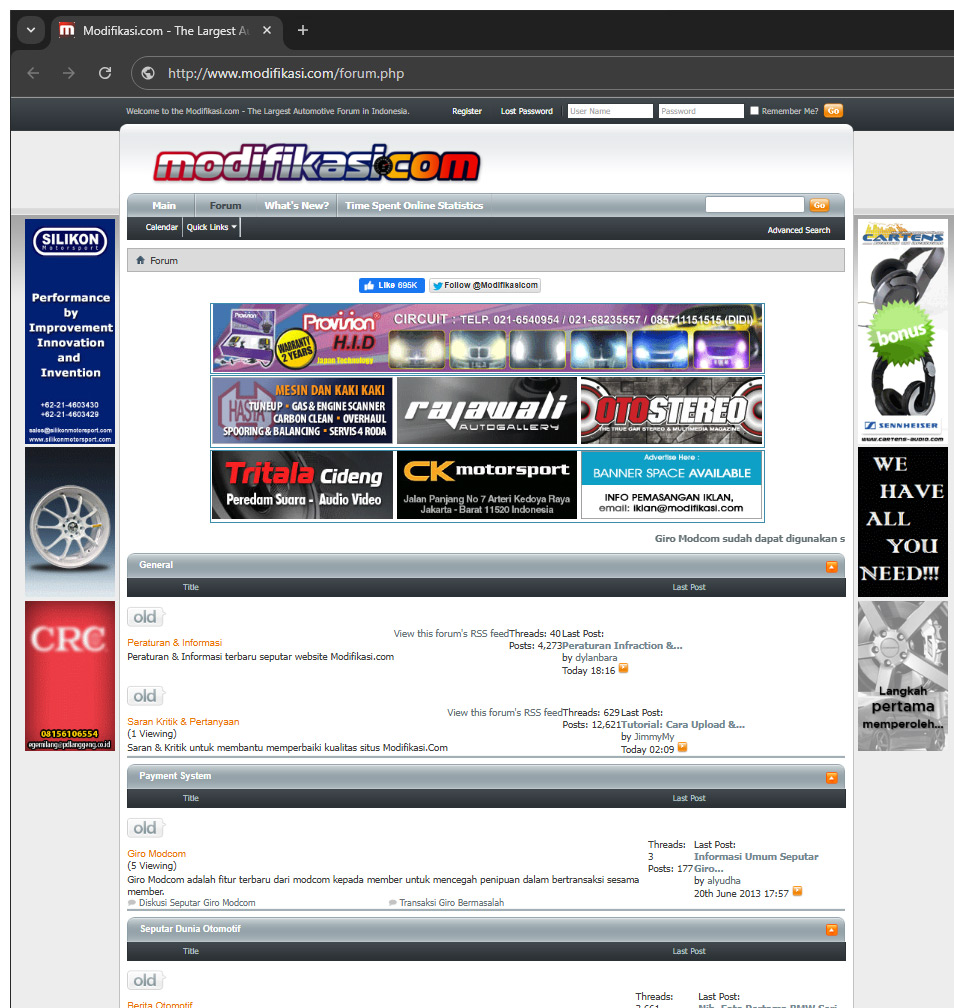
ModCom was born as an online forum, where enthusiasts debated engine swaps, showcased custom builds, documented both street and legal races, and traded endless tips about tuning, styling and detailing.
With more than 20 million posts from its over 100,000 unique users, it wasn’t just popular. ModCom was a digital pioneer that helped shape an entire generation of car culture in Indonesia.
But by the late 2010s, cracks began to show.
In 2018, a research paper (PDF) revealed a critical issue at PT Wahana Otomotif International, the company behind ModCom: there was no way to measure the platform’s effectiveness.
Despite its massive user base, the forum couldn’t prove its value in corporate terms. Brand awareness, engagement, return on investment. None of the things it has could be quantified. In an economy increasingly obsessed with metrics and analytics, a vibrant but unmeasurable community became a liability.
At the same time, the internet itself was evolving.
Static forums began to look outdated against the rise of social media feeds, glossy online magazines, and immersive apps. Instagram and YouTube gave car lovers visual inspiration; Facebook groups and Reddit provided faster, more interactive discussions; apps and games delivered customization experiences with built-in monetization.
Compared to these agile ecosystems, ModCom’s text-heavy format felt like a relic.
Even after having a dedicated marketplace for cars and parts, and hosting well-known automotive figures like Fitra Eri, Rifat Sungkar, and Akbar Rais, the company still had no way to demonstrate the forum’s value in corporate terms.
Caught between internal dilemmas and external shifts, ModCom slowly faded.
At its peak, thanks to its unique and long-standing community-driven brand, ModCom could achieve a market capitalization in the range of millions of dollars, with a valuation based only on the platform’s ability to keep visitors in.
This stickiness came from its dedicated forums, organized not only by car brands but also by passion points: engines modifications for speed enthusiasts, wheels and suspensions for those obsessed with cosmetics, and many other niche threads that catered to every corner of the modification scene.
But by the early 2020s, only a few years after its glorious days, ModCom slipped into silence, becoming a ghost of the once-thriving hub it used to be.
For PT Wahana Otomotif International, letting ModCom go wasn’t just failure. It was a strategy to help the community lives on, just in other places.
What remains is its legacy.
It will always be remembered as a pioneering community that shaped Indonesia’s automotive scene, representing a time when online forums were the lifeblood of subcultures and when value was measured in passion rather than metrics.
Its decline, however, is a reminder of digital Darwinism: even the largest and most loyal communities can fade if they fail to adapt.
The story of modifikasi.com is ultimately one of evolution.
What was once centralized in a single massive forum now lives across apps, expos, social platforms, and countless smaller communities.
The culture is still alive, arguably more vibrant than ever, but only the shape of it that has changed.