In today's digital world, the line between a local disaster and a global event has completely disappeared. Most people now learn about terrible accidents not from a serious news anchor on TV, but while scrolling through their social media feeds.
On a regular Sunday afternoon, the internet was suddenly shocked by a series of events that started as a normal flight log and turned into a massive viral story within minutes.
What was supposed to be a private weekend trip to a tropical island quickly became the focus of millions of smartphone screens worldwide, showing how fast the internet can spread a moment of pure terror.
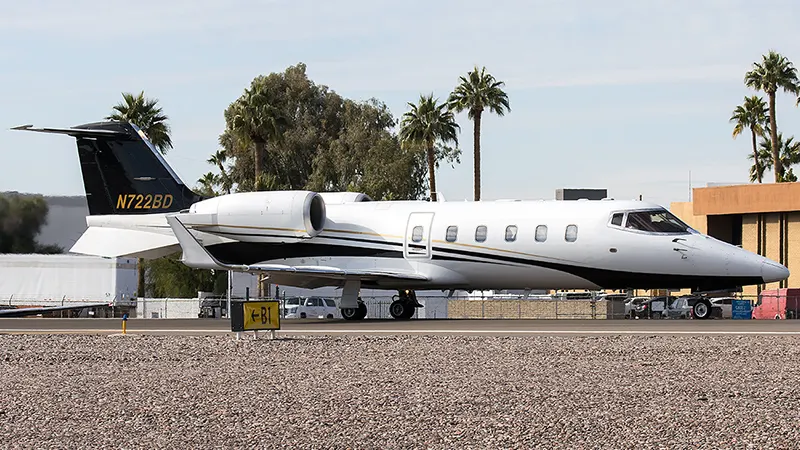
The digital records left behind by the plane, a 2004 Bombardier Learjet 60 with the tail number N722BD, tell a frightening story.
Owned by LR60271 LLC, the 22-year-old midsize twin-engine turbo-fan business jet crashed like a missile, hitting the ground well above its maximum operating speed.

The aircraft took off from Austin Bergstrom International Airport in Texas at around 15:37 UTC, carrying nine people toward North Eleuthera Airport in the Bahamas.
For the first few hours, nothing was out of the ordinary. The plane was just another invisible line on radar maps, flying smoothly until it reached the coast of Florida.
According to its real-time tracking data on websites like Flightradar24, the plane started to come down near Naples, Florida, the plane began a descent to 35,000 feet after encountering a severe storm with heavy rain, turbulence, and icing.
What happened next triggered a massive wave of online attention.
Inside the cockpit, the female pilot spoke to air traffic control, calmly asking if there was a smoother path ahead to get away from the rough weather. She mentioned that the outside temperature had dropped to a freezing minus 47° Celsius.
After being told they could climb to 37,000 feet, things went wrong incredibly fast.
The audio recordings of their voices, captured by a website called LiveATC, were quickly cut into short clips and shared all over Instagram, X, and Threads.
People in the aviation world felt a chill down their spines as the crew's voices completely changed.
They frantically yelled when the jet was moving much too fast and was diving down at 10,000 feet per minute. That number quickly jumped to 20,000 feet and finally near-vertical nosedive at a terrifying speed of about 32,000 feet per minute.
Flight data recorded the aircraft accelerating significantly as it plummeted, reaching a peak groundspeed of 505 knots (approximately 581 mph or 935 km/h).
Preliminary estimates based on radar tracking and dashcam analysis suggest the aircraft impacted the ground at a speed between 595 and 690 mph, destroying the plane instantly.
The last message from the cockpit cut off with a heartbreaking line saying they had run out of time, leaving a heavy silence that internet users began studying second by second.
The true viral explosion happened when the physical reality of the plane crash hit the digital world in Greenacres, Florida.
As the jet fell from the sky in a straight vertical dive, several dashboard cameras and phone videos from drivers on South Military Trail caught the exact moment of the crash.
The viral video showed the very moment the roughly 10-tonne jet disintegrated into nothing in split second.
Within minutes of the impact at 12:50 p.m. local time, raw and shocking videos of the incident flooded the internet.
Florida Governor Ron DeSantis later told reporters that the plane looked exactly like a falling missile. The jet smashed into the ground right near the corner of Military Trail and 10th Avenue North, missing a neighborhood of mobile homes by just a few feet and exploding into a massive fireball that sent thick black smoke into the air.
The speed at which this tragedy took over the internet shows how modern social media apps push shocking content to the top of everyone's feeds.
Within an hour, flight tracking maps showing the steep, straight-down line were shared tens of thousands of times on X.
Users started doing quick math to show that a drop of 32,000 feet per minute means the plane was screaming toward the ground at more than 360 miles per hour.
The audio recording of the pilot was put on TikTok with dramatic text captions, gaining millions of views as people talked about how scary it was to hear someone realize they were about to die.
Because the crash site was only a few miles south of Palm Beach International Airport and close to Mar-a-Lago, the internet immediately started spreading wild political rumors.
Crazy conspiracy theories about a missile strike or military air defenses started popping up on Reddit and Facebook, forcing news channels and aviation experts to spend hours explaining that weather (severe thunderstorm, icing, and turbulence) is a major focus of the investigation.

The actual damage on the ground looked just like the violent images seen in the viral videos.
The force of the crash was so devastating that it completely broke the plane into tiny pieces, leaving a huge, smoking hole in the side of the road that looked like a meteor strike.
The heavy impact tore down overhead power lines and broke main water pipes underground, leaving the whole neighborhood dark and cutting off local water and electricity.
U.S. Transportation Secretary Sean Duffy confirmed the sad news that all nine people on board had died.
Miraculously, even though the jet crashed inches away from a busy public road and nearly destroyed a house, no one on the ground was killed, though at least one home suffered severe structural damage.
Cleaning up the mess quickly became a massive problem for Palm Beach County. Emergency workers closed down all lanes of Military Trail between Cresthaven Boulevard and 10th Avenue North until further notice.
Because the giant hole blocked the main entrance to the nearby housing area, county officials and the Red Cross had to quickly evacuate about 600 residents from the Cresthaven mobile home park, using public transit buses to move families to temporary shelters.
Local engineers estimated that fixing the crushed road, filling the hole, and repairing the pipes could keep the busy street closed for at least a full month.
Meanwhile, a team from the National Transportation Safety Board arrived at the scene to lead the official investigation.
As federal workers start digging through the pieces over the coming months to figure out exactly how the ice and speed problems caused the crash, the online world remains glued to the story, constantly replaying the final moments of a flight that went from a quiet weekend trip to a globally watched tragedy in less than a minute.
The Learjet 60 is an efficient executive aircraft designed to provide exceptional performance and comfort. It is equipped with a reliable Pratt & Whitney 305A engine that delivers up to 4,500 pounds of thrust for fast climb and cruise speeds up to 530 mph.
The aircraft is further equipped with advanced Rockwell Collins Pro Line 21 avionics, including integrated displays, synthetic vision, radar altimetry, autrothrottles, and dual flight management systems with global navigation databases.
Its cabin comfortably seats up to 8 passengers, and more depending on request, with ample storage, combining fuel efficiency and luxury for business travel.






















































































































































































































































































