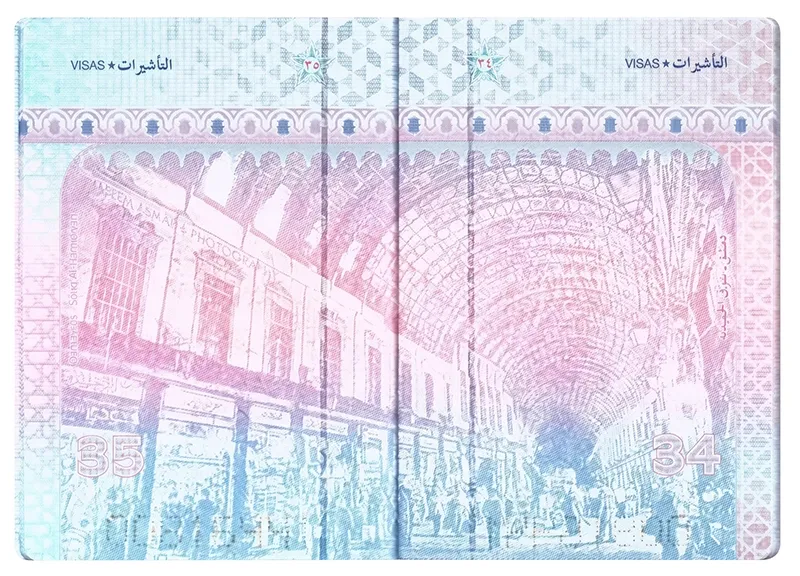
A photograph of Damascus's Al-Hamidiyah Souq, the long covered market now appears inside millions of Syrian passports.
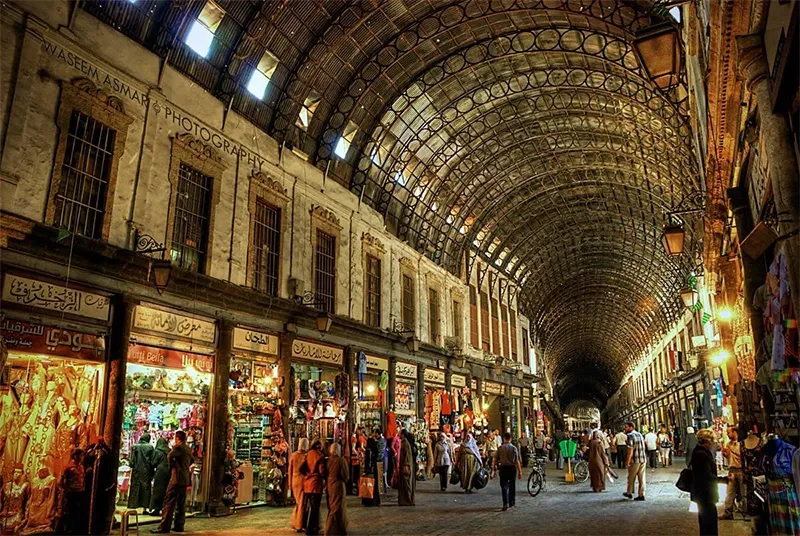
The photograph shows the iron-vaulted ceiling, rows of shopfronts and the everyday movement of people through one of the city's best-known landmarks. It was meant to be a quiet image of Damascus, the kind of photograph that could sit unobtrusively inside a national document.
Instead, it carried something with it that was never supposed to be there.
The detail is easy to miss at first. Across an upper wall in the photograph is a line of English text: WASEEM ASMAR COPYRIGHT PHOTOGRAPHY.
It is not part of the souq.
It is a watermark.
Al-Hamidiyah Souq is one of Syria's most recognizable shopping districts, lined with clothing stores, traditional crafts and jewelry shops, cafés, food stalls and the ice cream parlors for which the market is particularly famous.
The ancient covered market sits in the heart of Damascus, near the Citadel and the Umayyad Mosque.
There is no reason for an English copyright notice to be painted across one of its walls.
The explanation is considerably less mysterious.
The image was taken by Waseem Asmar, a Syrian engineer, photographer and entrepreneur who works under the name Symography. Like many photographers who publish their work online, Asmar had placed a watermark over the photograph to identify his work and discourage unauthorized use.
At some point, that watermarked version found its way into the design of the Syrian passport.
The biometric Syrian passport, first issued in August 2023, used the photograph on the pages representing Damascus. In the current booklet layout, the image appears across pages, with Asmar's watermark still visible in pale all-capital lettering.
The result is an unusual kind of accidental authorship: a photographer's copyright notice was reproduced inside a document issued by the state, while the watermark itself was made to look as though it belonged to the architecture of the capital.
Asmar eventually learned about it from a stranger.
In October 2024, someone contacted his photography page after noticing the familiar image while looking through a newly issued Syrian passport. Asmar immediately recognized the photograph. The composition was his, and the lettering on the wall was unmistakable.
It was also proof that the government had not used the original photograph.
It had used the version that was available online, watermark included.
The image had personal significance to Asmar beyond its use in the passport. He had taken it during one of his first exploratory visits to Damascus, a trip during which he also met friends who remained close to him.
He had never given permission for the photograph to be used in the passport.
At first, however, he kept the discovery to himself.
Then, in December 2024, roughly a week after the fall of Bashar al-Assad's government, Asmar posted a video about the photograph on Facebook.
His reaction was complicated. There was obvious pride in seeing one of his photographs selected to represent Damascus. But there was also frustration that the image had apparently been used without his permission.
There was another irony. While his photograph had been reproduced inside a state document carried by Syrians around the world, Asmar himself was still dealing with the practical difficulties of renewing his own passport on a short cycle.
The story circulated in Arabic-language media and on social media before largely disappearing from public attention.
The passport itself continued to exist.
That became more significant as Syria's political and administrative identity began changing. In July 2025, transitional authorities introduced a new visual identity that included a green passport cover and a revised national emblem. Officials said existing stocks of the previous passport would continue to be used before the transition was complete.
That meant the old interior pages did not simply disappear.
A passport issued years after the original photograph was selected could still contain the same Damascus spread, complete with the Asmar's watermark.
Other changes followed. Passport fees were reduced, validity periods were standardized, and applications increasingly moved onto electronic platforms. None of those changes altered the photograph inside the older booklets.
The mistake therefore acquired a life of its own.
What began as an apparently ordinary image-selection decision became an accidental piece of internet folklore. People joked about how obvious the watermark was, how the photographer had effectively been credited inside an official document, and how strange it was to see an English copyright notice apparently embedded in the walls of one of Damascus's most historic markets.
There is something particularly strange about the way the error survived.
Governments change. National symbols change. Passport designs change. Yet an old photograph, complete with its private copyright notice, can remain fixed inside a document intended to represent the state.
The simplest explanation is also the most plausible. Someone designing the passport found a high-resolution photograph online, downloaded the watermarked version and treated the lettering as part of the image.
The watermark was never removed.
For now, the market remains where it was placed: across pages of an older Syrian passport, complete with Asmar's watermark.
It was supposed to be a picture of Damascus.
Instead, it became an accidental byline.






















































































































































































































































































