Open-world games have traditionally been confined to fictional cities or carefully handcrafted maps.
Even AAA titles inspired by real locations typically compress, simplify, or recreate them rather than allowing players to explore the actual road network as it exists in the real world.
Advances in web graphics and open geographic data, however, are beginning to blur that distinction.
Instead of downloading a massive game world, it is now possible to generate roads, terrain, and landscapes dynamically from publicly available mapping data, creating an experience that extends far beyond a single city or region.
That is the idea behind Hop.Earth, a browser-based driving game that lets players parachute into almost any location on the planet before calling in a vehicle and driving along real roads.
Built entirely with web technologies, the project streams terrain and road networks as players move, transforming map and satellite data into a navigable three-dimensional world generated in real time on the user's own device.
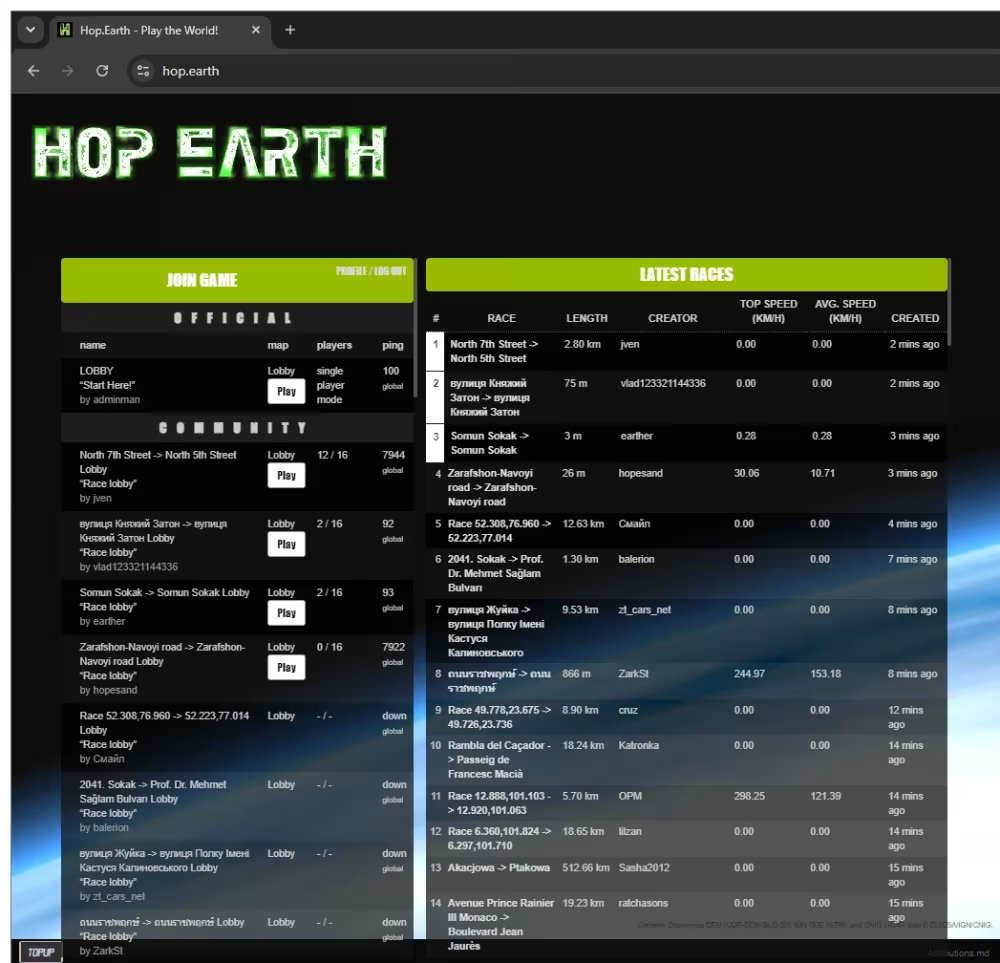
Hop.Earth is a browser based driving game that lets anyone parachute into almost any spot on the real planet and start driving on actual roads. There are no giant downloads and no pre built levels.
The world simply appears around the players as they move.
Users can simply begin by clicking on any location, choose to hop there, and after a short parachute drop, they can hold a key to call a car to the nearest road and then they are free to drive. Multiplayer races work the same way. Players pick a start and finish point, the system plots a route along real roads, and everyone can join from a shared link or directly from the homepage.
The entire experience runs inside a regular web browser using Three.js and WebGL.
Nothing is installed. Everything is generated on the fly on users own device.
With a parachute drop, the ability to navigate the seemingly endless world with a car in an open-world approach, Hop.Earth is like a blend of PUBG: Battlegrounds, with a sprinkle of Need for Speed game, and a bit of Grand Theft Auto topping.
Hop.Earth uses two main sources for the map.
The map itself comes from OpenStreetMap, which supplies the road network as vector lines with information about road types, widths, one way streets, tunnels, bridges and junctions. And for the elevations, it uses European Copernicus DEM elevation model at 30-meter resolution, the French IGN RGE ALTI array, and laser scanning data from the Spanish CNIG
These datasets arrive through a custom tile server that divides the planet into manageable geographic squares. When users first land only the nearest tiles load, which now takes roughly ten seconds. As they drive the system quietly fetches the next tiles ahead of them.
Since the system generates new tiles as users navigate, the world isn't exactly a fixed size map.
When it was first launched, buildints aren't yet present.
While OpenStreetMap data does contain building outlines, the developer said that the main focus at this time was perfecting the road and junction generation because that is the foundation everything else depends on.
Since it deals with heavy vectors, and that tiles are generated and eliminated as players navigate the world, performance can be demanding, due to how mesh creation is resource extensive.
Powerul PCs can handle this easily, whereas mobile device users may experience noticeable stuttering.
The developer has been clear that the core system is not driven by AI. The roads and terrain are produced by classical procedural code that reads the map vectors and height data and turns them into three dimensional geometry in real time.
The result is still rough around the edges.
Visuals are basic, some intersections can look imperfect, and the experience is clearly early. Yet the core idea already works.
Users can drop into a real city, call a car, and drive the actual streets while the world continues to build itself in front of them.
It's worth noting that Hop.Earth is far from the first of its kind.
People have been building browser-based driving experiences on real map data for years. Early examples used the Google Maps API for simpler top-down or basic 3D driving. Later projects combined Mapbox or OpenStreetMap with Three.js to let players drive in specific real cities.
There are also several indie games and demos that load real street layouts for racing or free roaming, some limited to selected cities and others more open.
However, it can be considered the most ambitious and complete examples of this idea so far.
This is because Hop.Earth allows users to drop into almost any location on Earth, not just a handful of pre-chosen cities.
The roads, intersections, tunnels, bridges, and terrain are generated in real time on your device from OpenStreetMap vector data and satellite elevation tiles as you drive.
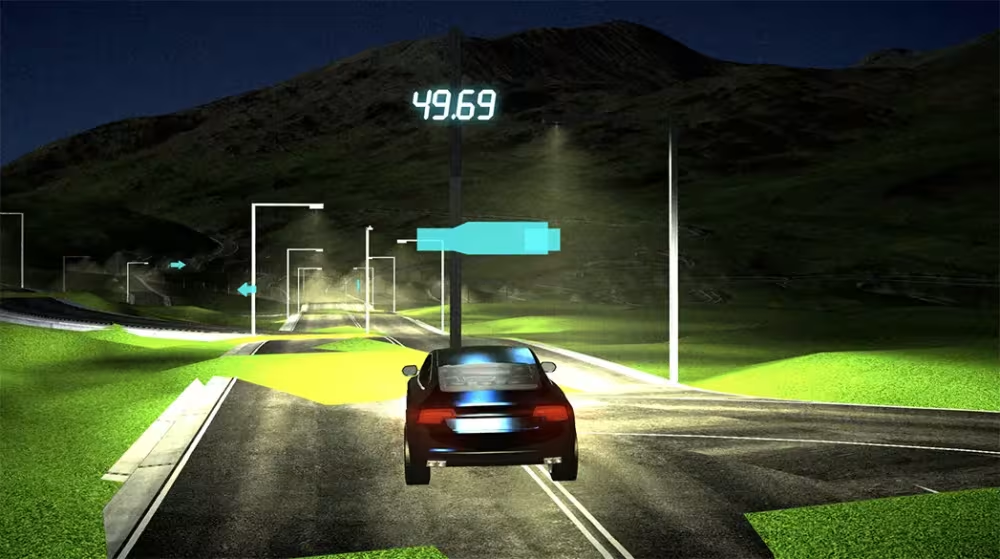
It streams new areas continuously so the world feels infinite rather than loading a fixed region.
It also includes a parachute drop, car summoning, and the ability to create and share multiplayer races anywhere.
Earlier projects usually either limited the playable area, used pre-processed or less detailed geometry, relied on external map rendering engines that already handled the 3D streets, or stayed smaller in scope, Hop.Earth pushes further by doing the full road and physics mesh generation itself in the browser from raw map data while covering the whole planet.
So while the core idea of "drive on real roads in the browser" has existed before, the seamless planet-wide real-time generation approach is still quite new and rare.
It feels like a meaningful step forward rather than a completely unprecedented invention.
It's also worth noting that Hop.Earth isn't a physics-accurate driving simulator or a replacement for route planning maps. The level of detail is limited by its data sources.
The project is being developed by a single develo[er who has been discussed on Hacker News and the OpenStreetMap community forum. It's more of a hobby project, not a company product.

















































































































































































































































































