In a country where millions navigate daily life with limited resources, access to medical care often becomes a quiet test of endurance rather than a straightforward right.
Social media platforms turn those private struggles into public conversations, sometimes revealing more about attitudes than about the systems themselves. Indonesia's BPJS Kesehatan, formally known as the National Health Insurance program, stands as the primary safety net for most citizens.
It operates as a contribution-based scheme, where the government covers premiums entirely for the poorest households. Since private hospital bills can quickly reach millions of rupiah, far beyond what many families can manage, those without steady income or private insurance options may have BPJS as their only realistic path to treatment.
In this case, when Yurizal Tri Chaerawan, a man who allegedly didn't have corporate coverage, not enough savings for emergency care, and no ability to pay out of pocket when illness strikes, was using BPJS, but met his demise because not only it was slow.
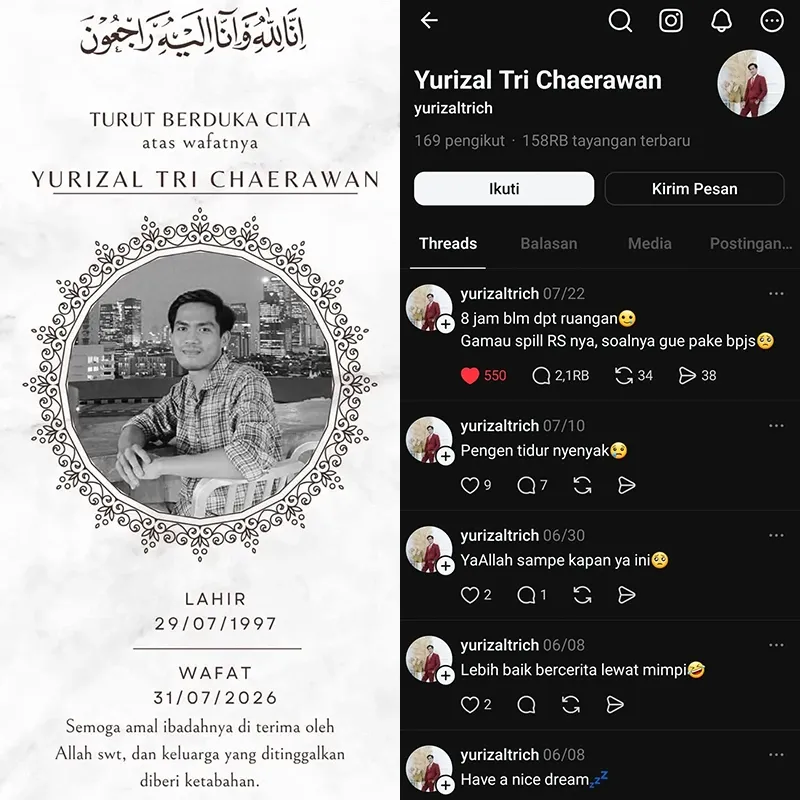
But things were far deeper (and more concerning, and tragic) than that.
BPJS is a program that aims for universal coverage. However, despite the noble effort, hospital capacity remains stretched.
Beds fill quickly, queues form in emergency departments, and patients often wait hours or longer for inpatient rooms, especially when demand peaks.That reality collided with online discourse in late July 2026 when Yurizal shared a simple update on Threads.
He wrote that he had already waited eight hours without securing a room and preferred not to name the hospital because he was using BPJS.
The post contained no insults, no demands, and no accusations.
It was a tired expression of frustration from someone seeking basic care.
Within days the comments section filled with responses from accounts that identified as doctors and healthcare workers.
Several replies dismissed the complaint as entitlement.
One stood out for its sharpness.

Dr. Elda Putri Rahardini, an internal medicine specialist holding an MD and PhD from Universitas Gadjah Mada and a recipient of the competitive LPDP scholarship funded by public money, replied by mocking the patient's profile picture and suggesting he lacked brain cells.
Other comments went further, with some joking about empty spaces in the morgue as a quicker alternative to waiting for a bed.
The thread remained relatively contained until early August, when Yurizal's family confirmed he had died on 31 July.
A cousin explained that his condition had already been critical and that delayed handling at the hospital contributed to the outcome.
Screenshots of the original post and the harsh replies began circulating widely across Threads, then spilled onto X and other platforms. Engagement numbers climbed rapidly as users shared the images side by side with the news of the death.
The combination of a modest complaint, the patient’s later passing, and the documented contempt from medical professionals created a potent wave of outrage.
Thousands of comments condemned the absence of basic empathy.
Many focused specifically on Dr. Elda, noting the contradiction between her advanced education, government-funded scholarship, and the casual cruelty of her wording toward a patient dependent on the very public system her training was meant to serve.
Posts highlighted that LPDP awards are paid by taxpayers, many of whom are themselves BPJS participants who cannot afford private care.
Accusations of class bias and professional failure spread quickly.
Calls for accountability from medical associations and the scholarship board appeared alongside personal expressions of disgust.
In the days that followed the full story’s virality, Dr. Elda issued a formal written apology.
She acknowledged that her comments had been unethical and had demonstrated a lack of empathy at a moment when the patient was already in difficulty.
She expressed regret to the family and the wider public, accepted that the words had caused harm, and stated she would take the episode as a lasting lesson in professional conduct both online and offline.
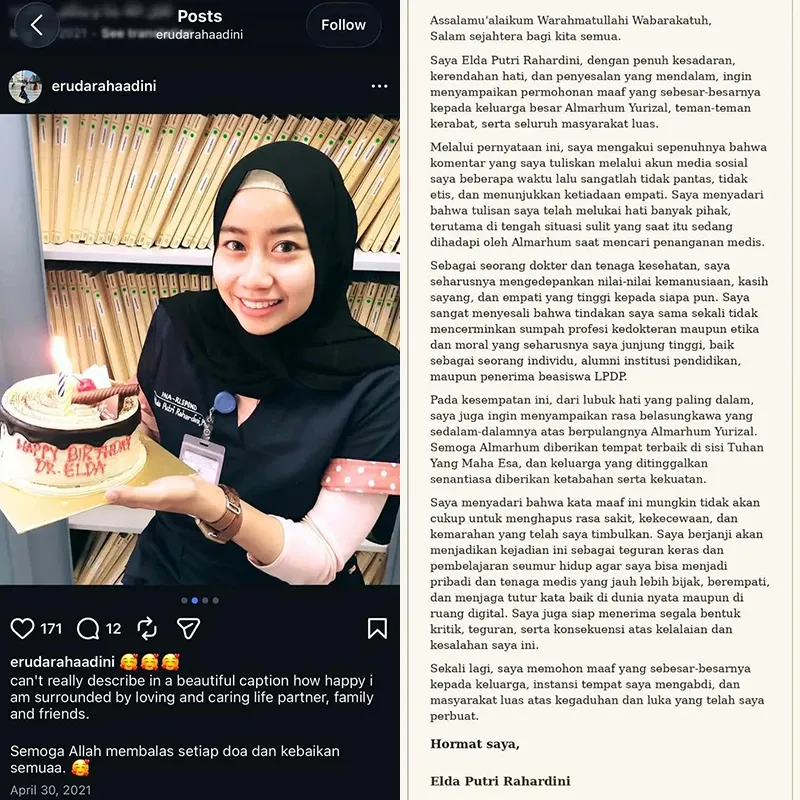
The apology circulated widely yet met mixed responses.
Some accepted it as a necessary first step.
Others argued that a statement arriving only after the patient’s death and the resulting public pressure could not fully repair the damage.
Discussions continued about the broader culture inside parts of the healthcare workforce, the frustrations of working within a strained BPJS system, and the expectation that those who treat patients should at least refrain from public ridicule when those patients voice ordinary needs.
The case remains a reference point in ongoing conversations about dignity, resource limits, and the responsibilities that come with medical authority in a society where free public insurance is often the only option available.
Following Yurizal's death and Dr. Elda's public apology, angry social media users began scrutinizing the comments left under his original post, identifying and exposing those responsible one by one.
Disturbingly, several of the individuals who had mocked Yurizal also appeared to be healthcare professionals. As public backlash intensified, some issued video apologies acknowledging their remarks, while others quietly deleted their comments or deactivated their accounts.




















































































































































































































































































