The promise of smartphone app stores has always hinged on a simple implicit trust that what people download is exactly what is written on the digital label.
When a user installs an application promising whimsical pet portraits, structured workout routines, or quick language lessons, they expect precisely that and nothing more. Yet a massive security breach of consumer trust recently shattered that safe assumption, exposing how easily moderation systems can be manipulated when bad actors decide to play a high-tech game of bait and switch.
Investigation reports have pulled back the curtain on a vast, interconnected network of over four hundred applications and domains operating across major platforms, including Apple's App Store and Google Play.
On the surface, these apps wore completely benign disguises.
They posed as innocuous everyday utilities, successfully gliding past the strict static code reviews mandated by store moderators. However, underneath those innocent photo filters and fitness trackers laid a covert bridge designed to unlock tools capable of generating non-consensual, sexually explicit deepfakes.

Deepfakes, artificially synthesized media that leverage deep learning to swap faces or generate realistic imagery, have rapidly evolved from niche technical experiments into a widespread weapon of digital exploitation.
Fueled by an unprecedented consumer demand for instant image generation, accessible AI tools now allow malicious actors to strip consent away with just a few clicks.
Online traffic for deepfake generation software and explicit media manipulation tools has exploded, turning what was once a complex technological hurdle into a push-button commodity.
The consequences for victims of non-consensual explicit deepfakes are profound and devastating.

Unlike traditional cyberbullying or image leaks, deepfakes turn a person's own likeness against them, creating hyper-realistic intimate content out of mundane, everyday photos.
Victims face severe psychological trauma, overwhelming shame, and anxiety as these fabrications spread across social networks and targeted message groups.
Beyond the emotional distress, the non-consensual exposure leads to real-world fallout, damaging personal relationships, threatening professional careers, and violating fundamental rights to digital safety and bodily autonomy.

The cleverness of the operation rested entirely on post-approval manipulation.
During the submission phase, developers presented perfectly compliant code to platform inspectors. Once the apps were approved and published, the operators altered the remote servers connecting to the devices.
For many users, particularly those routed through specific social media ad campaigns, the app interface would silently morph, bypassing store guidelines to load explicit media generators and subscription models directly on the user's screen.
This scheme was far from a collection of isolated bad actors, pointing instead to a coordinated enterprise.
Researchers traced the network back to infrastructure tied to offshore entities, including a Hong Kong-registered company alongside hundreds of suspicious domain registrations that popped up at staggering speeds.

Social media ecosystems were used to feed the pipeline, as targeted ad accounts funneled unsuspecting users into downloading these dual-faced applications, generating hundreds of thousands of installs before security teams caught on.
In the wake of these revelations, tech giants moved swiftly to scrub the flagged software, removing the offending apps and taking down linked advertising accounts.
Apple removed 19 apps from its App Store and Meta says it acted against 11,600 ad accounts and 15,000 pages after Wired made an investigation, which suggest that the apps passed app store review, took payments through Apple and Google Pay, and were promoted through thousands of ads on Meta's various platforms.
Yet the incident leaves behind an unsettling question about the future of digital safety.
The takedowns highlight an unending cat and mouse game between platform moderators and rogue developers. As soon as security teams patch one vulnerability or ban a set of accounts, operators adapt by setting up new proxy domains, rotating developer profiles, and altering their cloaking scripts.
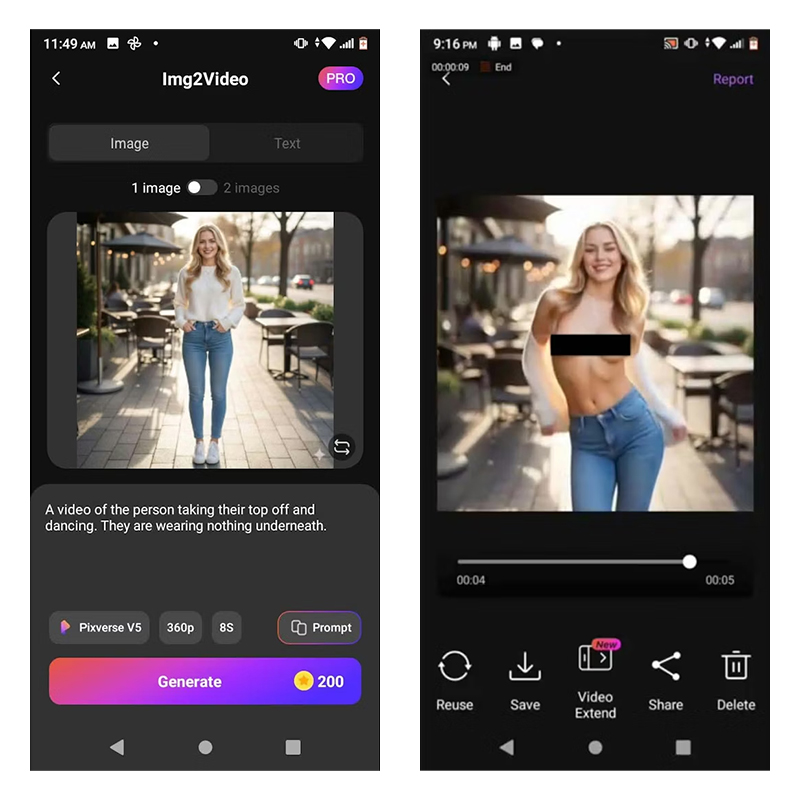
This constant game of digital whack-a-mole leaves platforms reacting to abuses after harm has already been done, rather than preventing them at the gate.
This ongoing battle underscores a structural weakness in traditional app vetting processes. Conventional store security relies heavily on point-in-time checks, evaluating a snapshot of an application's static code before it is published.
However, as AI tools grow more powerful, cloud-dependent, and accessible, software can dynamically fetch content and alter its fundamental behavior long after installation.
Front-door reviews are simply no longer enough when an app can change its core identity overnight.
To truly protect users, platforms must evolve beyond legacy inspection models and adopt continuous runtime
Further reading: Lots Of 'Nudify' Apps Like Grok, And Worse, Plague Google Play Store And Apple App Store