The internet and gadgets have helped people to communicate from a distance, in a way that is much easier than ever before.
During the 'COVID-19' pandemic where many people are forced to remain indoors and work from home, gadgets with cameras have helped many in doing their everyday job. Among others, this is the thing that help keep the economy going.
Students can also learn from afar, and family members can also keep in touch and share happiness despite restricted by lockdowns.
But things apparently go more than just that, as internet-connected gadgets can also be used to help patients communicate with their loved ones, without having them visiting. Doctors can hope that allowing that can bring happiness to the isolated patients, which in turn can help improve their immune systems to fight the virus.
At the same time, the devices can also be used for patients who are terminally ill and cannot be visited by their loved ones, so they can virtually say their last goodbye to their friends and family.
Knowing that internet-connected technology can aid communication this way, some hospitals have started stocking enough gadgets to reflect this grim reality.
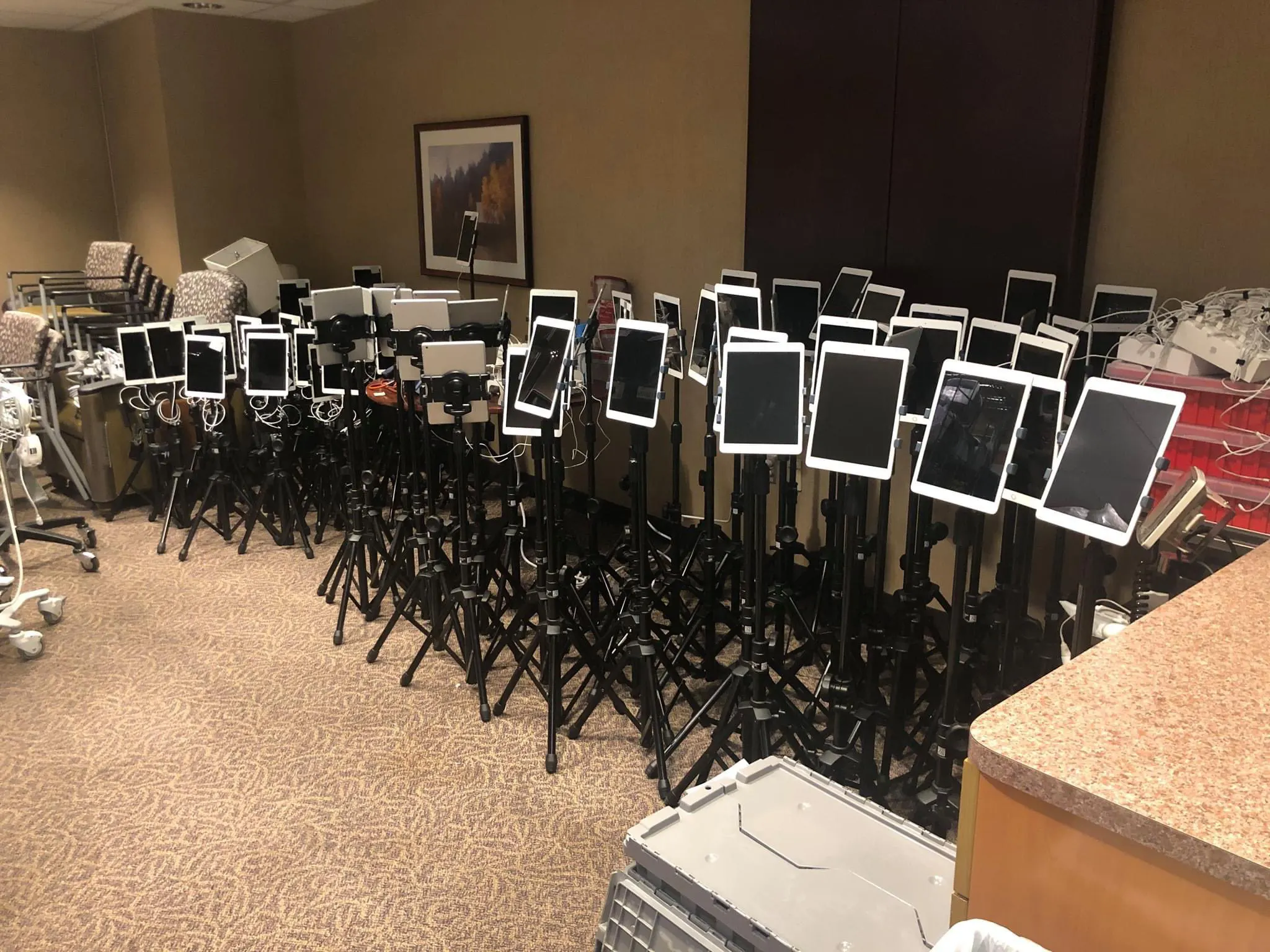
When Dr. Mark Shapiro shared a story about a patient saying goodbye to his family via an iPad, he wanted to communicate the severity of this pandemic.
"As the ICU (intensive care unit) team makes ready, there's a key step we mustn't forget," Shapiro, who is a hospitalist at Santa Rosa Memorial Hospital in California, wrote on Twitter. "At first he says 'No,' but we encourage him. The nurse brings in the iPad. With the last air in his shattered lungs, he says goodbye to his family. Over an internet connection."
Not just in the U.S., as also all over the world, hospitals have been dealing with overwhelming numbers of patients coming in every single day, most due to contracting the coronavirus.
In many countries and cities, there has also been a shortage of hospital supplies for medical staff and beds for patients.
Because of the contagious nature of the disease, hospitals are forced to limit, and often forbid, visitations rights in order to mitigate the virus' spread.
Shapiro said that the iPads are often used right before patients are intubated, because after that, there's no guarantee that the patient will have a chance to speak to their loved ones again.
"We intubate when their lungs are injured to the point where they just can't sustain organ function," said Shapiro to CNN. "They're not getting enough oxygen on their own. And we understand that we may be facilitating their last conversation."
Another option, is to use a camera installed inside the patient's room. With the camera, patients don't need to interact with any screen or keyboard, as they can utilize a large display, like a TV, for communicating with their loved ones.
The original intent was to let doctors who are short of supply, to visit patients remotely. But following the pandemic, hospitals then realized that the technology can also be used to let families virtually visit their loved ones in the hospital.
Gadgets and mobile devices can be potential carriers of the coronavirus, and this is why many hospitals and doctors recommend the restrictions of their use inside healthcare institution dealing with the coronavirus.
Phone surfaces, especially the screen, are a peculiar high-risk surface, which can directly come in contact with the face or mouth.
But still, communication is key. Especially during this pandemic.
Though there have been many significant guidelines from various health organizations, like from the WHO that focuses on prevention and control of disease, there is no particular mention of or focus on mobile phones in these guidelines.
In hospitals and healthcare facilities, phones can be used by doctors to communicate with other health care workers, to quickly look for recent medical guidelines, do some research on drug interactions, understand adverse events and side effects, conduct telemedicine appointments, track patients and more.
And for patients, especially those who are asymptomatic, they can keep their mobile devices in many cases.






















































































































































































































































































