In the U.S., San Francisco has always had a way of turning its latest obsessions into public spectacle.
These days the streets of SoMa and the freeways leading into the city are lined with oversized promises of AI that will rewrite work, creativity, and everyday decisions. The signs glow with confident slogans and sleek logos, creating an atmosphere where the future feels both inevitable and strangely impersonal.
Amid that constant visual noise, one particular billboard stands out. Not because it is louder or more polished than the rest, but because of what it quietly reveals once you look closer.
At the corner of Sixth and Folsom streets a 14-by-48-foot billboard went up on July 27, 2026.
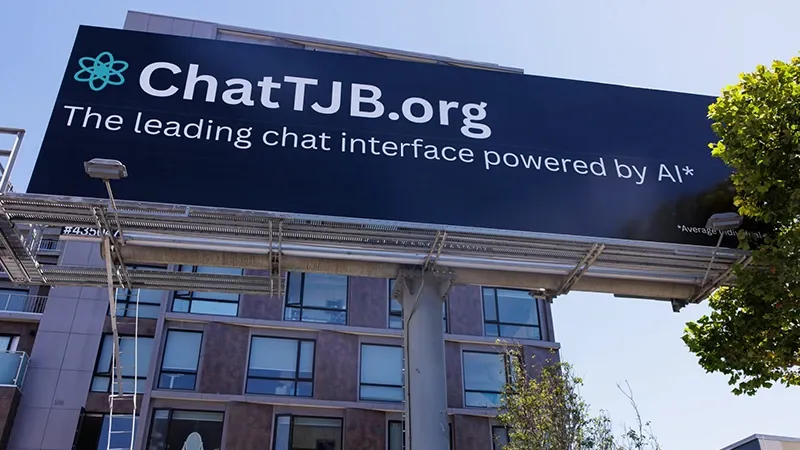
It cost its creator $6,000 for a one-month run, a relative bargain compared with the far more expensive placements along Highway 101. The ad promotes ChatTJB.org as the leading chat interface powered by AI, complete with a clean logo that echoes the visual language of every major language model.
A small asterisk sits after the letters AI.
That asterisk points to a note explaining that the letters "AI" stand for "Average Individual."
A tree partially obscures the fine print, an accidental detail the artist has described as fitting rather than frustrating.
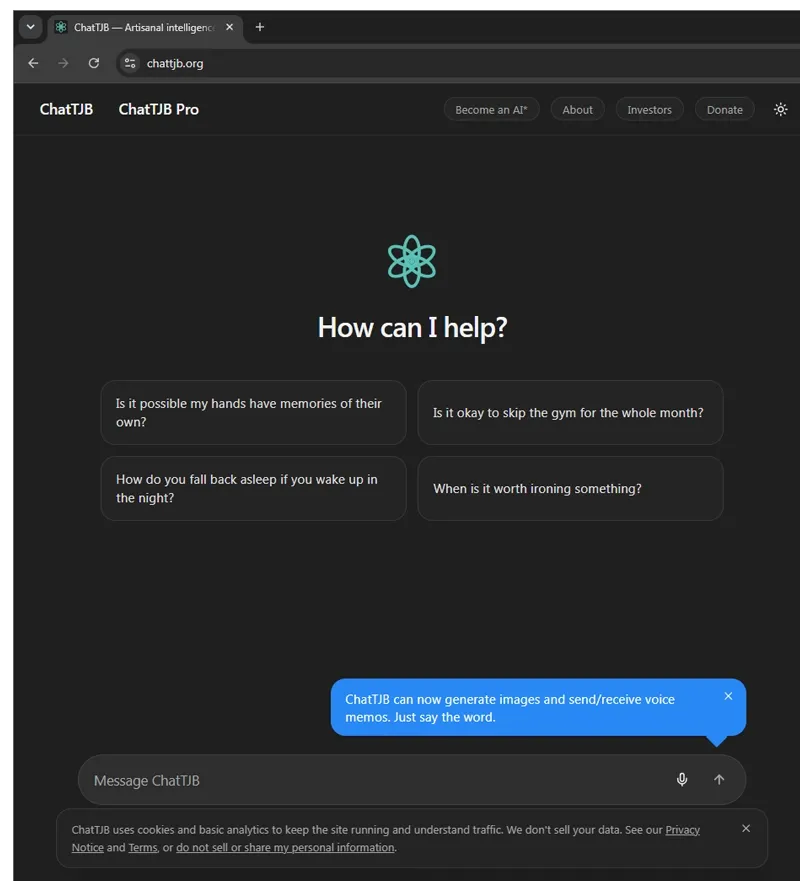
ChatTJB is a working chat interface that looks and feels almost identical to the familiar tools people open every day. Users type a question or request into a clean text box and wait for a reply.
The difference is that no large language model generates the answer.
Instead, each prompt is routed to a single human being who reads it, considers it, and types a response when he is awake and motivated.
The site describes the service as "artisanal intelligence" handcrafted by one human and as a single-operator large language experience built on a human-grounded inference layer.
In practice the experience is deliberately average.
Since a person answers the query, response time is extremely slow, and answers arrive even more slowly.
Spelling is also not always perfect, and information can be incomplete or simply wrong because the person on the other end is pulling ideas from memory rather than searching a database.
Requests for images are fulfilled by quick sketches drawn on a laptop trackpad, producing rough drawings that recall the early days of digital doodling rather than polished generative art.
There is even a $5 monthly Pro tier that the creator openly labels worthless, existing mainly as a lighthearted way for supporters to help cover the billboard cost.
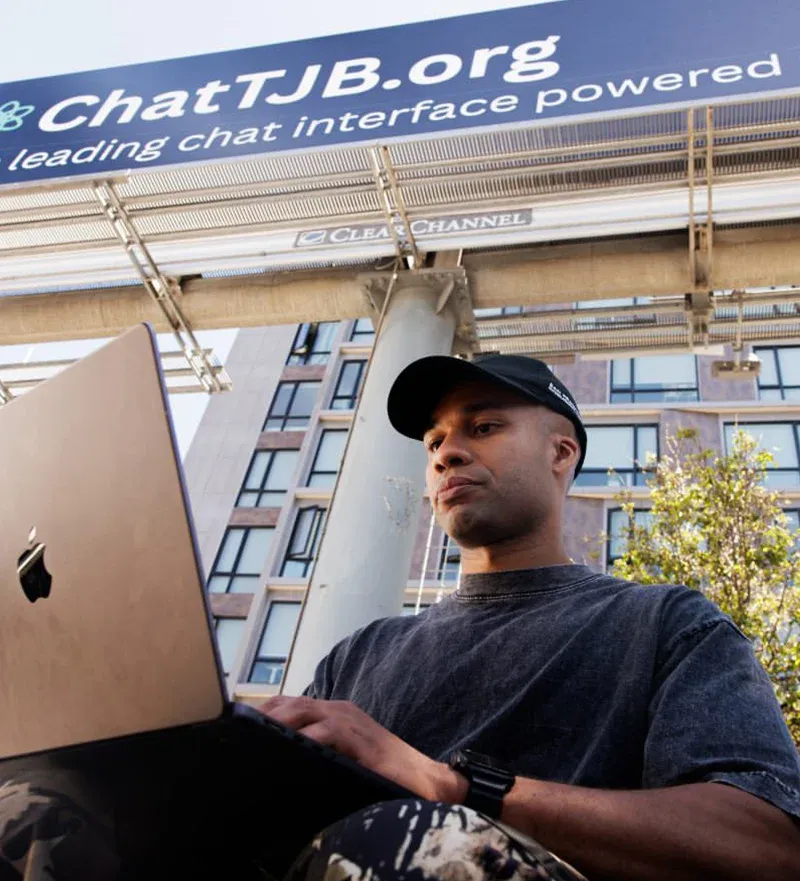
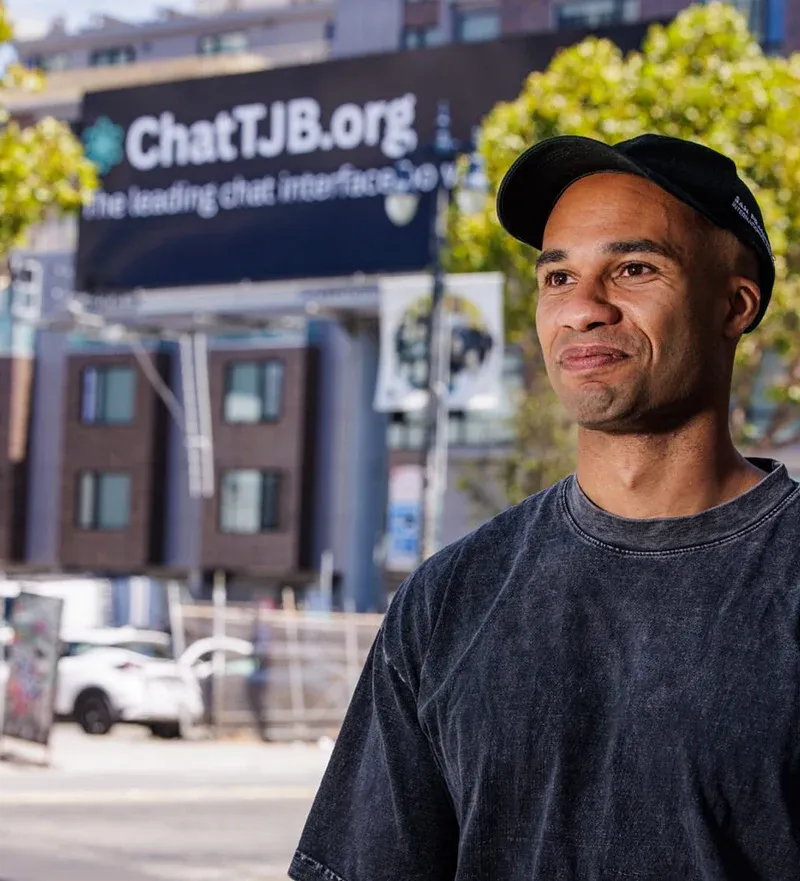
The man behind the weird but unique project is Tucker Bryant, a 32-year-old Stanford graduate, former Google marketing and project manager, conceptual artist, and keynote speaker who lives in San Francisco.
He first launched the site quietly in April 2026 as an experiment.
The idea grew from a phrase his partner shared with him, cognitive surrender, a term drawn from recent research showing how readily people accept AI outputs without scrutiny even when those outputs are flawed.
Bryant had noticed the same tendency in himself, asking chatbots for simple daily decisions and then realizing how quickly he stopped questioning the answers.
He wanted to build something that looked like the tools people already trust yet delivered the friction, unpredictability, and mediocrity of actual human conversation.
The goal was never to reject artificial intelligence.
It was to create a moment of pause, a reminder that polished text streaming across a screen does not automatically equal reliable judgment, and to poke gently at the cultural saturation of AI marketing that surrounds San Francisco.
What began as a low-key art project exploded after the billboard appeared and photos of it spread online.
Queries rose from a few dozen a day to a thousand, then surged to roughly 5,000 prompts in a single hour after a viral social media post. By early August the total had climbed past 30,000 questions.
People asked for waffle recipes, dinner ideas based on random ingredients, relationship advice, house paint colors, and custom drawings of skunks wearing sunglasses.
Bryant answered as many as he could, sometimes working ten hours or more a day, typing on his phone and laptop while deliberately ignoring minor errors to keep pace.
The volume eventually forced him to pause the open inbox, add safeguards, and begin experimenting with a community of other average individuals who apply through an onboarding process.
The project remains a satire and a public artwork, yet it has also become a genuine working conversation space staffed by real people.
In a city filled with claims of transformative technology, ChatTJB offers something quieter and more human.
It asks users to sit with the wait, the occasional wrong answer, and the knowledge that a living person is on the other side.






















































































































































































































































































